

Open us bank account online for non resident: Quick Guide to USA Banking

Yes, it's absolutely possible for entrepreneurs from the UK and elsewhere to open a U.S. business bank account online, but you can't just jump straight to the application. There’s some crucial groundwork to lay first. The secret lies in first establishing a proper U.S. business entity—like an LLC—and then securing an Employer Identification Number (EIN) from the IRS. These steps are what give you access to the modern, digital-first banking platforms you need.
Laying the Groundwork for Your US Bank Account
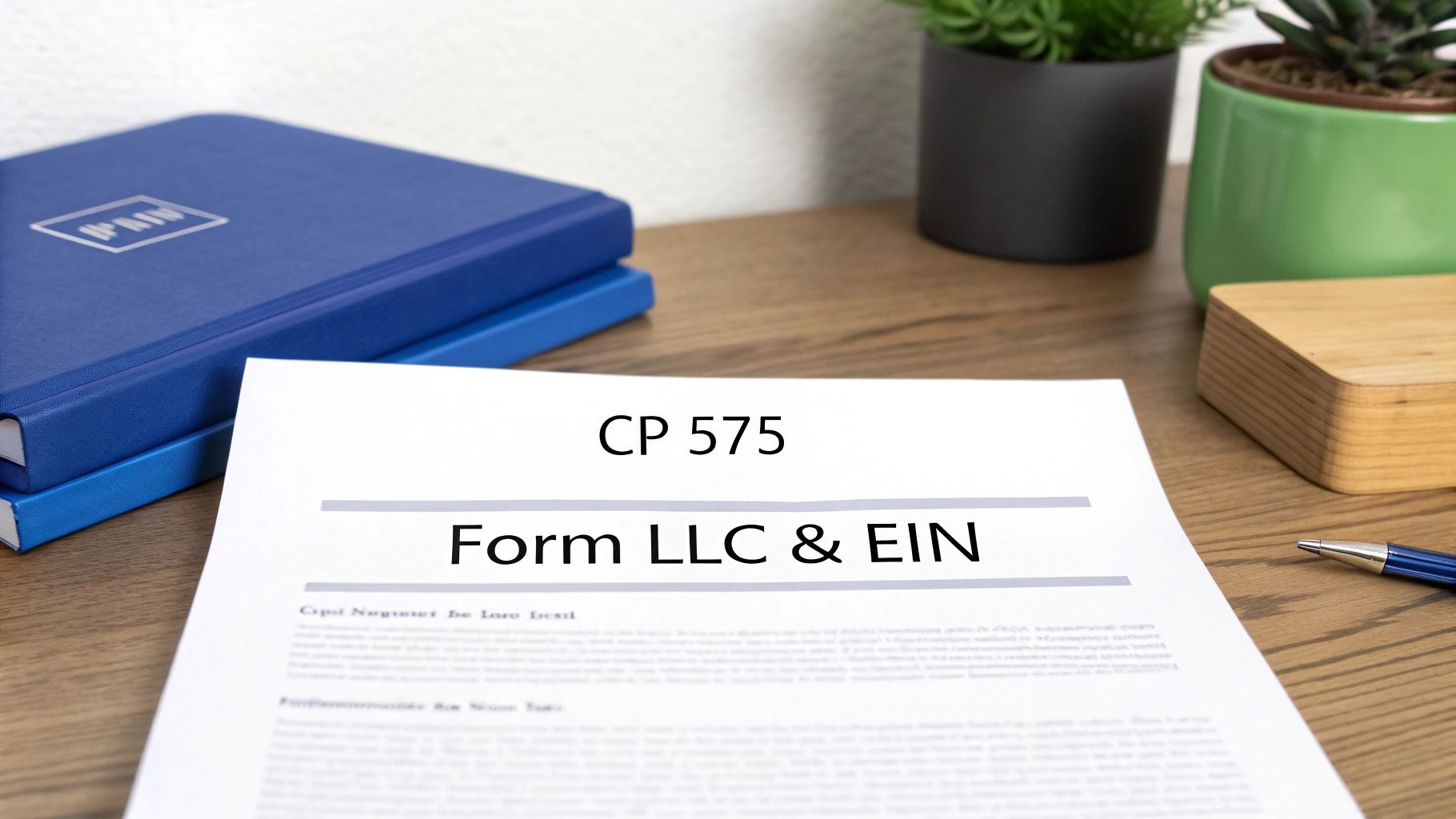
Before you even start comparing interest rates or app features, it’s vital to grasp one fundamental rule of American banking: both traditional banks and the newer fintechs open accounts for U.S. businesses, not directly for foreign individuals.
Getting this distinction right is the key to your success. Your first job is to create a legitimate U.S. business presence that financial institutions can legally recognise and work with.
This isn’t just a matter of ticking boxes on a form; you're building a solid legal and financial foundation. Banks are bound by strict "Know Your Customer" (KYC) and anti-money laundering (AML) regulations. A properly registered U.S. company with a federal tax ID number is what gives them the confidence and legal cover they need to approve your application from thousands of miles away. Without these pieces in place, your attempt to open a U.S. bank account will hit a brick wall before it even begins.
Before you can even apply, there are a few non-negotiables you need to sort out. This table breaks down exactly what's required and why it matters so much.
Essential Prerequisites for US Business Banking
Requirement | Why It's Non-Negotiable | Practical Tip |
|---|---|---|
US Business Entity (e.g., LLC) | Banks open accounts for US companies, not foreign individuals. This creates the legal "person" the account will belong to. | The LLC is the go-to for most non-residents due to its flexibility, liability protection, and simpler tax structure. |
Employer Identification Number (EIN) | This is your business's official tax ID. For non-residents, it's the primary credential banks use to verify your company. | Think of the EIN as the Social Security Number for your business. You absolutely cannot open an account without one. |
US Business Address | Banks need proof of a physical U.S. footprint for compliance. It's where official notices and documents will be sent. | A simple P.O. Box won't cut it. Use a reputable virtual address service to get a real street address. |
Registered Agent | Every state requires a designated person or service to receive official legal mail on behalf of your company. | This is a legal must-have for forming your LLC and is usually offered by the same service providing your virtual address. |
Having these four elements in place transforms you from an overseas individual into the owner of a legitimate U.S. business in the eyes of the banking system.
The Non-Negotiable First Step: Your US Business Entity
Trying to open a business account without a registered U.S. company is a complete non-starter. You have to form a legal entity first. The Limited Liability Company (LLC) is far and away the most popular choice for non-resident founders, and for good reason—it offers great flexibility and solid liability protection.
Forming an LLC establishes your business as a separate legal entity in the United States. This is a huge deal, as it shields your personal assets from your business debts. But just as importantly for banking, it creates the official "person" that the bank account will actually belong to.
If you're new to this, we've put together a comprehensive resource on the topic. Check out our complete guide on forming an LLC from abroad to see how it all works.
Your Business's Financial Passport: The EIN
Once your LLC is officially formed, the next critical piece of the puzzle is your Employer Identification Number (EIN). The best way to think of an EIN is as a Social Security Number (SSN) for your business. It's a unique nine-digit number the IRS issues to identify your company for all tax and financial purposes.
For any non-resident founder without an SSN, the EIN is the single most important document you'll get. It's the credential that digital-first banks and fintech platforms rely on to verify your business and let you proceed with an online application. Without it, you simply can't open a business bank account.
Key Takeaway: The sequence here is absolutely critical and can't be changed. First, you establish the legal entity (your LLC). Only then can you apply for its unique tax identifier (your EIN). This logical, step-by-step approach is what proves your legitimacy to financial institutions.
Establishing a Legitimate US Footprint
Finally, every U.S. business needs to prove it has a physical presence, even if it’s an entirely online operation. To satisfy banks on this front, you’ll need two things:
A US Business Address: This can't be a P.O. Box. It has to be a real street address where official and legal mail can be delivered. For most non-resident founders, a virtual address service is the perfect, cost-effective solution.
A Registered Agent: This is a person or company you designate in your LLC's formation state. Their job is to be available during business hours to receive legal documents (like a lawsuit notice) on your company's behalf. This isn't just a good idea—it's a mandatory legal requirement in every U.S. state.
These two elements together prove to the bank that your company has a real, verifiable base in the United States, which is a must for their compliance and risk checks. An application without a valid address and registered agent is almost guaranteed to be rejected.
Choosing Your Banking Partner: Traditional vs. Fintech
So, you've got your US entity formed and your EIN is hot off the press. Now for the big one: where are you actually going to put your money? When it comes to banking in the States, you’re looking at two fundamentally different paths: the old-guard, traditional banks on every street corner, and the new wave of digital-first fintech platforms.
For a founder sitting in the UK, this choice isn't just about cool app features. It's about what's actually possible. The path you pick can be the difference between a smooth online setup and a complete dead end.
The Reality of Traditional Banks for Non-Residents
We all know the names—Chase, Bank of America, Wells Fargo. They're giants. But for founders living outside the US, they are, frankly, a non-starter most of the time.
Their entire system was built for a world before global, remote-first businesses became the norm. Their compliance and "Know Your Customer" (KYC) rules are rigid and almost always demand two things most international founders can't provide:
An In-Person Visit: This is the big one. Legacy banks almost universally require an authorized person on the account to physically walk into a branch, show their passport, and sign paperwork.
A Social Security Number (SSN): Their online forms and internal systems are hardwired to ask for an SSN. Even if they technically accept an ITIN (Individual Taxpayer Identification Number), getting one is a whole separate headache, and they’ll likely still insist you show up in person.
For a UK entrepreneur, this means booking a flight to the US just to try and open an account, with zero guarantee they'll even say yes when you get there. It’s an expensive, time-consuming gamble that makes traditional banking a poor fit for nearly every non-resident.
The Rise of Fintech Solutions for Global Founders
This is where financial technology—fintech—has completely changed the game. Platforms like Mercury and Relay aren't technically banks. They're tech companies that provide FDIC-insured banking services through partner banks.
That distinction is everything. They were built from the ground up for modern, digital, and often borderless businesses.
Fintechs saw the huge, underserved market of international founders who needed access to the US banking system but couldn't just pop into a branch in Miami. They built their entire onboarding process around this simple fact, making them the go-to choice for non-residents.
Just look at the clean, tech-focused experience on Mercury's homepage. It’s a world away from the clunky, dated online portals you often find with traditional banks.
So, what makes these platforms the obvious choice for someone in the UK trying to open a US bank account online for a non resident?
100% Remote Onboarding: The entire application, from start to finish, is done online. You can do it from your desk in London or a café in Manchester, no flights required.
Built for Your EIN: Their systems are designed to use your company's EIN as the primary tax ID, neatly sidestepping the whole SSN/ITIN issue.
Plug-and-Play Integrations: They get how a modern business runs. They connect directly with the tools you already use, like Stripe for payments, Shopify for e-commerce, and Xero for your books. It creates a seamless financial workflow that saves a ton of admin time.
Founder-Friendly Terms: You’ll typically find no monthly fees, no minimum deposit requirements, and straightforward pricing on things like wire transfers. They’re built for startups, not massive corporations with complex treasury needs.
Traditional Banks vs Fintech Platforms for Non-Residents
Choosing between these two models is one of the most important decisions you'll make. This table breaks down the key differences to help you see why fintech is almost always the right call for an international founder.
Feature | Traditional Banks (e.g., Chase, BofA) | Fintech Platforms (e.g., Mercury, Relay) |
|---|---|---|
In-Person Visit Required? | Almost always. | No, 100% remote online application. |
SSN/ITIN Required? | Usually an SSN is mandatory. | No, your company's EIN is sufficient. |
Account Opening Speed | Days or weeks, pending an in-person appointment. | Typically 24-72 hours online. |
Monthly Fees | Common, often waived with high minimum balances. | Usually $0 monthly maintenance fees. |
Software Integrations | Limited or require clunky third-party tools. | Deep, direct integrations with Stripe, Shopify, etc. |
Ideal Customer | US-based individuals and established domestic businesses. | Tech startups, e-commerce stores, and global founders. |
For UK founders launching an e-commerce brand, a SaaS product, or a digital agency targeting the US, the verdict is clear. A fintech partner gives you the access, speed, and modern tools you need to run your US company effectively from thousands of miles away.
Navigating the Online Application Process
Alright, you've got your LLC formed and your EIN in hand. Now comes the main event: applying for the bank account. This is where all that prep work really starts to pay off. Fintech platforms have made this a surprisingly smooth process, but the devil is truly in the details.
Think of it like building a piece of flat-pack furniture. If you have all the screws, panels, and tools laid out before you start, it’s a breeze. If you’re scrambling for a missing part halfway through, it’s a nightmare. The goal here is a quick, successful assembly from your desk in the UK.
This flowchart lays out the typical journey for a non-resident founder, highlighting how a digital-first banking partner is the most direct path forward.
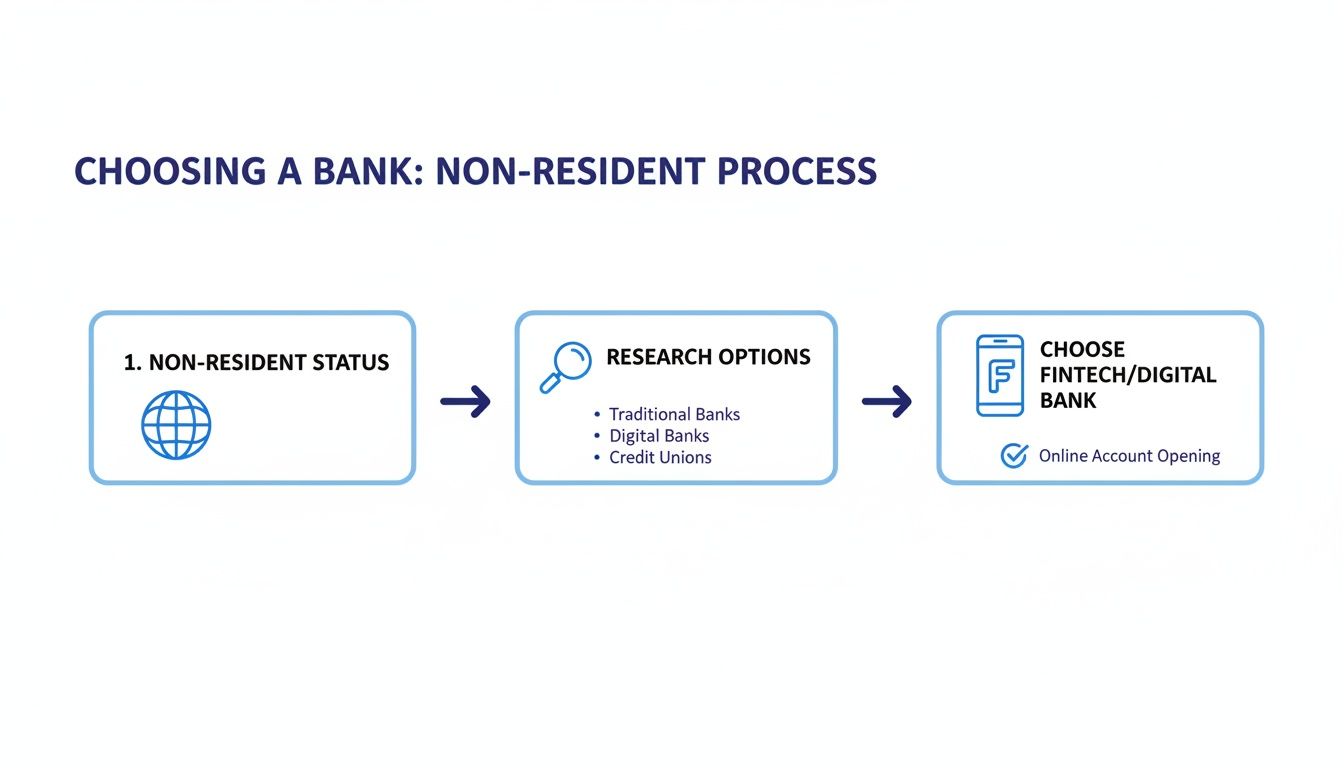
The takeaway is clear: for anyone outside the U.S., a modern fintech provider is almost always the most efficient and realistic option.
Your Essential Application Checklist
Before you click "Apply Now," get your documents in order. I recommend creating a dedicated folder on your computer to house everything. It's a small step that saves a ton of time and prevents you from having to hunt for things mid-application.
Here’s your must-have list:
Government-Issued Photo ID: Your passport is the gold standard here. Make sure it's not expired and you have a crystal-clear digital copy or scan.
EIN Confirmation Letter (CP 575): This is the official letter from the IRS. It’s non-negotiable proof of your tax ID, so ensure your scan is high-quality and legible.
LLC Formation Documents: This means your Articles of Organization. If you also have an Operating Agreement (and you should), have that ready to go, too.
U.S. Business Address: You'll need the full, physical street address you set up. Remember, P.O. boxes won’t cut it. If you need a refresher, we've covered the details of using a professional business address for your LLC.
With these files ready, you can fly through the application without any frustrating interruptions.
Filling Out the Application Accurately
The application form is the bank's first impression of your business. Precision is everything. Even a tiny mismatch between your documents and what you type into the form can flag your application for a manual review, potentially adding days or weeks to your timeline.
Pay close attention to the business description. Vague answers are a red flag. Instead of just writing "e-commerce," get specific. For example: "Online retailer selling handmade leather goods, primarily to customers in the U.S. market." This gives the compliance team a clear picture of what you do, making their risk assessment much easier.
Insider Tip: When the form asks for ownership information, you must list every single person who owns 25% or more of the LLC. This is a strict anti-money laundering requirement. Hiding or forgetting a major stakeholder is one of the most common and easily avoidable reasons for an instant rejection.
The Verification and Final Steps
Once you hit submit, the platform's compliance team takes over. This review process typically takes anywhere from 24 to 72 hours. Behind the scenes, they're checking your LLC's registration with the state and confirming your EIN against the IRS database.
If your paperwork is solid, you'll get that welcome email. Don't be surprised if they ask for a quick video call or an additional document to verify your identity—this is a perfectly normal security measure.
After you get the green light, you’ll have access to your online dashboard. The final step is to fund the account. Most founders do this via an international wire transfer from their UK bank. Just keep an eye on the transfer fees and exchange rates to make sure your initial deposit meets the bank's minimum (which is usually quite low).
Once the funds land, that's it. You're officially ready to do business in the U.S.
Managing US Tax and Reporting Compliance
Getting your U.S. bank account open is a huge win, but it’s also where the real work begins. Now you’re officially on the U.S. financial grid, which means you've got to play by a new set of tax and reporting rules. Getting this right from the start is absolutely essential to avoid headaches and penalties down the road.
Think of your new account as more than just a place to hold money. It's a financial footprint that U.S. regulators, especially the IRS, are watching. As a founder based in the UK, you’re now on the hook for compliance obligations that you didn’t have to worry about before.
Trying to fly under the radar simply isn't an option. The U.S. system is built on strict financial transparency laws. Dropping the ball can lead to hefty fines, your account being shut down, and legal issues you really don’t want to deal with. Being proactive about your tax and reporting duties is one of the smartest things you can do for your business.
Getting to Grips with Key US Reporting Rules
For non-resident founders, two acronyms immediately jump to the front of the line: FATCA and FBAR. They might sound intimidating, but their goal is pretty straightforward—to keep financial dealings transparent and prevent tax evasion across borders.
Here's the lowdown:
FATCA (Foreign Account Tax Compliance Act): This law mainly puts the onus on foreign banks to report accounts held by U.S. taxpayers. For you, this means your U.S. bank or fintech partner will need specific documents, like a W-8BEN-E form for your LLC, to confirm your company’s non-U.S. status and get everything squared away.
FBAR (Report of Foreign Bank and Financial Accounts): This one is a direct reporting task for U.S. entities, which includes your LLC. If your U.S. company holds more than $10,000 in accounts outside the U.S. at any point during the year, you'll likely need to file a special report with FinCEN (the Financial Crimes Enforcement Network).
The FBAR rules are particularly important for UK founders who might be moving funds between their U.S. entity and UK bank accounts. If the total balance in your non-U.S. accounts tops $10,000 even for a single day, it triggers the filing requirement.
Crucial Takeaway: Never assume these regulations don't apply to you. The definitions can be surprisingly broad. Your best move is to talk to a tax professional who specializes in cross-border compliance to figure out exactly what you need to do.
The Power of Clean Bookkeeping from Day One
With these new responsibilities, keeping clean financial records goes from being a good habit to a critical business function. The absolute best way to stay on top of this is to connect your U.S. bank account to accounting software like Xero or QuickBooks the very day you get your login details.
Integrating your accounts immediately sets up a smooth, automated flow of your financial data. You can track every dollar coming in, categorize every expense, and be ready for tax time without that last-minute scramble. Believe me, trying to piece together a year's worth of transactions after the fact is a nightmare you want to avoid.
Clean books also give you a crystal-clear audit trail. If the IRS ever comes knocking with questions, you’ll have professional, organized records on hand. This level of preparation doesn't just make compliance easier—it sets your business up for smart, sustainable growth. After all, you can't make good decisions about cash flow or future investments without accurate financial data. This all ties back to having your foundational elements in order, which you can learn more about in our guide on what an EIN number is and how to get one.
Troubleshooting Common Application Problems
Even after you've prepared everything perfectly, sometimes things go sideways. You submit your application feeling great, only to get an email asking for more information or, worse, a flat-out rejection.
First off, don't panic. This is rarely a dead end.
Financial institutions are under massive regulatory pressure, especially with international founders. A tiny mismatch in your details or a business description that sounds a bit vague can easily trigger their automated risk systems. This flags your application for a much slower manual review, which is what we want to avoid.
Let's walk through the most common bumps in the road and, more importantly, how to get your application back on track.
Dealing With Application Rejections or Delays
The number one reason for a rejection is almost laughably simple: incomplete or inconsistent information. If the name on your passport doesn't perfectly match the name on your LLC formation documents, that's an immediate red flag for a compliance officer. The same goes for a business address that looks suspicious.
Another common pitfall is a vague business description. Just writing "e-commerce" or "consulting" won't cut it. Banks need a clear picture of your business model to assess their risk. You have to be specific about what you sell, who your customers are, and how you get paid.
So, what do you do if you get that dreaded email?
Go Back and Review Everything: Scrutinise every single document you submitted. Is your passport scan crystal clear? Does your EIN confirmation letter (the CP 575) have a typo? Make sure every detail is perfect.
Be More Specific About Your Business: If you were vague before, now's the time for detail. A much better description is something like: "An e-commerce store selling handmade, sustainable pet toys via Shopify, with all payments processed through Stripe."
Get in Touch With Support: Don't just sit there and wait. Reach out to the bank or fintech's support team. Politely ask for the specific reason for the delay or rejection. That feedback is gold for your next move.
Here's some reassurance: most initial rejections for non-residents aren't about the business idea itself. They almost always come down to documentation mismatches or verification problems. Get the paperwork right, and you can usually turn that "no" into a "yes."
When Your Account Gets Flagged for Manual Review
Seeing that your application has been sent for "manual review" can feel like you've been banished to banking purgatory. In reality, this is often a standard step for international applicants. It just means a human needs to look over the details an algorithm couldn't instantly approve. This is a common hurdle when you try to open a US bank account online for a non resident.
The key here is patience and promptness. The compliance officer reviewing your file will likely have follow-up questions or need more documents.
Common Additional Requests During Manual Review:
Proof Your Business Is Real: They might ask for a link to your live website, contracts with your first few clients, or supplier invoices. Anything that proves you're a real, active business.
Address Verification: If you're using a virtual address, they may want to see a utility bill or lease agreement from that provider to confirm it’s a legitimate commercial location.
A Quick Video Call: Some platforms ask for a short video call where you hold your passport up next to your face. It’s a fast and effective way for them to put a face to the name and tick a security box.
Your best strategy is to reply to these requests as quickly and completely as you can. I always recommend keeping a folder with these potential supporting documents ready to go—it can dramatically speed things up.
Overcoming Challenges With Initial Funding
Congratulations, your account is approved! Now for the final hurdle: getting money into it. Funding the account from overseas can bring its own set of challenges. International wire transfers can be painfully slow, surprisingly expensive, and sometimes get held up by intermediary banks for more compliance checks.
The biggest issue is usually the high cost of a traditional wire. Your UK bank might hit you with a flat fee plus a terrible exchange rate, meaning a decent chunk of your money vanishes before it even lands in the U.S.
To sidestep these headaches, look at more modern funding methods:
Use a Specialist Service: I almost always point clients towards Wise (which used to be TransferWise). They're built for exactly this scenario, offering rock-bottom fees and the real mid-market exchange rate. You'll get more dollars for your pounds.
Check the Transfer Limits: Both your sending bank in the UK and the new US bank will have limits on incoming international transfers. Confirm these limits before you send anything to avoid the frustration of a failed transaction.
State a Clear "Reason for Transfer": When you set up the wire, you’ll be asked for a reason. Be professional and clear. Something like, “Initial capital contribution for [Your LLC Name]” is perfect and avoids raising any red flags.
Common Questions and Sticking Points
Expanding your business into the U.S. from the UK is a big move, and it's totally normal to have a ton of questions. We get asked the same things time and again by founders just like you. Let's clear up some of the most common points of confusion so you can feel confident you’re on the right track when you decide to open a US bank account online for a non resident.
Can I Just Use My UK Company to Open the US Account?
This is probably the biggest misconception we see, and the short answer is no. U.S. banks—even the modern online ones—are set up to serve U.S. companies.
From their perspective, your UK Limited Company is a completely foreign entity. To get a U.S. bank account, you first need to have a U.S. business, like an LLC or a C Corp. That new American company is the legal "person" the account will belong to.
Do I Really Need an EIN?
Yes, this is non-negotiable. Without a U.S. Social Security Number (SSN) or an Individual Taxpayer Identification Number (ITIN), your Employer Identification Number (EIN) is the only way a bank can identify and verify your business.
Think of it this way: an SSN identifies a U.S. person, but an EIN identifies a U.S. business. It's the unique tax ID for your company, and without that nine-digit number from the IRS, your bank application is dead in the water.
Is It Possible to Open an Account Without Flying to the US?
Absolutely. This is the key to the whole strategy for overseas founders. The big, old-school banks like Chase or Bank of America will almost certainly make you show up in person at a branch. But the new breed of online banking platforms was built for exactly this scenario.
Here's the crucial insight: Fintechs like Mercury and Relay have built their entire onboarding process to be done 100% online. They’ve figured out how to verify international founders remotely, which is what makes it possible for an entrepreneur in London to get a real, fully functional U.S. bank account from their desk.
For nearly every non-resident founder, this digital-first route is the only one that makes practical sense.
What’s the Deal With the US Address Requirement?
You'll need a U.S. address—that's a firm rule for both forming the company and opening the bank account. It's your official mailing address in the States for any legal or financial notices.
But don't worry, you don't need to rent an office. A good virtual address service gives you a real street address that satisfies all the legal and banking rules. Just make sure you avoid a P.O. Box; that’s a rookie mistake that will get your application flagged and likely rejected.
How Long is This Whole Thing Going to Take?
Getting everything set up happens in stages. While every situation is a bit different, this is a realistic timeline you can work with from start to finish.
Stage | Task | Realistic Timeframe |
|---|---|---|
1 | Form Your US LLC | 1-2 weeks |
2 | Apply for and Receive Your EIN | 2-4 weeks |
3 | Open Your Bank Account Online | 2-5 business days |
Total | End-to-End Process | 4-7 weeks |
As you can see, the biggest bottleneck is usually waiting for the IRS to issue your EIN. Once you have that, the bank account part is surprisingly quick, assuming all your paperwork is in order.
Why Do Applications Get Rejected?
Nine times out of ten, rejections have nothing to do with the quality of your business. They're almost always caused by simple, avoidable paperwork errors.
Here are the most common culprits we see:
Mismatched Names: The name on your passport doesn't match the owner's name on the LLC formation documents exactly. Even a missing middle initial can cause problems.
A Vague Business Description: Don't just say "e-commerce." Banks see that as a red flag. Be specific: "We sell handmade leather goods to customers in the U.S. via our Shopify store."
Missing Owners: You must list every single person who owns 25% or more of the company. Hiding this is a serious compliance breach.
A Bad Address: Using a P.O. Box or an address that the bank's system can't verify as a legitimate commercial location.
Double-check these details before you hit submit. A few extra minutes of review can save you weeks of headaches and get you approved on the first try.
Trying to piece together U.S. company formation, EIN applications, and ongoing tax rules can feel overwhelming. Set Up Stateside offers a complete, done-for-you service designed specifically for UK founders. We handle everything from the legal filings to the bookkeeping, so you can stay focused on what you do best: growing your U.S. business. Learn how we can help you get started.


Comments