

Using a PO Box as a Business Address for Your US Company

For UK founders looking to break into the US market, one of the first practical questions that comes up is, can I just use a PO Box for my business address? The short answer is yes... but only for basic mail. When it comes to the essentials—like legally forming your company, getting an EIN from the IRS, or opening a bank account—a PO Box simply won't cut it.
Why Your US Business Address Matters More Than You Think

Think of your US business address as the bedrock of your American company. It’s far more than just a spot to get letters. It's a legal anchor that proves your business is legitimate in the eyes of federal and state governments. While a PO Box is handy for managing general correspondence privately, it falls flat when it comes to meeting the legal requirements for a formal business presence.
US regulations are very clear: for several critical functions, you need a verifiable physical street address. This isn't just bureaucratic red tape; it's a rule designed to ensure accountability and prevent fraud. Government agencies, banks, and legal systems need a real-world location where they can serve official documents and unequivocally find your business. A PO Box, which is essentially just a locked box in a post office, doesn't meet that standard.
The Two Types of Business Addresses
To operate successfully in the US, you absolutely have to understand the difference between a simple mailing address and an official registered address. Getting this wrong can lead to rejected legal filings, frozen bank accounts, and frustrating delays that stall your launch.
Here’s a simple way to think about the roles these two addresses play:
PO Box (Mailing Address): This is perfect for the day-to-day stuff—receiving customer mail, invoices, marketing flyers, and general business letters. It's a great tool for managing your mail, but it has no legal weight for official purposes.
Physical Street Address (Official/Registered Address): This is the non-negotiable one. You'll need it for company formation (whether an LLC or C Corp), EIN applications, state filings, and opening a US bank account. It's your legal footprint in the country.
The U.S. Postal Service is a massive operation, delivering mail to an incredible 12.6 million business addresses. This just goes to show how vital mail services are to American commerce. For UK founders, it also highlights why a PO Box or a virtual mailbox is such a smart, low-cost way to get started. A mailbox solution, like the one we offer at Set Up Stateside, can slash your setup costs—often to under $100 a year—letting you operate in the US from your UK base without the huge expense of leasing office space. You can get a sense of the scale of postal operations from their official report about mail delivery scope.
Using a PO box as a business address is like having a key to a mailbox but not the key to the building. It gets you part of the way there, but you can't access the most important rooms—like your bank, the Secretary of State, or the IRS.
Throughout this guide, we'll walk you through the compliant alternatives that provide the solid legal foundation you need. We'll dive into what Registered Agents and virtual business addresses are, explaining how these solutions give you a legitimate US presence and ensure your venture is built on solid ground from day one.
So, When Can I Actually Use a PO Box? (And When Is It a Major Problem?)
This is where things get tricky, and where so many founders get tripped up. It’s crucial to understand exactly where a PO Box fits in—and more importantly, where it absolutely doesn't. Getting this wrong from day one can lead to rejected filings and major headaches.
Think of a PO Box as a simple mail-drop for non-critical items. It’s a great, affordable way to handle the day-to-day flow of mail that doesn’t have any legal significance.
For instance, a PO Box is perfectly fine for:
Routine customer mail: Letters, order forms, or general questions from your customers.
Invoices and bills: A central spot for vendors to send their invoices.
Marketing materials: A convenient place to collect flyers and catalogs you get from other companies.
But that's really where its usefulness ends. The moment you step into anything official, a PO Box becomes a liability.
The Hard “No” From Government and Legal Bodies
When you're ready to officially form your business—whether it's an LLC or a C Corp—the state government will demand a physical street address. This isn't just a suggestion; it's a hard-and-fast rule. Why? They need a verifiable, physical location where they can deliver important legal documents, a process called "service of process." A PO Box just won't cut it.
Your business formation address is your company’s legal home base. State authorities, courts, and federal agencies need a real place where they can find you. A locked box at the post office simply doesn't offer the legal accountability required.
This rule also applies to your Registered Agent, the person or company you appoint to receive official notices on your behalf. Every single US company must have one, and their address must be a physical street address in the state where you've incorporated. Try to use a PO Box here, and your formation paperwork will be rejected flat out.
What About the IRS and Your EIN?
The IRS plays by the same rules. You can use a PO Box as your mailing address to get routine tax forms and updates. But it absolutely cannot be your primary business address when you apply for your Employer Identification Number (EIN).
Your EIN application, Form SS-4, explicitly requires a physical street address. This is the address the IRS uses to legally locate your business for all tax matters. If you only provide a PO Box, you're looking at delays or an outright rejection, which completely stalls your ability to open a bank account or hire anyone.
Let’s break it down with a simple comparison.
PO Box vs Physical Address Use Cases for US Business
Here's a quick side-by-side look at what works and what doesn't, so you can see why having a real street address is so critical for the important stuff.
Business Requirement | Acceptable with a PO Box? | Why It Matters |
|---|---|---|
LLC or C Corp Formation | No | State governments need a physical street address for legal service and official notices. |
Registered Agent Address | No | Your Registered Agent must be physically present at a street address to accept legal documents. |
EIN Application (IRS) | No | The IRS requires a physical location to establish your business for tax purposes. |
General Mailing | Yes | Perfect for non-legal mail like customer letters, vendor invoices, and marketing materials. |
Ultimately, trying to use a po box as a business address for official filings is like trying to register your car using the address of a parking space. It’s a temporary spot, not a permanent, legally recognized home. For all the foundational steps—from incorporation to federal taxes—a real, physical address isn't just a good idea; it's non-negotiable.
The Hidden Roadblocks to Banking and Payments
While sorting out government filings is a big first step, you’ll find that the financial system throws up an even bigger wall. Your U.S. bank account is the engine that will power your business, but trying to open one with a PO Box is like showing up to a car race on a bicycle. You won't even make it to the starting line.
This is exactly where many international founders hit a dead end, discovering that using a PO Box as a business address creates immediate and serious problems with banks and payment providers.
Why? U.S. banks and financial institutions are bound by strict federal laws aimed at preventing money laundering, terrorism financing, and fraud. The big one is the Bank Secrecy Act, which mandates a process known as "Know Your Customer" (KYC).
Think of KYC as the bank’s mandatory background check on your company. They are legally required to verify your business's identity and assess any potential risks. A huge part of that verification is confirming a legitimate physical location, and a PO Box simply doesn't count. It’s an anonymous mail drop, not a verifiable place where you conduct business.
Why Banks Demand a Physical Street Address
A physical street address gives a bank a real, tangible location to connect with your business. It proves you have a genuine presence in the country and aren't just a paper-thin shell company.
For this very reason, almost every major U.S. bank will reject an application that lists a PO Box as the main business address. It's not just an internal policy; it’s a matter of federal compliance. The second their automated system flags your address as a USPS post office, your application is toast.
You simply cannot build a U.S. financial foundation on a PO Box. Banks need to know where your business lives, not just where it gets its mail. A physical address is non-negotiable for establishing the trust required to handle your money.
The Payment Processor Gatekeepers
This roadblock doesn't stop with traditional banks. It extends to the payment processors that are the lifeblood of any online business. Companies like Stripe and PayPal have their own strict verification processes that are just as demanding as the banks'.
When you sign up for an account with Stripe or PayPal, they’ll ask for the same core information:
Your EIN: As we covered, you need a physical address to get one from the IRS in the first place.
Your Business Formation Documents: These officially list your registered agent’s address, which can't be a PO Box.
A Verifiable Business Address: They run this address against multiple databases to confirm it’s a legitimate commercial or residential location.
If you try to sneak a PO Box through, you'll likely be denied. Even worse, your account could be approved initially and then frozen later during a routine audit, locking up your funds and bringing your sales to a screeching halt.
E-commerce Platforms Play by the Same Rules
The same logic carries over to major e-commerce platforms like Shopify and Amazon. Before you can sell a single product, you have to pass their verification process, which is there to protect consumers and maintain the marketplace's integrity. Both platforms explicitly require a physical address for seller accounts.
This is especially critical for Amazon sellers. Amazon's verification is notoriously tough, and using an address that isn't a verifiable physical location is one of the fastest ways to get your account suspended. They need to know you're a real business that can be held accountable, and a PO Box just doesn't offer that assurance.
Ultimately, your business address is the key that unlocks the entire U.S. financial and e-commerce ecosystem. Without a valid, physical street address, you're locked out. You won't be able to get paid or sell your products, effectively shutting down your business before it ever gets off the ground.
How Your Address Choice Impacts Taxes and Shipping
The address you pick for your business isn't just about where you get your mail. It's a foundational decision that ripples out to affect your tax burden and your ability to ship products to customers. For anyone in e-commerce, this is huge. Get it right from day one, and you can save yourself from some major logistical headaches and surprise tax bills later on.
This brings us to the concept of sales tax nexus. Think of nexus as a "significant connection" your business has to a U.S. state. Once you establish nexus in a state, you're on the hook for collecting and paying sales tax on every sale you make to customers who live there.
Every state has its own rules for what triggers nexus, but a physical presence is almost always the key. While using a PO box as a business address might not create nexus by itself, that's not the full story. The physical address you'll need anyway for your LLC formation, your bank account, and your registered agent absolutely will.
For UK founders, this is a make-or-break detail. The state where you set up your virtual business address isn't just a mail-forwarding spot; it’s the place you're planting your first legal and financial flag in America. That one choice directly locks in your initial sales tax obligations.
This is why choosing your state strategically is so critical. Picking a state with business-friendly tax laws, like Delaware (which has no state sales tax) or Florida (a major hub for e-commerce), is a core business decision that will shape your U.S. tax strategy for years to come.
Navigating the Shipping and Logistics Maze
Taxes aside, your address choice can create some very real, day-to-day problems with shipping. This is where the limitations of a PO box become a deal-breaker for any business that sells physical goods. Sure, the United States Postal Service (USPS) delivers to its own PO boxes—that's a given. But many of the other major carriers simply can't.
This creates an immediate operational bottleneck. The reality for any modern e-commerce brand is that you'll need to work with multiple shipping companies to find the best rates and delivery speeds for your customers.
Here’s a quick rundown of the issue:
FedEx: Won't deliver to standard PO boxes. They need a physical street address, period.
UPS: Same story. UPS requires a physical location and a recipient, so standard PO boxes are a no-go.
DHL: As a major international carrier, DHL plays by the same rules and requires a proper street address for all its deliveries.
If your main business address is a PO box, you're effectively shutting the door on the biggest private shipping companies in the country. This can lead to a mess of returned packages, frustrated customers, and a fulfillment process that's a constant headache.
Why a Real Street Address Is the Only Solution
This shipping dilemma makes it crystal clear: for e-commerce entrepreneurs, a virtual business address isn't just a good idea, it's the only practical solution. A virtual address gives you a real, physical street address at a commercial building. This means all carriers—USPS, FedEx, UPS, and DHL—can deliver your packages without a hitch.
The demand for these kinds of flexible mail services is exploding, and North America is leading the charge in the mailbox rental market. This boom is fueled by the rise of e-commerce and entrepreneurs setting up shop in the U.S. For UK founders working with a partner like Set Up Stateside, this means you get access to top-tier virtual addresses in strategic states like Florida or Delaware—locations that are perfect for both smooth LLC formation and seamless shipping. You can learn more about the growth of the mailbox rental market here.
At the end of the day, your business address isn't just a line on a form. It’s a vital piece of your infrastructure that dictates who you owe taxes to and whether you can even run an efficient supply chain. Making a smart choice that works for both compliance and logistics is one of the most important first steps in setting your U.S. business up for success.
Smarter Address Solutions for International Founders
Now that we’ve seen why a PO Box is a non-starter, let's look at the alternatives that actually work. For international founders, choosing the right address isn't just a logistical step—it's the foundation for your entire U.S. operation. The wrong choice creates endless roadblocks with legal formation and banking, while the right one opens every door you need.
Let's break down the three main options you'll come across. Each plays a very different role, and getting the distinction right from the start is crucial for building a solid American company.
The Registered Agent Address
Every single LLC or C Corporation formed in the U.S. is required by law to have a Registered Agent. Think of this as your company's official point of contact for the government. It’s a designated person or company responsible for receiving critical legal and government notices on your behalf, like a lawsuit or an official tax summons. This must be a physical street address in your state of formation—a PO Box is never allowed.
But here’s the key thing to understand: a Registered Agent's address is a highly specialized tool, not an all-purpose business address.
Its sole job: To accept time-sensitive legal and government documents. That's it.
What it's NOT for: It's absolutely not meant for your day-to-day business mail, bank statements, customer letters, or packages from suppliers.
Your Registered Agent is like a legal receptionist, required to be available during business hours to sign for official papers. Trying to use this address for your general mail is not only impractical but usually violates the terms of service. It’s a vital piece of the compliance puzzle, but it doesn't solve your need for a real, operational business address.
Commercial Mailbox Rental Services
One step up from a standard post office box is a mailbox from a commercial provider like The UPS Store. The big appeal here is that they give you a real street address format, not a PO box number. This definitely looks more professional on paper and can sometimes slip past basic address verification checks.
For instance, your address might look like this:
123 Main Street, #456 Anytown, USA 12345
That looks a lot better than "PO Box 456," right? The problem is, this often comes with a major catch. Banks, payment processors, and government agencies use sophisticated software that can easily identify these locations as Commercial Mail Receiving Agencies (CMRAs). Once your address is flagged as a mailbox at a retail store, your application for a bank account or merchant account will likely be rejected. It’s a short-term fix with long-term risks.
The Ultimate Solution: Virtual Business Addresses
For any non-resident founder, the Virtual Business Address is the undisputed gold standard. This service provides a real, physical street address located in a professional office building, which satisfies every requirement from the IRS, state authorities, and banks—all without the hefty price tag of leasing an actual office.
A virtual address is so much more than just a place to get mail. It’s a complete mail management system built for a global entrepreneur.
Legitimacy: The address is tied to a verifiable commercial building, so it easily passes the strict verification checks used by financial institutions and government agencies.
Functionality: These services are designed for remote management. They typically include mail scanning, forwarding, and secure package handling, letting you manage all your U.S. correspondence from your home in the UK or anywhere else.
Credibility: It projects a professional image on your website, invoices, and business cards, which builds immediate trust with American customers and partners.
It’s no surprise that the demand for these services is growing fast. The global virtual address and mailbox market is projected to expand from USD 1.8 billion in 2024 to USD 2.2 billion by 2032, largely driven by entrepreneurs who need a professional U.S. footprint without the overhead. Successful founders understand this and make a proper address a top priority from day one. You can dig deeper into this growing market and its key drivers.
Address Solutions Compared for US Business Formation
To make the choice even clearer, let's put these three options side-by-side. For UK founders setting up a U.S. company, understanding these distinctions is key to a smooth launch.
Feature | PO Box | Registered Agent | Virtual Business Address |
|---|---|---|---|
Address Format | PO Box Number | Physical Street Address | Physical Street Address (Commercial Building) |
Company Formation | No | Yes, but only for this purpose | Yes |
IRS EIN Application | No | No | Yes |
US Business Bank Account | No | No | Yes |
Receives General Mail | Yes | No (violates terms of service) | Yes (mail scanning, forwarding) |
Professional Image | Low | Neutral (but not for public use) | High |
Best For | Personal mail only | Fulfilling a state legal requirement | All-in-one operational business address |
As the table shows, a Virtual Business Address is the only solution that checks all the boxes, providing the legitimacy, functionality, and professional image needed to operate a U.S. company successfully from abroad.
For a UK founder, a virtual business address isn't just a nice-to-have; it's the key that unlocks the U.S. market. It gives you the stable, compliant, and professional presence that using a PO box as a business address simply cannot provide.
As you plan your U.S. expansion, you might find our other guides for international founders helpful. Check them out on our blog.
Choosing the Right US Address Strategy for Your Business
Okay, let's put all this theory into action. At this point, the core difference should be crystal clear: a PO box as a business address is only good for handling general, non-critical mail. For the real foundational stuff—forming your company, opening a bank account, and getting right with the IRS—you absolutely need a legitimate physical address. Getting this right from the start is what separates a smooth launch from a bureaucratic nightmare.
To cut through the noise, just run through this simple checklist. Ask yourself:
Am I forming a US LLC or C Corporation?
Do I need to open a US business bank account?
Will I be applying for an EIN?
Do I plan on selling through platforms like Amazon or Shopify?
Will I need to receive packages from couriers like FedEx or UPS?
If you nodded your head to even one of those, a virtual business address isn't just a good idea—it's your only viable path forward. It gives you that verifiable, physical street address that US institutions demand, letting you run a fully compliant and functional company from anywhere in the world.
A Visual Guide to Your Address Decision
Sometimes a picture just makes things click. This decision tree lays out the entire process, showing you how to get from "I need a US address" to the specific solution you need for legal, banking, and mail purposes.
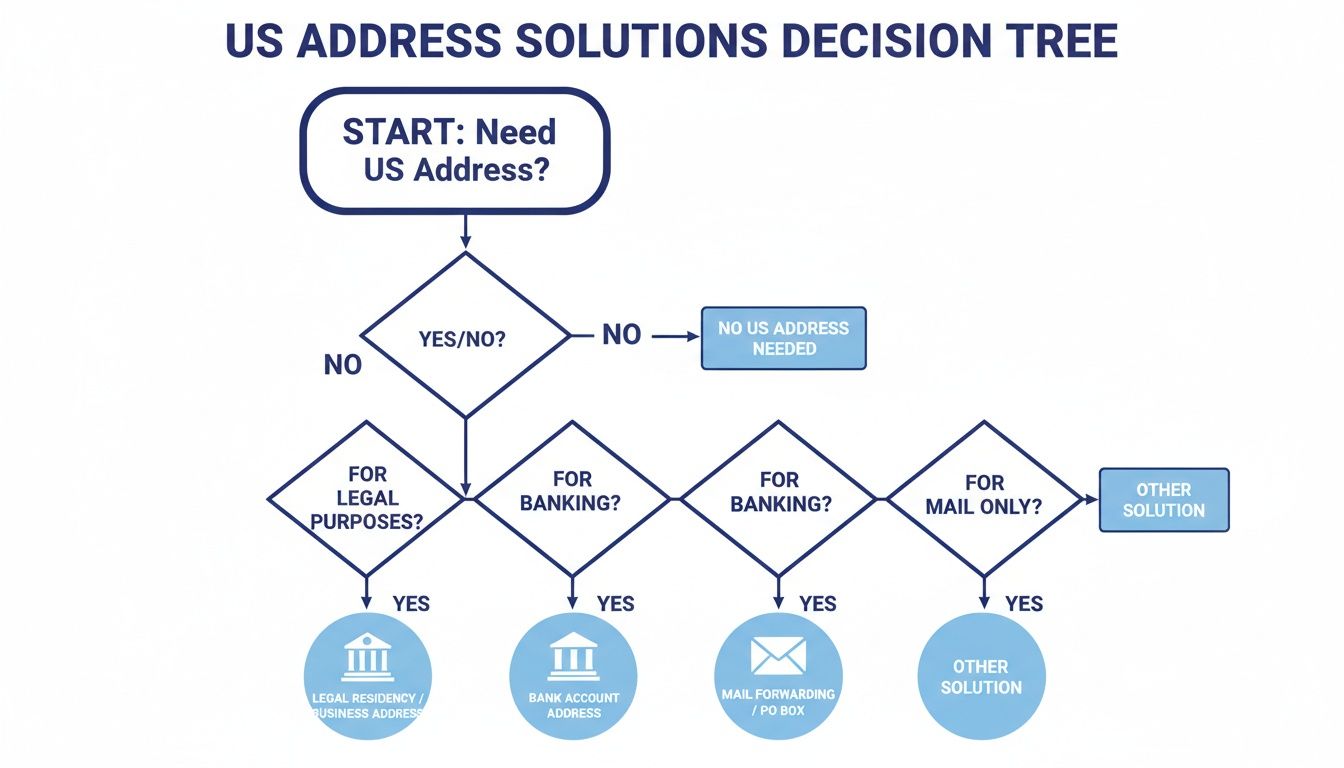
As you can see, a PO Box has a very limited role. The moment you step into any serious business activity, like official filings or banking, the path points directly to a more robust solution like a virtual business address.
Your Path Forward with a US Partner
Navigating all these rules can feel like a headache, but it doesn’t have to be. The smartest move is to find a partner who lives and breathes this stuff—especially one who gets the specific hurdles non-resident founders face.
Choosing the right address isn't just about ticking a compliance box; it's about building a credible, operational business from day one. A premium virtual address is the key that unlocks the entire US financial and legal ecosystem for international entrepreneurs.
Instead of trying to juggle a separate Registered Agent service and a different business address provider, find a unified solution. When your official Registered Agent address and your day-to-day virtual business address are managed under one roof, everything just works. It's a seamless approach that saves you time, prevents critical compliance documents from getting lost, and lets you focus on what you actually want to do: grow your business.
For UK founders ready to build a real US presence, teaming up with a specialized formation partner is the most direct route to getting it done right. To see how we bundle everything from company formation to your official business address into one package, you can explore the all-in-one solutions at Set Up Stateside. We’re here to give you a clear, confident path forward so your US venture is built to last.
Frequently Asked Questions
Let's tackle some of the most common questions UK founders ask when sorting out their US business address. Here are some quick, practical answers to help you lock in the final details for your American launch.
Can I Use a UPS Store Mailbox Instead of a PO Box?
Using a mailbox from a place like The UPS Store or another commercial mail receiving agency (CMRA) definitely feels like a step up from a classic PO Box. They give you an address that looks like a real street address, which certainly beats "PO Box 123" on your website.
But be warned: this is often just a short-term fix that can backfire. Banks, the IRS, and state agencies have gotten incredibly good at spotting these addresses. Their verification systems can flag a CMRA in seconds, which can get your application for a bank account or payment processor instantly rejected.
A UPS Store address might look the part, but it often crumbles under official scrutiny. It’s a gamble that can lead to frustrating delays and a stack of rejection letters right when you need momentum.
What Is the Cheapest Way to Get a US Business Address?
If we're talking purely about cost, the cheapest option on paper is a standard USPS PO Box. You can find them for as little as $20 per month. The problem, as we've covered, is that this low price comes with some major strings attached. It's a non-starter for company formation, banking, or getting your EIN.
A virtual business address, which usually runs between $49-$79 per month, delivers far more value for your money. Yes, the initial cost is higher, but you get a fully compliant, physical street address that works for everything—from legal filings to opening a bank account. Think of it as an investment in getting things right the first time, saving you from the headaches and costs of dealing with rejections down the line.
Is a Virtual Business Address the Same as a Registered Agent?
Nope, they're two completely different things, and you'll need both.
A Registered Agent is a legal necessity. Their sole job is to be the official point of contact for receiving important legal notices and government mail (like court summons or tax alerts) on behalf of your company. You can't use this address for your day-to-day business mail.
A Virtual Business Address is your company's public-facing, operational address. This is the real street address where you’ll get mail from customers, packages from suppliers, and statements from your bank. Crucially, this is the address you'll use to form your LLC, apply for an EIN, and open that all-important US bank account.
Getting your address strategy right is one of the most important steps for a smooth entry into the US market. If you're still unsure about what's best for your specific situation, you can always get in touch with our team of experts for some one-on-one advice.


Comments