

Your Guide to Getting a US Sales Tax Permit from the UK

So, you're a UK founder eyeing the massive US market. Fantastic. But before you get too far, we need to talk about something decidedly less exciting but absolutely critical: sales tax.
Unlike the UK's straightforward VAT system, the US doesn't have a single, national sales tax. Instead, it’s a dizzying patchwork of thousands of individual tax jurisdictions across states, counties, and even cities. This means you won’t just get one US sales tax permit; you might end up needing several, depending on where your customers are.
The golden question is: when do you need one? It all comes down to a little word with big implications: nexus.
Do You Really Need a US Sales Tax Permit?
Nexus is simply a legal term for having a significant connection to a US state. If your business establishes nexus with a state, you're legally on the hook to register there, collect sales tax from customers in that state, and hand it over to their tax authorities.
For years, this was pretty simple—it meant having a physical presence, like an office, warehouse, or staff on the ground. But the game changed completely with the rise of e-commerce.
Understanding Your Sales Tax Triggers
Today, establishing nexus can happen without you ever setting foot in the state. As a UK entrepreneur, you need to be acutely aware of what activities can pull you into the US sales tax net.
Here are the most common triggers I see catch founders off guard:
Economic Nexus: This is the big one for online sellers. Most states now have thresholds based on sales revenue or the number of transactions. A common benchmark is $100,000 in sales or 200 separate transactions within a year. Cross that line in a state like California or New York, and you've got nexus.
Physical Nexus: The traditional trigger is still very much alive. Storing your inventory in a US warehouse (think Amazon FBA), leasing office space, or even having a single remote employee or contractor in a state almost always creates physical nexus.
Affiliate Nexus: This one is a bit more obscure but can be a trap. If you have partners or affiliates in a state driving sales for you, their presence can sometimes create nexus for your business.
This decision tree gives you a quick visual on how to think through the process.
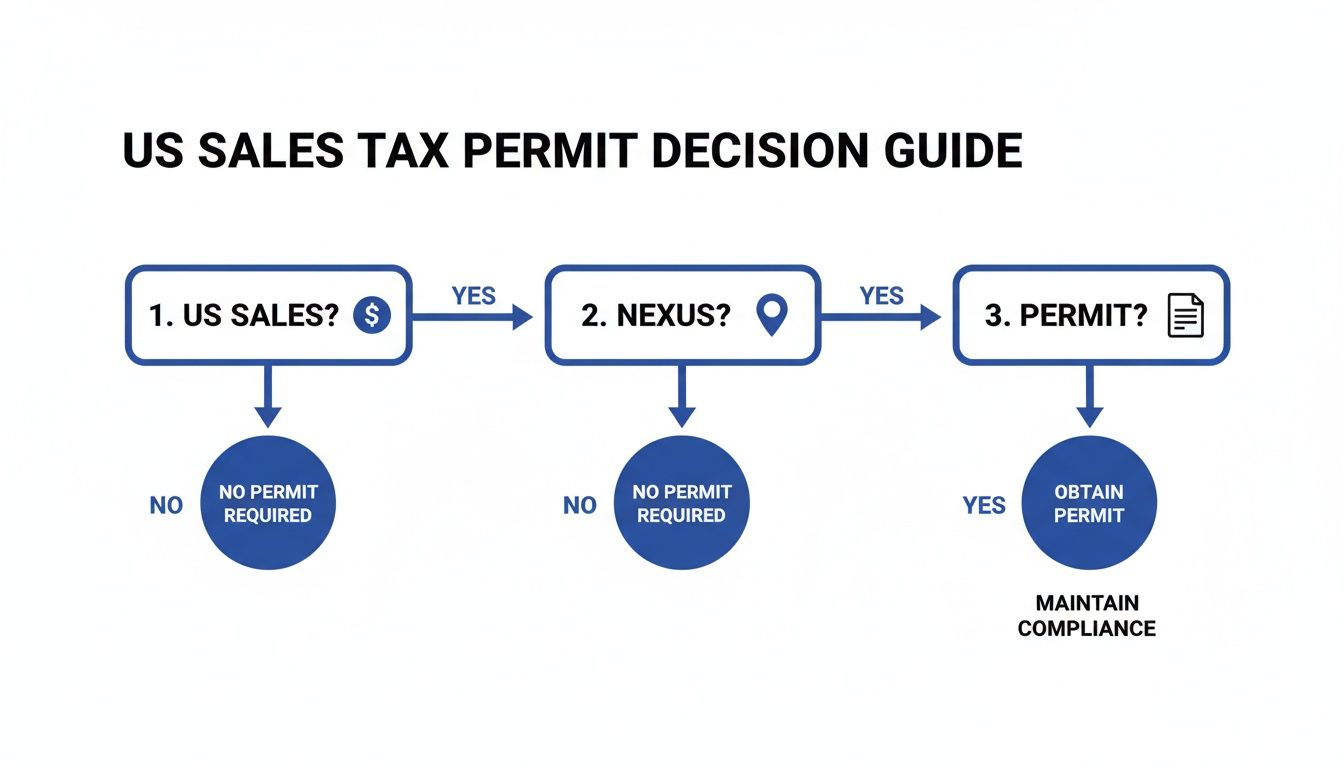
As you can see, simply making sales is just the starting point. The real work is figuring out if and where those sales have created a tax obligation.
Quick Sales Tax Nexus Checklist for UK Sellers
Not sure where you stand? Run through this quick checklist. If you answer "yes" to any of these, it's a strong signal you need to dig deeper into your potential sales tax obligations in that specific state.
Business Activity | Potential Sales Tax Obligation | Key Consideration |
|---|---|---|
Exceeding Sales Thresholds | High | Have you made over $100,000 in sales or 200 transactions into any single US state in the last 12 months? |
Using a 3PL/FBA Warehouse | High | Is your inventory stored in a US warehouse, such as an Amazon FBA center? If so, where are those centers located? |
Hiring US Staff/Contractors | High | Do you have any employees, salespeople, or even long-term contractors working for you from within a US state? |
Attending Trade Shows | Medium | Did you or a representative attend a trade show in the US to solicit sales? Some states are aggressive about this. |
Using US Affiliates | Medium | Do you rely on US-based affiliates to drive a significant portion of your sales into certain states? |
Making Digital Product Sales | Varies | Are you selling software, courses, or other digital goods? Rules vary wildly by state. |
This isn't an exhaustive list, but it covers the main red flags for UK businesses. Each "yes" is a reason to investigate that state's specific rules more closely.
The biggest mistake we see is founders assuming they're too small to have a sales tax problem. But with state economic nexus thresholds, even modest success can create a significant compliance burden faster than you expect.
Getting a handle on these triggers is your first step. It's the foundation for building a compliant US business. From here, the journey involves registering in the right states and setting up systems to manage it all—a process that is detailed, but with the right guidance, is entirely achievable. For more on getting your US structure right from the start, check out the expert services at Set Up Stateside.
Understanding Your Sales Tax Nexus in Each State
If there's one term you absolutely must get your head around, it's "nexus." This is the legal lingo for the connection between your business and a US state. Once that connection is strong enough, it triggers an obligation for you to start collecting their sales tax.
For years, this was pretty straightforward. Nexus meant having a physical presence—an office, a warehouse, that sort of thing. But for a UK business selling online, the game has changed completely. The rules are now far more complex, mostly because of something called economic nexus.

The Rise of Economic Nexus
Everything shifted back in 2018 with a landmark Supreme Court case, South Dakota v. Wayfair, Inc. This ruling gave states the green light to force businesses with no physical presence to collect sales tax, as long as they met certain economic thresholds.
Suddenly, a UK-based e-commerce store could find itself on the hook for a California sales tax permit just by selling enough products to customers there—all without ever setting foot on US soil. This is economic nexus, and it's the number one way UK sellers get pulled into the US tax net.
Each state sets its own thresholds, but a common benchmark has emerged: $100,000 in gross sales or 200 separate transactions into the state within a 12-month period. If your business crosses either of those lines, you've likely established nexus.
Key Takeaway: You don’t need a US office to have a tax obligation. Your sales figures alone can create nexus, one state at a time. Overlooking this is the fastest way for UK founders to stumble into expensive, and completely avoidable, compliance headaches.
Other Ways to Create Sales Tax Nexus
While economic nexus is the main culprit for online sellers, don't forget that the old physical presence rules are still very much in play. They can catch you out in ways you might not expect.
Be mindful of these common physical nexus triggers:
Storing Inventory in the US: This is a big one. If you use a third-party logistics (3PL) provider or Amazon FBA, your stock is sitting in warehouses across the US. Each of those warehouse locations creates an immediate physical nexus in that state, no matter how much you sell there.
Hiring US-Based Staff: This isn't just full-time employees. Part-timers or even certain independent contractors working for you in a state will almost always establish a physical nexus.
Attending Trade Shows or Events: In some states, just sending a representative to a trade show to drum up sales can be enough to create a temporary—or even permanent—nexus.
Using Affiliate Marketers: Be careful with affiliate relationships. If a US-based affiliate is driving sales for your business, it can trigger what’s known as "click-through nexus" in a handful of states.
A Real-World Nexus Scenario
Let's put this into practice. Imagine you run a successful UK-based Shopify store selling unique apparel. You pull your sales data for the last 12 months and see the following:
California: $120,000 in sales across 150 transactions.
New York: $95,000 in sales across 210 transactions.
Texas: $80,000 in sales across 180 transactions. You also use a 3PL with a warehouse in Dallas.
Florida: $50,000 in sales across 90 transactions.
Here’s how that breaks down:
California: You have economic nexus. Your sales blew past the $100,000 threshold. Time to register.
New York: You have economic nexus here, too. Even though you were under the sales threshold, you surpassed the 200-transaction mark.
Texas: You have physical nexus. Your inventory is stored there, which creates an immediate obligation, even though you’re below both economic thresholds.
Florida: You have no nexus here yet. You're safely under both the sales and transaction counts and have no physical ties.
This simple example shows how crucial it is to monitor both your sales data and your operational footprint. States are also getting more aggressive. The US recently saw a 10-year high in new sales tax legislation, with states like South Dakota and Louisiana even ditching their 200-transaction thresholds to focus purely on sales volume. You can find more insights on these legislative shifts over at Stripe's resource hub.
How to Actually Register for a Sales Tax Permit
Alright, you’ve done the analysis and confirmed you have nexus in a U.S. state. Now it’s time to roll up your sleeves and get it done. The next step is applying for a sales tax permit.
This document is your official green light from a state to start collecting sales tax. Depending on the state, you might hear it called a seller's permit or a retail license, but it all means the same thing.
For UK founders, this is often the point where the theoretical headache of U.S. tax becomes a very real, very frustrating reality. Each state has its own quirky forms, its own online portal, and its own peculiar set of questions. A simple mistake can lead to delays or even a flat-out rejection of your application.
Gathering Your Essential Documents
Before you even dream of clicking "start application," you need to get all your ducks in a row. States are incredibly meticulous, and being unprepared is the fastest way to grind the whole process to a halt.
Think of this as your registration toolkit. Just about every state will ask for a core set of documents:
Federal Employer Identification Number (EIN): This is your business’s unique tax ID with the IRS. As a non-resident founder, this is non-negotiable. You simply cannot get a sales tax permit without one.
Company Formation Documents: Have your Articles of Incorporation (for a C Corp) or Articles of Organization (for an LLC) handy. This is your proof that the business is a legitimate legal entity.
Business Address Information: You’ll need your primary UK business address, plus any U.S. addresses you use, like a virtual office or the location of your 3PL warehouse.
Owner and Officer Details: Be ready with the names, addresses, and sometimes other personal identifiers for the company’s directors or key officers.
Insider Tip: State registration portals are notorious for timing out or not letting you save your progress. Do yourself a massive favour and scan all these documents into a single folder on your computer before you start. It will save you from pulling your hair out.
Navigating State-Specific Application Portals
With your documents organised, you're ready to tackle the applications themselves. No two states are exactly alike, but let's look at a few common e-commerce destinations to give you a feel for the differences.
Texas: The Texas Comptroller’s office uses a relatively user-friendly online portal. They pay close attention to the date your business started in the state—that is, the date you first established nexus. Be precise, because this date can directly impact when your first tax filing is due.
Florida: Florida's application is also online. One key detail they'll ask for is a thorough description of the products you sell. This helps them figure out if any of your items happen to be exempt from sales tax in Florida. Getting this right from the beginning can prevent a lot of headaches down the road.
California: Registering in California can feel a bit more intense. The California Department of Tax and Fee Administration (CDTFA) runs a comprehensive online system. You’ll be asked to estimate your future monthly taxable sales in the state. Don't just guess—this number is important because it's used to set your filing frequency (monthly, quarterly, or annually).
This permit process can be a real bureaucratic maze. Just to give you a sense of state-level complexity, look at California’s residential building permit market. Total permits fell by 22 percent in one year, and it takes nearly twice as long to get a project approved there as it does in Texas, which adds huge costs. While that’s not sales tax, it paints a clear picture of the state-specific administrative hurdles you can expect. You can see the full report on California's economic drivers and challenges on hdlcompanies.com.
Choosing the Right Business Codes
Somewhere in the registration process, you'll be asked for a NAICS code. This stands for the North American Industry Classification System, a set of standard codes used to classify businesses.
Picking the right NAICS code is more important than it sounds. It tells the state exactly what kind of business you're in, which can affect everything from your taxability assessments to whether you get flagged for an industry-specific audit. Take a few minutes to browse the official NAICS website and find the code that truly fits your business. Don't just pick the first one that seems close enough.
The Non-Resident Roadblock
As a UK-based founder, you’re guaranteed to run into questions that were clearly written for U.S. residents, which can be baffling. For instance, an application might demand a Social Security Number (SSN), which you won’t have.
Most online forms today have an option for non-residents, but sometimes you have to hunt for it or even resort to a paper form. This is one of the most common stumbling blocks for international applicants. A single misplaced entry or misunderstanding a U.S.-centric question can get your application kicked into a manual review queue, adding weeks or even months to the process.
This is where having a U.S.-based partner who gets these nuances is invaluable. For more practical advice on managing your U.S. compliance journey, feel free to explore the articles on our Set Up Stateside blog.
Managing Your Compliance After Registration
Getting your sales tax permit isn't the end of the journey—it's actually the beginning. Once that registration is confirmed, the state considers you live, and you're officially on the hook for calculating, collecting, and sending them sales tax for every eligible sale. This is where the real work kicks in, and it requires careful attention to detail.
The moment you're registered, you have to start adding the correct sales tax to every customer transaction in that state. On the surface, it sounds simple enough, but the U.S. sales tax system is a minefield of complexity. There's no single national rate. You'll find that tax rates vary by state, county, and city, and there are even special taxing districts. A customer in downtown Los Angeles could easily pay a different rate than someone just a few miles away in a different suburb.
The Ongoing Cycle of Tax Management
Managing sales tax is a constant loop of recurring tasks. First off, you need to know which of your products are actually taxable in each state. Not everything is taxed equally across the board. For example, clothing might be completely tax-exempt in Pennsylvania but fully taxable in California. You've got to understand these nuances for your specific product line, state by state.
Then comes the collection itself. Your e-commerce platform has to be set up to charge the right, location-specific tax rate for every single order. This is non-negotiable and why having a robust system is so critical.
Finally, you have to file your returns and remit the tax you've collected. The state will tell you how often you need to file based on your sales volume. It could be:
Monthly: Usually for businesses with a higher volume of sales.
Quarterly: A very common schedule for small and medium-sized businesses.
Annually: Typically reserved for businesses with minimal sales in that state.
Heads up: missing a filing deadline is a big deal. Even if you made no sales and owe nothing (this is called a "zero-dollar return"), you still have to file. States are notoriously strict and will hit you with penalties and interest charges without hesitation.
Key Takeaway: Compliance isn't a one-and-done task. It's an active, ongoing process. The more you sell in the U.S., the bigger the administrative workload gets.
Building Your Compliance Tech Stack
Let’s be honest: trying to manage multi-state sales tax with a spreadsheet is a recipe for disaster. Manually tracking thousands of constantly changing tax rates and rules just isn't a viable strategy for a growing business. This is why getting your technology sorted from day one is so important.
Automated sales tax software is the answer here. Tools like TaxJar, Avalara, or even the native services on platforms like Shopify are built to do the heavy lifting for you. They plug right into your online store and can:
Calculate the precise sales tax for every order in real-time, right down to the customer's rooftop.
Stay current with all the latest rate changes across thousands of jurisdictions.
Generate the detailed reports you need to make filing your returns much less painful.
Putting one of these tools in place is a foundational step. It takes the burden of rate calculation off your shoulders and puts it onto a reliable, automated system, which drastically cuts down your risk of making expensive mistakes.
The complexity of all this just explodes as a business grows. In fact, tax filing requirements can increase by nearly 47-fold as a company scales from a startup to an enterprise. You might start with just two annual tax filings, but that can quickly balloon to 94 or more filings per year as you expand. Once your revenue starts hitting milestones like $5 million or $10 million, manual processes simply can't keep up. You can see the full breakdown of this challenge in the global sales tax benchmark report on anrok.com.
This ever-growing administrative load is a clear signal. As your U.S. footprint gets bigger, the value of handing these specialised, repetitive tasks over to an expert firm becomes impossible to ignore, letting you get back to focusing on what you do best—growing your business.
Common Sales Tax Pitfalls (and How to Sidestep Them)
When you're running a UK business and selling into the U.S., it's incredibly easy to get tripped up by the sales tax system. It’s a completely different beast than VAT. From my experience helping founders navigate this, a few common (and costly) mistakes pop up time and time again.
The biggest one? Honestly, it's just waiting too long. You might feel like you're flying under the radar, but state tax authorities are much better at tracking online sales than you'd think. Ignoring your nexus obligations doesn't make them vanish. It just turns a small, manageable task into a massive headache of back taxes, penalties, and interest down the line.
Forgetting About Physical Nexus
With all the buzz around economic nexus, it's easy to forget that the old-school rules of physical presence are still very much in play. One of the most common oversights I see from UK sellers is not realizing that using a U.S. warehouse or a third-party logistics (3PL) provider creates an instant physical nexus.
Real-world scenario: A UK-based apparel brand starts using an Amazon FBA warehouse in Texas to get products to their U.S. customers faster. They figure they don’t have to worry about sales tax until they hit the $100,000 economic threshold.
The reality check: The moment their inventory landed in that Dallas warehouse, they established physical nexus. This meant they were on the hook to get a Texas sales tax permit and start collecting tax on their very first sale to a Texan customer, regardless of their total sales.
My advice: Always, always know where your inventory is being stored. Before you sign up with any 3PL or FBA service, ask for a list of their warehouse locations. Each of those locations is a state where you'll have an immediate registration duty.
Misunderstanding How Marketplaces Work
So many sellers assume that because they're on a platform like Amazon or Etsy, all their sales tax worries are over. And while it's true these platforms handle tax on sales made through their site, that protection doesn't magically extend to your other channels.
This creates a dangerous blind spot. You could be thinking you're totally compliant because Amazon's got it covered, but all those direct-to-consumer sales coming from your own Shopify store? That's all on you.
Real-world scenario: A UK gadget company makes 70% of its U.S. sales via Amazon and 30% directly from its own website. Their combined sales tip them over the economic nexus threshold in California.
The reality check: They think they're fine since Amazon is handling remittance. But California still requires them to get their own sales tax permit to manage the tax on their direct website sales. By not doing so, they've left a huge chunk of their revenue non-compliant.
Applying a Single, Flat Tax Rate
This is a classic rookie mistake, especially for anyone used to the UK's VAT system. You can't just find a state's tax rate and apply it across the board. U.S. sales tax is incredibly local, with rates often changing from one city, county, or even zip code to the next.
Real-world scenario: A business gets its permit for Florida and starts charging the statewide 6% sales tax rate on every order shipped there.
The reality check: They completely missed the local "discretionary sales surtaxes." In some Florida counties, these extra taxes can push the total combined rate up to 7.5% or even 8%. This means they under-collected on every single sale in those areas and will have to pay the difference out of their own profits when it's time to file their return.
When Is It Time to Call in a US Tax Specialist?
Let’s be honest: trying to navigate the US sales tax system from the UK can feel like a full-time job. As we've seen, it's a tangled web of constantly changing state laws, tricky nexus rules, and a mountain of administrative work. The penalties for getting it wrong aren't trivial, either.
That's why it's crucial to stop thinking of professional help as a 'cost' and start seeing it as a strategic investment in your US expansion. The time you pour into deciphering confusing state websites and tracking sales thresholds is time you're not spending on what really matters—growing your business.
It's About More Than Just Paperwork
A good US-based tax specialist does a lot more than just fill out forms. Think of them as your on-the-ground compliance partner, the expert in your corner who handles the critical stuff that protects your business and gives you your time back.
What does that look like in practice?
Keeping a Watchful Eye on Nexus: They'll proactively track your sales and activities against each state's specific rules, so you're never caught off guard by a sudden tax obligation.
Getting Registrations Right the First Time: They know how to handle multi-state sales tax permit applications for non-resident founders, steering clear of the common mistakes that can cause major delays.
Dealing with Official Notices: When a confusing letter from a state tax agency arrives, they're the ones who intercept it, understand it, and resolve it for you. No more worrying about missing a critical deadline.
Ultimately, bringing in an expert is about smart risk management. It’s the difference between constantly putting out tax-related fires and having a clear, proactive strategy that actually supports your growth.
You’re essentially turning a major business headache into a smooth, managed process. This gives you the peace of mind to focus on scaling your sales, confident that your compliance is being handled by people who know exactly what they're doing.
If you’re ready to get a clear strategy for your US sales tax, book a consultation with Set Up Stateside. Our team can build a plan that's right for your business.
Got Questions About US Sales Tax Permits? We've Got Answers
Stepping into the US market from the UK always throws up a few curveballs, especially around sales tax. We see the same questions time and time again from founders, so we’ve put together some straight-talking answers to the most common ones.
I Only Sell Digital Products. Do I Really Need a Permit?
This is a minefield, and honestly, the answer is a classic "it depends." Taxing digital products—whether it's SaaS, e-books, or online courses—is handled very differently across the states. It's not as clear-cut as selling a physical item.
Some states are all over taxing digital goods, treating them just like a t-shirt you'd buy in a shop. Others haven't caught up yet and leave them exempt. It's a moving target, with tax laws constantly being updated. If you're selling digital-only to US customers, you absolutely need a state-by-state analysis to see where you stand and if a sales tax permit is required.
What's the Difference Between a Sales Tax Permit and a Resale Certificate?
It's easy to get these two mixed up, but they serve very different purposes.
Think of it this way: the sales tax permit is your license to operate. It’s the official green light from a state that allows you to collect sales tax from your customers. You can't legally collect a penny in sales tax without one.
A resale certificate, on the other hand, is a tool you use with your own suppliers. It’s a form you provide them that proves you're buying goods or materials to resell, not for your own use. This lets you purchase that inventory without paying sales tax on it yourself. You can only get and use a resale certificate after you have a valid sales tax permit.
The whole point is to make sure sales tax is only paid once—by the final customer. A resale certificate is your way of telling your supplier, "Don't tax me on this, I'm not the end user."
How Much Does a Sales Tax Permit Actually Cost?
The state filing fees themselves are surprisingly low. Many states don't charge anything at all, and for those that do, you're typically looking at something under $100. The one catch is that some states might ask you, as a non-resident business, to post a security bond.
But the real cost isn't the application fee. It's the time and headache involved in getting it right. The real investment is in the expertise needed to navigate each state's unique rules, prepare the application correctly, and then manage all the compliance that comes after you're registered. That's where mistakes get expensive.
This is exactly where having an expert in your corner makes all the difference. At Set Up Stateside, we handle these complexities so your US expansion starts on a solid, compliant footing. Get in touch to create a clear sales tax strategy for your US launch.


Comments