

The Real Cost to Form an LLC for UK Founders

When you first look into forming an LLC in the U.S., you'll see state filing fees ranging from as low as $40 to over $500. But that initial number? That's just the tip of the iceberg. For UK founders, getting a complete financial picture—including all the ongoing compliance and agent fees—is absolutely critical for a successful launch.
Your Quick Guide to U.S. LLC Formation Costs
Starting a U.S. company from across the pond involves more than just a single payment. A good way to think about it is like buying a car. The sticker price is just the beginning; you also have to budget for insurance (your Registered Agent), annual registration (state reports), and fuel (taxes and compliance). Each piece is essential to keep your business legally on the road.
This section gives you a clear, immediate overview of all the financial components you need to consider. We'll kick things off with a summary table that breaks down every key expense, from that initial state filing fee to the mandatory annual compliance reports.
Summary of Key LLC Formation and Maintenance Costs
Here’s a quick snapshot of the expenses you can expect as a UK founder. This table outlines the typical costs and how often you'll encounter them, helping you build a realistic budget from day one.
Cost Component | Typical Cost Range (USD) | Frequency |
|---|---|---|
State Filing Fee | $40 - $500 | One-Time |
Registered Agent Fee | $100 - $300 | Annually |
Annual Report/Franchise Tax | $0 - $800+ | Annually |
Formation Service (Optional) | $150 - $1,000+ | One-Time |
EIN Application (DIY) | $0 (Free from IRS) | One-Time |
Operating Agreement (Template vs. Legal) | $0 - $2,000+ | One-Time |
Bookkeeping & Tax Compliance | $500 - $5,000+ | Annually |
Seeing these costs laid out makes it much easier to plan. It’s a roadmap that helps you see beyond the initial price tag and prepare for the full financial journey of running your U.S. business.
Key Cost Components at a Glance
For UK entrepreneurs, forming an LLC is still one of the most accessible ways to plant a flag in the U.S. market. The nationwide average filing fee hovers around $130, making it a pretty cost-effective entry point.
But that's just an average. The actual fee for your Articles of Organization can vary dramatically, from a low of $40 in Kentucky to a high of $500 in Massachusetts. It’s a wide spectrum.
To help you plan, here’s a simple breakdown of the most common costs you'll face:
State Filing Fee: The one-time fee you pay directly to the state to officially register and create your LLC.
Registered Agent Service: An annual fee for a mandatory service. This gives you a physical address in your state of formation where official legal and tax documents can be sent.
Annual Report/Franchise Tax: A recurring fee (usually yearly) paid to the state to keep your LLC in "good standing." Some states have a flat fee, while others, like California, have a minimum franchise tax of $800.
Formation Service: An optional fee if you hire a company (like Set Up Stateside) to manage the entire process for you. This is highly recommended for non-US residents to ensure everything is done correctly.
Understanding these distinct costs is the first step toward creating an accurate budget. A common pitfall is failing to account for recurring fees like annual reports or registered agent services, which can lead to nasty surprises and compliance headaches down the line.
Our comprehensive guide to LLC formation for non-US residents dives even deeper into this topic. It’s designed to help you understand why the cheapest state isn't always the smartest long-term decision for your U.S. venture.
The Core Costs of Setting Up Your LLC
When you're mapping out your budget, the total cost to form your LLC really boils down to a few key, non-negotiable expenses. Think of these as the absolute essentials—the costs of entry to get your US company off the ground.
Getting these right from day one is crucial. Some are one-time fees to get you started, while others will become recurring annual costs you'll need to factor into your financial planning. Let's dig into what they are and why they're so important.
The State Filing Fee
First up is the state filing fee. This is a one-time fee you pay directly to the state where you’re forming your company—usually to the Secretary of State's office. When you submit your formation document (often called the "Articles of Organization"), this payment is what officially brings your LLC into existence.
You can think of it as the fee for your company's birth certificate. Until the state cashes your check and processes the paperwork, your LLC doesn't legally exist. This fee is all over the map, ranging from as little as $40 in Kentucky to a hefty $500 in Massachusetts.
A classic mistake I see international founders make is picking a state just because it has a low filing fee. This can backfire badly if that state hits you with high annual taxes or complex reporting that ends up costing you far more in the long run.
The Registered Agent Fee
As a non-US resident, appointing a Registered Agent isn't just a good idea—it's the law. A Registered Agent is simply a person or company with a physical street address in your LLC's home state. Their job is to be your official point of contact for any legal documents, tax notices, or government mail.
They are, for all intents and purposes, your company's official US mailbox. Since you're based in the UK, you don't have a physical presence in the state, and the Registered Agent fills that critical legal gap.
Why it's a must-have: States need a guaranteed way to deliver important legal papers (like a lawsuit notice) to a business. The Registered Agent ensures there's always someone at a physical address ready to receive these documents during business hours.
What to budget: Expect to pay somewhere between $100 and $300 per year for this service. This is an ongoing cost, so make sure you budget for it every year to keep your LLC active and in good standing.
Dropping the ball on this can lead to serious trouble, including the state shutting down your LLC.
The Employer Identification Number (EIN)
An Employer Identification Number (EIN) is a nine-digit number the IRS gives your business for all things tax-related. It's basically a Social Security Number for your company. You'll need an EIN to open a US business bank account, hire people, and file your federal taxes.
Here's the good news: getting an EIN directly from the IRS is absolutely free. They don't charge a penny for it.
The catch? The application process for a non-US resident without a Social Security Number (SSN) or an Individual Taxpayer Identification Number (ITIN) is a whole different beast. It involves a manual application over the phone or by fax, which is notoriously slow and easy to mess up.
This is why so many UK founders choose to pay a formation service to handle the EIN application. You're not paying for the number itself; you're paying for the expertise to navigate the IRS bureaucracy for you. It ensures the paperwork is done right the first time, saving you from weeks or even months of frustrating delays.
Business Licenses and Permits
Finally, don't forget about business licenses and permits. Depending on what you sell and where you operate, you might need specific licenses from federal, state, or even local governments. These are totally separate from forming your LLC.
For instance, an e-commerce store selling regulated products will likely need special permits, while a simple consulting business might not need any. It's worth researching this early on. The costs can be anything from a small $50 fee for a local permit to hundreds of dollars for more specialized state licenses, adding another variable to your total startup cost.
Comparing Popular States for LLC Formation
Picking a state for your new LLC isn't just about finding the lowest startup fee. Think of it like choosing a business partner—some are cheap to get started with but come with expensive demands down the line. Others might cost a bit more upfront but offer real, tangible benefits for years to come. It’s a strategic decision with long-term financial consequences.
The "sticker price"—that initial state filing fee—is often just the tip of the iceberg. For UK founders, the only way to get a true sense of the cost is to look at the total picture over five years. This includes annual reports, franchise taxes, and registered agent fees. Only then can you see which states offer genuine value versus those that just have a cheap entry ticket.
This chart breaks down the typical upfront costs you can expect, separating the state filing fee from other necessary services like a registered agent.
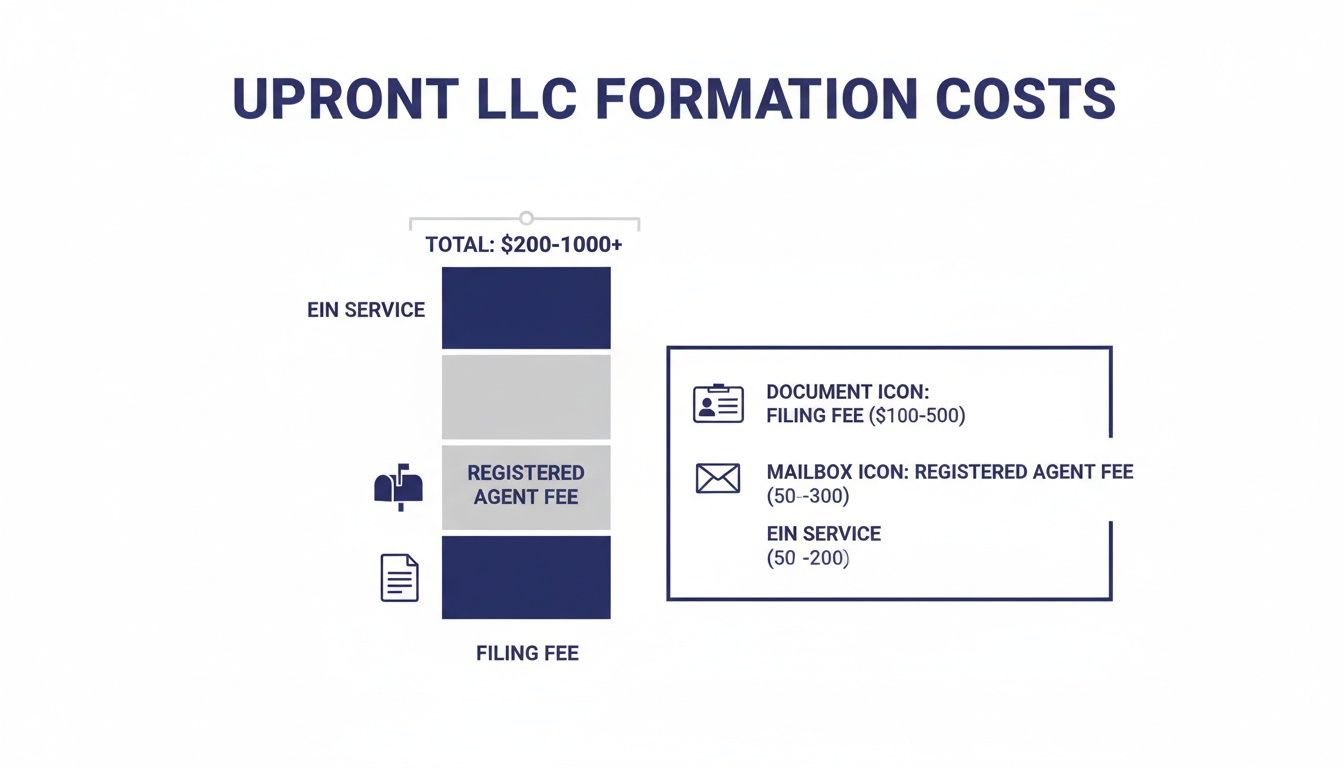
As you can see, the total cost to get started is a mix of several key services, not just the single filing fee that states advertise.
Why Wyoming Is a Founder Favorite
Wyoming has quietly become a go-to for non-US residents, especially those running e-commerce shops or consulting businesses. It hits the sweet spot with a low initial filing fee of just $100 and, crucially, no state income tax. This creates an incredibly founder-friendly financial environment right from the start.
But the state's real advantage reveals itself over time. The annual report fee is a predictable $62, keeping your ongoing compliance costs low and manageable. This combination of affordability, privacy, and simplicity makes Wyoming a standout choice. If you want to dive deeper, our ultimate guide to forming an LLC in Wyoming for UK founders has all the details.
Understanding Delaware's Premium Appeal
You’ve probably heard Delaware called the "gold standard" for U.S. business, but that reputation comes with a price. While the initial filing fee is a reasonable $90, the catch is the annual $300 franchise tax. This is a flat tax you have to pay every single year, regardless of whether your company made a dime.
So, why would anyone pay it? It comes down to one thing: Delaware's Court of Chancery. This is a highly respected, specialized court that only deals with business law, providing a level of legal predictability that is invaluable for companies planning to seek venture capital. Investors know and trust Delaware's legal system, making it the default choice for high-growth startups with their eyes on a big exit.
Florida and Other Business-Friendly States
Florida is another solid option, particularly for e-commerce, thanks to its booming economy and lack of state income tax. Its initial filing fee is a little higher at $125, but the annual report fee of $138.75 keeps it competitive in the long run.
The key takeaway is to look at the complete financial picture. When UK founders expand stateside, understanding the multi-year costs is critical. The five-year total can differ by over 10x across U.S. states, from a few hundred dollars to thousands. For instance, Wyoming offers a compelling alternative to Delaware with its $100 formation fee and $62 annual report, totaling around $1,010 over five years with a registered agent. Meanwhile, Delaware's costs can easily top $2,000 in the same period because of that hefty $300 annual franchise tax.
Choosing a state is a balancing act between upfront cost, ongoing compliance fees, and the state's legal and tax environment. For most UK founders who aren't immediately seeking VC funding, a state like Wyoming often provides the best blend of affordability, privacy, and simplicity.
To really hammer this home, let’s lay it all out in a simple comparison table.
5-Year Estimated LLC Cost Comparison for Popular States
Here’s a side-by-side look at the estimated total costs to form and maintain an LLC over five years in a few key states. This table includes the initial filing fee and recurring annual fees, giving you a much more realistic long-term budget.
State | Initial Filing Fee | Annual Report/Franchise Tax Fee | Estimated 5-Year Total Cost |
|---|---|---|---|
Wyoming | $100 | $62 | ~$1,010 |
Delaware | $90 | $300 | ~$2,090 |
Florida | $125 | $138.75 | ~$1,370 |
California | $70 | $800 (minimum) | ~$4,570 |
Estimated 5-Year Total includes the initial filing fee, five years of annual fees, and a typical registered agent fee of around $120/year.
This table perfectly illustrates why you can't judge a book by its cover. A state with a super-low entry fee like California ($70) quickly becomes the most expensive option by a mile, all thanks to its notorious $800 minimum annual franchise tax. This is the kind of context you need to look beyond the sticker price and choose the state that truly aligns with your long-term business goals.
Budgeting for Hidden Costs and Ongoing Compliance

The state filing fee you pay to create your LLC? That's just the tip of the iceberg. The real, long-term cost to form an LLC and keep it running is found in the ongoing compliance—the recurring expenses that often blindside founders a year or two down the road.
Think of it like a subscription service. You pay a one-time setup fee, but it's the ongoing subscription that keeps the service active. For your LLC, these "subscriptions" are the mandatory payments that keep your business in good legal standing with the state.
Ignoring these costs is one of the easiest ways to get into trouble. It can lead to penalties, loss of your company's good standing, and, in the worst-case scenario, the state dissolving your business entirely. Let’s pull back the curtain on these so-called hidden fees so you can build a budget that reflects reality.
Annual Reports and Franchise Taxes
Almost every state will require your LLC to file an Annual Report. Don't let the name fool you; this isn't a detailed financial statement. It’s more like a yearly check-in to confirm or update basic details like your business address and registered agent information.
The fees for these reports are all over the map, ranging from $0 in a handful of states to over $300 in others. It's a recurring cost you absolutely have to plan for.
Then there’s the franchise tax. This is a fee some states charge you for the simple "privilege" of doing business there. What's crucial to understand is that this tax is often due even if your LLC didn't make a single penny.
The most infamous example is California's $800 minimum annual franchise tax. This hits every LLC, every single year, starting from its second year in business. It’s a hefty ongoing expense that makes California a pricey home for new ventures.
Unique State-Specific Requirements
On top of the standard reports, some states throw in their own quirky and often expensive rules. New York, for example, has a bizarre "publication requirement." This old-fashioned rule forces new LLCs to announce their formation in two local newspapers for six weeks straight. The cost for this? It can easily add $1,000 or more to your setup expenses.
These state-specific traps are a minefield for UK founders. A state might look cheap on paper with a low filing fee, but other requirements can make it incredibly expensive. For instance, New York's domestic filing fee is $200, but a foreign LLC (one formed in another state but operating in NY) pays $250 plus income-based fees—and that’s before you even get to the costly publication rule.
It’s why a state like California, with its $800 franchise tax, can push the five-year cost to form an LLC and maintain it to over $4,000.
Legal Documents and Professional Services
While not always mandatory, some documents are essential for protecting your business and your personal assets. A professionally drafted Operating Agreement is at the top of that list. This is your company's internal rulebook, defining ownership and how the business will be run, which is invaluable for preventing disputes later on. While templates exist, having a lawyer draft one tailored to your needs can cost anywhere from $500 to over $2,000.
For UK founders, however, the most critical ongoing cost will be professional bookkeeping and tax preparation. Juggling tax compliance with both the IRS in the U.S. and HMRC in the UK is not a DIY job. It demands real expertise in international tax treaties and reporting. This isn't a luxury; it's a necessity.
These services ensure you stay compliant on both sides of the Atlantic, saving you from enormous penalties and legal headaches. Budgeting $500 to $5,000+ per year for quality accounting support is a realistic—and vital—investment. You’ll also want to learn more about the role of a registered agent service in our guide, as this is another non-negotiable annual expense.
How Set Up Stateside Simplifies Your US Launch
Trying to form a US company from the UK can feel like trying to solve a puzzle with 50 different rulebooks. You're suddenly juggling non-resident tax forms, deciphering unfamiliar state laws, and constantly worrying about staying compliant on both sides of the Atlantic. This is exactly where having a specialist in your corner makes all the difference.
Set Up Stateside was built from the ground up for one reason: to help UK founders like you navigate this exact challenge. We take what is often a tangled, stressful process and turn it into a single, straightforward experience.
Your All-in-One Formation Partner
Think about all the different pieces you need. You'd have to find a state filing service, then hunt down a separate registered agent, find an accountant to get your EIN, and maybe even hire a lawyer for your Operating Agreement. It's a lot to manage.
We bundle all of that into one clear, transparent package. Our job is to take the admin headache off your plate so you can focus on what actually matters—growing your business.
With us, you get one point of contact who genuinely understands the non-resident founder journey. There are no hidden fees or surprise upsells that sneakily drive up the cost to form an LLC. What you see is what you get.
Our all-in-one packages are designed for complete peace of mind. We handle every critical step—from state registration to securing your EIN—so nothing falls through the cracks. Your business is set up for compliance from day one.
This integrated approach doesn't just save you time; it reduces stress and helps you avoid the expensive mistakes that happen when different providers aren't on the same page. We're there for the entire formation process, from start to finish.
Expertise That Bridges the Atlantic
Our value goes far beyond just filing paperwork. We have deep expertise in both US (IRS) and UK (HMRC) tax systems, which is a massive advantage for any UK founder selling in the States. The guidance we offer is practical, accurate, and always tailored to your cross-border situation.
We get the nuances that most US-based formation services completely miss. For example:
Correctly filing for an EIN without a Social Security Number (SSN) to avoid getting stuck in IRS limbo for months.
Structuring your Operating Agreement to meet US legal standards while aligning with your UK business goals.
Advising on state selection with a long-term view of your costs, not just the cheapest initial filing fee.
Guiding you on US banking options that actually welcome international founders.
A Long-Term Compliance Ally
Getting your LLC formed is really just the starting line. The ongoing compliance is where many founders trip up. We don’t just set up your company and wish you luck; we stick around to help you keep your business in good standing.
Our team offers a full suite of accounting and tax services designed specifically for UK-owned US companies. That means everything from bookkeeping and sales tax management to your annual tax filings. We make sure you stay compliant with both federal and state rules, so you can operate with confidence.
Let us handle the tricky administrative and compliance work. By taking that weight off your shoulders, we free you up to concentrate on entering the market, finding customers, and building a real US presence. Your American dream is a big one—our mission is to build the solid foundation you need to make it happen.
Frequently Asked Questions About LLC Costs
Jumping into the US market from the UK naturally stirs up a lot of questions about the financial side of things. The mix of fees, taxes, and state-specific rules can feel like a maze at first. To help you budget with confidence and make the right calls, we’ve put together straight-up answers to the questions we hear most often from founders just like you.
This is all about tackling the practical money concerns that really matter when you're calculating the true cost to form an LLC. Let's cut through the noise and get you the clarity you need.
What Is the Absolute Cheapest State to Form an LLC?
You'll often see states like Kentucky or Arkansas pop up in articles for having rock-bottom filing fees, sometimes as low as $40-$50. But here's the catch: "cheapest" can be a very misleading word. A low initial fee doesn't mean you're getting the best deal in the long run. The smart way to think about cost is to look at the total financial picture over a few years.
For most international founders, Wyoming consistently comes out on top as the best overall value. Yes, the initial filing fee is $100, but it's what happens next that counts. Wyoming has no state income tax and a predictable annual report fee of just $62. That simple, low-cost structure makes it far more affordable over five years than a state that lures you in with a cheap filing fee only to hit you with higher ongoing costs later on.
It's a classic case of looking beyond the sticker price. A state that saves you $50 on day one could end up costing you hundreds more in annual fees or taxes down the road. True value is all about low, predictable ongoing costs.
Is an Expensive State Like Delaware Ever Worth It?
Absolutely. For certain businesses, Delaware's higher cost is a calculated, strategic investment. The main reason it's more expensive is its $300 annual franchise tax. You have to pay this every single year, even if your company doesn't make a dime.
So why would anyone choose it? It all comes down to its unique and highly respected legal system, specifically the Delaware Court of Chancery. This court only deals with business law, which has created an incredibly stable and predictable legal playing field. Venture capitalists and angel investors know Delaware's corporate laws inside and out.
If your game plan involves raising serious money from US investors, the legal shield and investor-friendly reputation of Delaware can absolutely justify the higher cost to form an LLC. It sends a clear signal to investors that you're built for growth and have a corporate structure they know and trust.
Can I Form an LLC Myself to Save Money?
You technically can, but for a non-US resident, it's a path loaded with complexity and risk. Going the DIY route means you have to untangle unfamiliar state rules, find a registered agent on your own, and tackle the biggest hurdle of all: getting an EIN from the IRS without a Social Security Number (SSN).
The IRS application process for international founders is manual, paper-based, and has zero tolerance for errors. Even a tiny mistake on the form can lead to a rejection, kicking off months of frustrating delays. A stalled EIN means you can't open a bank account, sign key contracts, or get your business off the ground.
Working with a formation service that specializes in helping international founders is a smart investment. It ensures everything is handled correctly from day one, saving you an incredible amount of time, stress, and potential compliance nightmares. You're not just paying someone to file papers; you're paying for expertise and the peace of mind to focus on your business.
How Do I Get a US Business Bank Account as a UK Founder?
Getting a US business bank account is a non-negotiable step. It's how you'll accept payments in USD and manage your American finances smoothly. For a long time, this was a massive headache for non-residents.
Most traditional, brick-and-mortar US banks still demand that you show up in person to open an account, which just isn't practical for most founders based in the UK.
Thankfully, the fintech world has stepped up with a solution. There are now several modern banking platforms built from the ground up for international and remote founders. They get the unique needs of non-resident-owned LLCs and let you open an account entirely online once your company is formed and you have your EIN. A good formation partner can point you to these founder-friendly banks and make this crucial step a breeze.
Ready to launch your US company without the guesswork? Set Up Stateside offers all-in-one formation, accounting, and tax packages designed specifically for UK founders. We handle the complexities so you can focus on growth. Learn more about our services for UK founders.


Comments