

The Real Deal on a Free Business Address for Your US Company

Let's be honest—when you're launching a US company from the UK, the thought of a free business address sounds like a brilliant cost-saving move. But is it actually a smart play? The short answer: almost never.
The options that seem "free" on the surface can end up costing you your entire US venture before you even make your first sale.
Why a "Free" US Address is So Tempting
For any founder, especially one managing international setup costs, every penny counts. The promise of a free address feels like a no-brainer. You see it as a clever way to keep initial overheads low, freeing up cash for the things that really matter, like building your product or finding your first customers. It's an incredibly powerful and completely understandable impulse.
But here’s the hard truth: in the US, a business address isn't just a spot on a map for your mail to land. It’s the bedrock of your company's legal identity. It's what lets you register your business, open a bank account, and stay on the right side of the tax authorities.
Going with a "free" or non-compliant address is like building a house on a foundation of sand. It might stand up for a little while, but it's only a matter of time before serious cracks start to show.
The Hidden Costs of Cutting This Corner
Chasing a free address usually leads UK founders down a couple of well-trodden, but treacherous, paths. These options seem harmless at first glance, but they crash and burn when they come up against the strict rules set by US banks and government agencies. The problem is simple: they aren't recognized as legitimate, commercial addresses.
Think of your US business address less as an expense and more as a foundational investment. It's a non-negotiable requirement for legal formation, getting your tax ID from the IRS, and opening that all-important bank account. Getting this right from day one is the key to a smooth launch.
Let's break down what that "free" address will actually cost you. The price isn't paid in dollars, but in rejected bank applications, compliance headaches, and even the risk of having your company shut down. It’s a shortcut that almost always leads to a dead end, forcing you to waste precious time and money to fix a mistake that was entirely avoidable.
To make this crystal clear, let's look at a quick comparison. It shows the massive gap between the tempting "free" options and the professional solutions you actually need for your US business to succeed.
At a Glance: Free vs. Professional US Addresses
Feature | Common 'Free' Options (Friend's Address, PO Box) | Professional Virtual Address |
|---|---|---|
Legal Compliance | Often non-compliant for LLC/Corp formation and registered agent requirements. | Fully compliant with state and federal regulations for business registration. |
Bank Account Opening | Frequently rejected by major US banks due to lack of a verifiable physical address. | Accepted by most US banks, meeting their stringent "Know Your Customer" (KYC) rules. |
IRS EIN Application | Can cause delays or rejection if the address is flagged as non-commercial or a PO Box. | Provides a legitimate physical street address that satisfies IRS requirements. |
Professional Image | Appears unprofessional and can raise credibility concerns with clients and partners. | Establishes a credible, professional US presence in a commercial location. |
Mail Handling | Unreliable, insecure, and burdens a personal contact. No digital access. | Secure mail receiving, scanning, and digital forwarding managed by a professional team. |
Privacy Protection | Exposes personal home addresses (yours or a friend's) on public records. | Keeps your personal address private and off public databases. |
As you can see, a small upfront investment in a proper address isn't just about ticking a box; it's about building a secure and credible foundation for long-term growth in the US market.
What Counts as a Real US Business Address
When you’re setting up a US company, state and federal agencies aren’t looking for just any old address—they need a real one. Think of it as your company’s official anchor in the United States. It has to be a legitimate, physical location where you can be reached and, more importantly, where you can receive official mail. This isn't just a box-ticking exercise; it's a fundamental legal requirement.
This is a common stumbling block for UK founders. Many assume their UK address will do, or that a simple US PO Box is enough. Unfortunately, US authorities are quite strict on this. Their rules are designed to make sure every registered company has a genuine physical footprint in the country. This one address is the key to everything, from your state registration documents to getting that all-important Employer Identification Number (EIN) from the IRS.
The Three Core Address Types You Need to Know
To get your US presence right from the start, you have to understand that not all addresses are created equal. In the eyes of US regulators, there are very different types of addresses, and each has a specific job. Mixing them up can lead to rejected applications and some serious compliance headaches down the road.
Here are the three big ones:
Principal Place of Business: This is your command center, the main location where you actually run your business. It absolutely has to be a physical street address.
Mailing Address: This is simply where you want your day-to-day mail sent. While it can be different from your principal address, you'll find that banks and the IRS almost always insist that your principal address is a real, physical location, not a PO Box.
Registered Agent Address: This is a legal must-have in every single state. It’s the official address on public record for getting served with critical legal documents, like a lawsuit or official notices from the state. This address must be a physical street address in the state where you’ve formed your company, and the agent has to be available there during business hours.
Getting a handle on these distinctions is the very first step to building a compliant—and successful—address strategy.
Why Common 'Free' Shortcuts Fail the Test
So, what’s the big deal? Why can’t you just use your friend's house or a standard PO Box? It all comes down to one word: verification.
US government agencies and banks use surprisingly sophisticated systems to check addresses. These systems are built to automatically flag anything that doesn't look like a legitimate commercial location.
For example, a standard PO Box is an instant rejection for most LLC or corporation filings because it's not a physical address where someone can hand-deliver legal papers. And using a friend's residential address? That's a red flag, too. It raises questions about your company’s legitimacy and could even create messy legal and tax problems for your friend.
The real problem with nearly every free business address is that it doesn’t meet the legal standard of a Commercial Mail Receiving Agency (CMRA). Banks and government bodies require an address that is commercially zoned and properly staffed to handle official mail securely.
The flowchart below shows the all-too-common journey a founder takes—from the temptation of a "free" address to the reality of what's actually required.
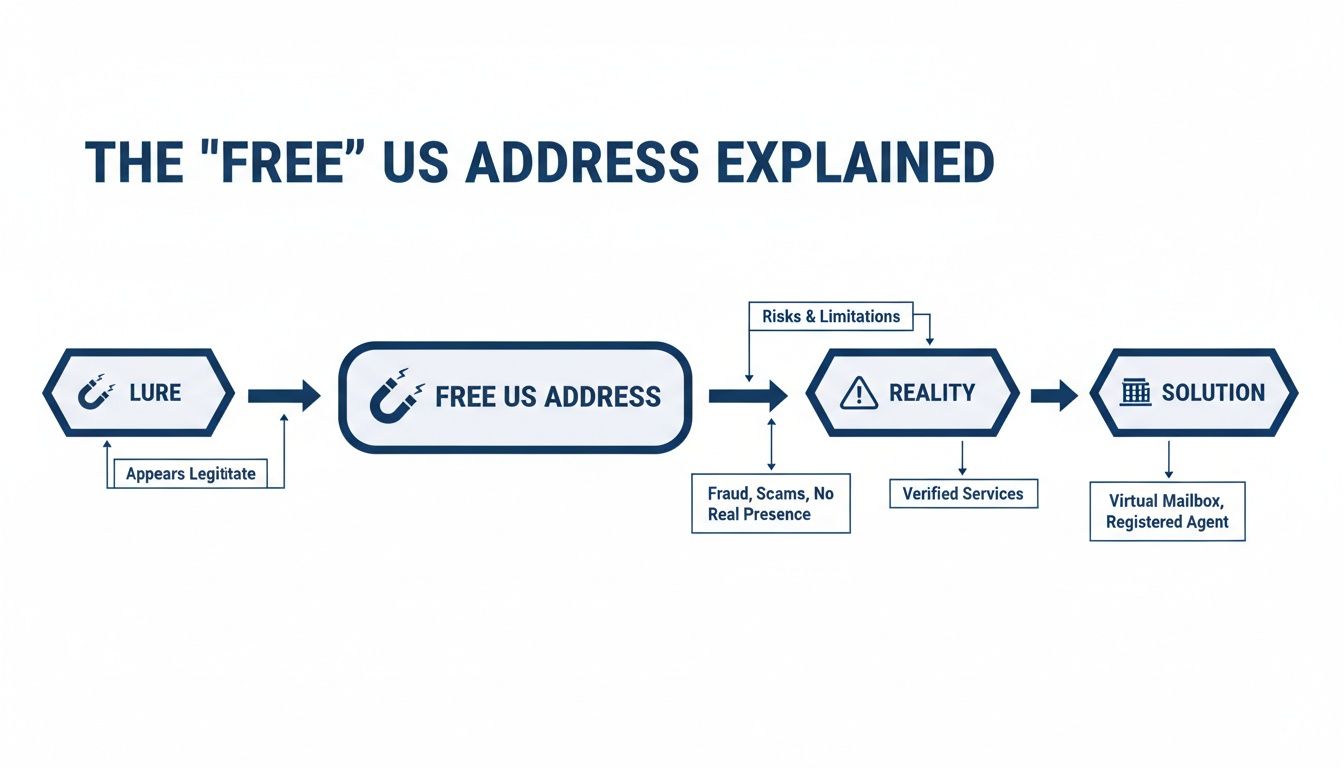
This visual says it all. The initial appeal of saving a few quid quickly evaporates when you hit the first compliance roadblock, pushing you right back to where you should have started: with a professional, legitimate address service.
The Real-World Consequences of a Non-Compliant Address
Using a dodgy address isn't a minor slip-up. It has serious, immediate consequences that can grind your US expansion to a halt before it even begins. You aren't just risking a bit of a delay; you're putting your company's entire legal standing on the line.
Here’s what actually happens when your address doesn’t pass the test:
State Formation Rejection: Your LLC or Corporation filing will be flat-out denied. Your company won't legally exist.
IRS EIN Denial: The IRS will reject your application for an Employer Identification Number. Without an EIN, you can't open a bank account, hire staff, or file taxes.
Bank Account Refusal: Major US business banks like Mercury and Relay will refuse to open an account for you. This cuts off your financial lifeline in the US.
In short, getting your address right isn't just about playing by the rules. It's about unlocking the ability to form your company, get your tax ID, and open the bank account you need to actually start doing business.
The Hidden Dangers of 'Free' Address Options
The idea of a free business address is definitely tempting, especially when you're keeping a close eye on your US launch budget from all the way over in the UK. But let's be real—the most common "free" options are riddled with traps that can seriously undermine your entire venture. These so-called shortcuts often lead to compliance dead ends, privacy nightmares, and operational headaches that end up costing far more than a proper address service ever would.
Let’s pull back the curtain on the three biggest traps UK founders fall into and expose the hidden dangers lurking in each one.

Trap 1: Using Your UK Home Address
At first glance, listing your UK home address seems like the most logical thing to do. It’s where you work, after all. But this simple choice creates immediate and significant problems for a US-based company.
Right off the bat, a foreign address is a huge red flag for US state registration offices and banks. It completely fails to establish the local US presence they need to see for compliance. This often leads to an outright rejection of your company formation documents and bank account applications.
Worse, you’re putting your personal privacy on the line. In the US, your business address becomes part of the public record, permanently searchable by anyone. That means your home address is suddenly out there for data scrapers, junk mailers, and even disgruntled customers to find.
Trap 2: Borrowing a Friend's US Address
Asking a friend or relative in the States if you can use their address seems like a harmless favor, right? In reality, you're stepping into a legal and financial minefield for both of you.
By listing their residential address, you’re accidentally creating a business presence, or "nexus," for your company in that specific state. This can trigger some serious consequences. For example, if your e-commerce business uses a friend’s California address, you could suddenly be on the hook for collecting and remitting California sales tax.
This seemingly small favor can morph into a massive headache for your friend, potentially triggering unexpected tax obligations and legally connecting their home to your business activities. It blurs personal and professional lines in a way that can strain relationships and create a real legal mess.
This setup is also just plain unprofessional and insecure. What happens when crucial legal notices or sensitive bank documents for your company get lost in their personal mail pile? It’s an easy way to miss critical deadlines and fall out of compliance.
Trap 3: Relying on a Standard PO Box
A Post Office Box might feel a bit more official than someone’s house, but it still falls far short of what a US company legally requires. Government agencies, including the IRS and state filing offices, demand a physical street address where legal documents—known as service of process—can be delivered in person. A standard PO Box just doesn't meet this fundamental legal standard.
This limitation is a dealbreaker for one of the most vital steps in your US journey: opening a business bank account. US banks operate under strict "Know Your Customer" (KYC) regulations designed to prevent fraud. A PO Box is immediately flagged as a non-physical location, resulting in an almost certain denial of your application.
While it's fine for receiving general mail, it simply doesn't work as the foundational legal and financial address for your company. You can learn more by checking out our guide on why you can't use a PO box for your LLC.
The need for compliant, professional address solutions has fueled a massive industry. In recent years, the global virtual office market ballooned to an incredible USD 16,255.5 million, with North America alone making up over 40% of that market. This explosive growth shows just how many entrepreneurs are ditching risky shortcuts for professional services that slash overheads while guaranteeing compliance.
At the end of the day, these "free" options are anything but. They expose your business to privacy risks, legal trouble, and operational roadblocks that can stop your US expansion before it even starts. The smart move is to see these dangers for what they are and invest in a compliant solution from day one.
Understanding Your Registered Agent Address
Alright, after steering clear of the risky "free" address options, let's talk about the first part of a real, compliant solution: the Registered Agent. If you're setting up an LLC or Corporation in the US, getting a Registered Agent isn't just a good idea—it's a legal requirement in every single state. This is a non-negotiable step to get your company into good standing.
Think of your Registered Agent as your company's official liaison with the state government and the legal system. Their job is very specific: they must be physically present at a street address in your state of registration during normal business hours. This address goes on the public record for a very important reason.
This is the designated spot for receiving time-sensitive, official documents, legally known as service of process. We’re talking about things like official state mail, tax notices, and—most critically—legal summons if your company is ever sued. A reliable agent ensures these documents get to you immediately, so you never miss a deadline that could jeopardize your business.
The Critical Distinction Most Founders Miss
This is where a lot of international founders stumble. Your Registered Agent service gives you an address, and it's easy to assume you can use it for everything. That's a huge mistake. While this address is perfect for its legal purpose, it is not a substitute for a proper business or mailing address.
Why is that? A Registered Agent's address is built for one job and one job only. It's simply not equipped for your day-to-day operational needs.
The Registered Agent address is your legal lifeline, not your commercial hub. Its purpose is to ensure you meet state compliance rules for receiving official notices. It is not designed to handle your general business mail, bank statements, or customer correspondence.
Trying to use this address for your bank account or general mail often leads to the same rejections you'd get with a "free" address. Banks can often spot it as a compliance address, not a genuine place of business. On top of that, most Registered Agent services aren't set up to process regular mail; they might charge you extra fees or just send it back. We cover this in much more detail in our guide on what a Registered Agent is and why you need one.
Building Your Complete Address Strategy
Getting this distinction right is the key to a solid, compliant address strategy. For your US company to run smoothly, you really need two separate things:
A Registered Agent Address: This is for the state. It fulfills your legal obligation and keeps your company compliant. This is always step one.
A Professional Business Address: This is for everyone else—banks, the IRS, clients, and vendors. It's your mailing address, your professional front, and the hub for all your operational correspondence.
Keeping these two roles separate isn't just best practice; it's essential for a successful launch in the US. You avoid all the headaches of a non-compliant free business address and ensure every piece of your company's foundation—from legal filings to bank accounts—is legitimate and secure. With your Registered Agent sorted, you’re already halfway there.
The Smart Alternative: A Professional Virtual Address
So, after working through the legal maze and sidestepping the common traps, we've arrived at the modern, compliant solution that solves every single problem we've talked about. Instead of chasing a risky free business address, the smart move is to invest in a professional virtual business address. For UK founders, this is the key that unlocks the US market, giving you a secure and legitimate foundation to build on.
Think of it like having a fully staffed, professional front office in the US but without the crippling expense of a physical lease. A virtual address is a real, physical office location run by a specialised company. They handle your business mail, digitise it for you, and provide a credible commercial address that you can use for everything your business needs.
Unlocking Credibility and Compliance
For a founder based in the UK, a virtual address is a genuine game-changer. It instantly gives you a legitimate US presence that satisfies the strict rules of state agencies, the IRS, and major US banks. When you go to apply for your EIN or open a business bank account, this commercial address ticks all the right boxes, making sure the whole process goes off without a hitch.
That credibility also extends to your customers and partners. Having a proper US address on your website and invoices builds trust. It shows you're a serious, established player in the market, not just someone operating from a distance. It's a small detail that makes a massive professional impact.
How a Virtual Address Protects and Empowers You
Beyond just keeping you compliant, a virtual business address offers some powerful operational benefits that are crucial for any remote founder. It puts a clear line between your professional and personal life and gives you a secure way to manage your US correspondence from anywhere in the world.
Here’s what you get:
Privacy Protection: Your home address stays off the public record. This protects you and your family from junk mail, unwanted visitors, and potential security risks.
Secure Mail Management: A professional team receives and handles all your mail. Critical documents are scanned and uploaded to a secure online portal, meaning you’ll never miss an important notice again.
Global Accessibility: You can log in and manage your US mail from your laptop in London just as easily as if you were in New York. Mail can be opened, scanned, forwarded, or securely destroyed with just a few clicks.
A virtual address is so much more than a mailbox. It’s a complete mail management system built for the modern remote business. It turns a physical necessity into a digital convenience, allowing you to run your US operations seamlessly from the UK.
This mix of legal compliance and operational freedom is exactly why so many international entrepreneurs depend on this solution. It bridges the gap between your UK base and your US ambitions. On a related note, you might also find our guide on what a registered agent service is helpful, as it works hand-in-hand with your virtual address.
The Clear Financial Advantage
The market for these services is booming for a reason. Virtual office solutions are projected to more than double from USD 15.1 billion to USD 30.1 billion by 2031. This growth is being driven by small and medium-sized businesses—over 60% of the users—who can get a prestigious address while cutting setup costs by as much as 70-90% compared to a traditional office. You can explore more about this market trend on Verified Market Research.
For a small monthly fee, you get a premium address, a secure mail system, and the peace of mind that comes with being fully compliant. This small, predictable operating cost saves you from the massive potential headaches of non-compliance, like rejected applications, legal fees, or simply being unable to do business. It's an investment in stability and long-term success, proving that the smartest alternative to a "free" address is a professional one.
Your Next Steps to a Compliant US Address
Getting your US business address right might seem complicated, but it's actually pretty straightforward when you know the steps. The single most important thing to remember? Stay far away from the temptation of a free business address.
Think of a professional address not as a cost, but as a crucial investment in your company’s foundation. Getting this right from the start helps you sidestep the common headaches—like rejected bank applications or state filings—that can stop a business dead in its tracks.
Your Actionable Checklist for Success
For UK founders, breaking this down into a simple roadmap makes all the difference. This checklist is designed to build your company's legitimacy and pave the way for smooth sailing. It's all about doing it right, without cutting corners on compliance.
Follow these four steps to get your US address set up correctly:
Partner with a US Formation Specialist Work with a team that gets the specific hurdles for non-resident founders. Companies like Set Up Stateside can walk you through the entire process, making sure nothing gets missed.
Secure a Registered Agent This is your non-negotiable first move. You absolutely need a Registered Agent in the state you're forming in. This address is where official legal notices and state mail will go, and it's essential for keeping your company in good standing.
Add a Professional Virtual Business Address Next, get a commercial address for everything else. This is the address you'll put on your website, marketing materials, and use for all your day-to-day business mail. It gives you a credible, professional image from day one.
Use Your Compliant Address for Key Applications Be consistent. Use this professional address when you file for your EIN with the IRS and when you open your US business bank account. It makes the approval process much, much smoother.
Following this roadmap helps you launch your US venture on a solid, compliant foundation. It's the difference between hitting constant roadblocks and being set up for long-term growth in a new market.
The shift to virtual solutions is only getting bigger. The virtual mailbox market alone is on track to hit USD 2.5 billion by 2025, a trend powered by startups and entrepreneurs who want a professional presence without the expense of a physical lease. You can discover more insights about virtual mailbox market trends on Data Insights Market.
Frequently Asked Questions
When you're launching a US company from the UK, the address requirements can feel a bit murky. It’s totally normal to have questions, and getting them answered upfront saves a ton of headaches later. Here are the most common things we get asked by founders just starting their journey.
Can I Use a Virtual Business Address to Open a US Bank Account?
Yes, you absolutely can—and you should. A quality virtual business address from a trusted provider isn't just a mailbox; it's a real, physical commercial location. That’s exactly what US banks look for to satisfy their strict "Know Your Customer" (KYC) rules.
This is a huge reason why options like a free business address or a basic PO Box are non-starters. Banks will almost always flag and reject them, stopping your application in its tracks.
Is My Registered Agent Address the Same as My Virtual Address?
It's a common point of confusion, but no, they are two completely different services with distinct jobs. Mixing them up is a critical mistake.
A Registered Agent Address is purely for legal compliance. Its only job is to be the official address on file with the state to receive legal documents and government notices. Think of it as your official line to the authorities.
A Virtual Business Address is your day-to-day, public-facing address. This is where your bank statements, customer payments, and general business mail will go. It's the address you'll put on your website, your business cards, and your marketing materials.
Here’s a simple way to think about it: your Registered Agent keeps you compliant with the government. Your virtual address makes your business functional and credible to everyone else—your bank, your clients, and your partners.
The easiest way to remember the difference is that a Registered Agent address keeps you legal, while a virtual business address keeps you operational and looking professional in the US market.
What Really Happens if I Use a Non-Compliant Address?
Using a dodgy address isn't just a minor slip-up. It has serious, real-world consequences that can derail your US ambitions before you even get started. The fallout is often fast and messy.
Here's what you're risking:
Business Dissolution: The state can literally shut down your LLC or corporation for not maintaining a proper address.
EIN Rejection: The IRS will almost certainly deny your application for an Employer Identification Number (EIN), which you need for nearly everything, including banking and taxes.
Bank Account Denial: You'll find it impossible to open a US business bank account, which effectively cuts off your ability to operate financially.
Legal & Tax Nightmares: Down the road, it can lead to a tangled mess of legal and tax problems, including fines and penalties.
Will Having a US Virtual Address Affect My UK Tax Status?
On its own, a US virtual address is just a mail-forwarding service and typically won't create a tax headache for you in the UK. It doesn't establish what's known as a "permanent establishment."
However, how you structure and run your US company is a completely different story and absolutely has tax implications in both countries. Authorities like the IRS and HMRC will look at factors like where your key decisions are made and how profits flow. It is essential to speak with a cross-border tax advisor who knows both US and UK tax law inside and out. They'll make sure you're set up correctly from day one.
Ready to build your US presence on a solid foundation? The team at Set Up Stateside specializes in helping UK founders navigate every step of the process, from getting a compliant address to managing complex cross-border tax issues. Get in touch today to start your US journey the right way.


Comments