

Using a PO Box as a Business Address for Your LLC

Are you considering using a PO Box as a business address? It's a common question for new entrepreneurs, particularly those based internationally, and the answer isn't a simple yes or no. For critical legal steps—like forming your U.S. LLC or corporation—the answer is a definite no. State and federal agencies require a physical street address to ensure your business is legally accountable and can be officially contacted.
Understanding the Limits of a PO Box Address
When launching a business in the U.S., you'll quickly find that you need different types of addresses for various purposes. A PO Box is a useful tool, but it simply doesn't cover all the legal and financial bases.
Think of it this way: your physical address is your company's legal "home." It's where the government sends official notices and where you can be found if legal action is ever taken. A PO Box, in contrast, is just a locked box rented at a post office for mail management. The U.S. government needs to know your company's home, not just its mailbox.
Getting this right from the start is critical for compliance and a smooth business launch. If you attempt to use a PO Box on your formation documents, your application will be rejected. This leads to unnecessary delays, administrative headaches, and a rocky start to your new venture.
When Can You Use a PO Box?
While it’s a non-starter for legal registration, a PO Box is an excellent tool for many of your day-to-day business activities.
Here’s where it shines:
Marketing Materials: Feel free to put a PO Box on business cards, your website, or flyers to keep your home address private.
General Correspondence: It’s a secure and professional solution for receiving mail and packages from customers and suppliers.
Email Marketing: Under the CAN-SPAM Act, you can use a registered PO Box as your required physical postal address in commercial emails.
This decision tree gives you a quick visual guide for figuring out if a PO Box is the right tool for the job.
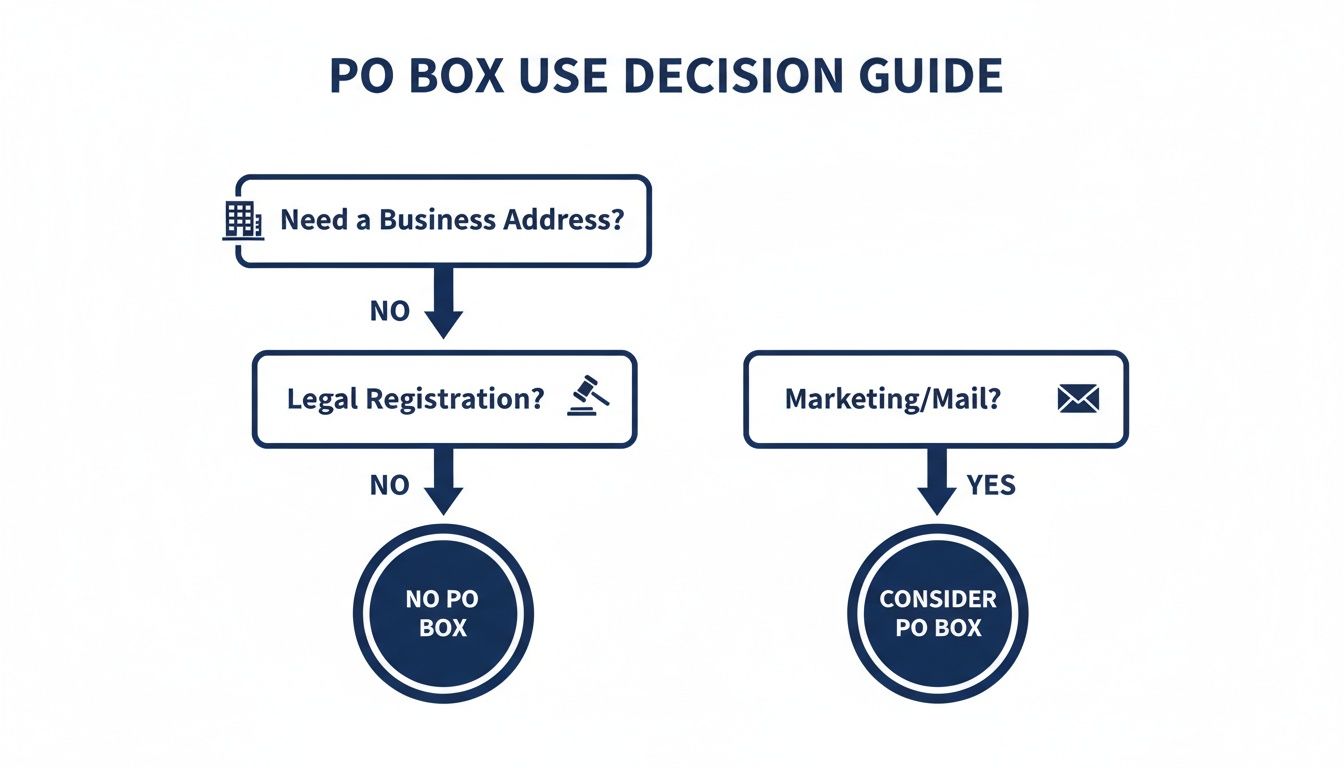
The main takeaway is that a PO Box works well for your public-facing communications but falls short when it comes to the legal and financial backbone of your company.
To make this even clearer, let's break down exactly where a PO Box is and isn't allowed.
PO Box vs Physical Address for Official Business Use
This table offers a quick at-a-glance comparison for U.S. business owners.
Business Requirement | PO Box Accepted? | Physical Address Required? |
|---|---|---|
State LLC/Corp Registration | No | Yes |
Registered Agent Address | No | Yes |
IRS EIN Application | No | Yes |
U.S. Business Bank Account | No | Yes |
General Customer Mail | Yes | No |
Website & Business Cards | Yes | No |
Email Marketing (CAN-SPAM Act) | Yes | No |
Knowing these rules upfront is especially important for international founders. While a PO Box provides privacy and a convenient way to manage mail, it is simply not a substitute for the legitimate physical address you need to operate legally in the United States.
Navigating the Official Rules for Business Addresses
When you're establishing a U.S. business, the address can seem like a minor detail—but it's not. Understanding the official rules makes it crystal clear why a PO box as a business address often falls short. Government agencies and banks have strict, non-negotiable requirements for a reason: ensuring legal accountability and preventing fraud.
Think of your official business address as your company's anchor in the real world. It proves you have a physical presence, a specific spot on the map where legal documents can be delivered. A PO Box, on the other hand, is just a mail slot. It doesn't meet that fundamental need for legal accountability.
The Role of the Registered Agent
This is where the concept of a Registered Agent becomes critically important. Every LLC or corporation formed in the U.S. is legally required to appoint one. This designated person or company is your official point of contact for receiving legal notices, government correspondence, and what’s known as "service of process"—the formal delivery of documents like a lawsuit.
There are a few hard-and-fast rules for a Registered Agent:
A Physical Street Address: They must maintain a real, physical address in the state where your company is formed. This is often called a "registered office."
Cannot Be a PO Box: This is an absolute rule. Legal papers must be hand-delivered to a real person at a verifiable location, so a PO Box is out of the question.
Regular Business Hours: The agent must be available during normal business hours to accept critical documents on your company’s behalf.
For most entrepreneurs, especially those operating from outside the U.S., using a professional Registered Agent service is the only practical solution. It instantly provides a compliant physical address and guarantees someone is always there to handle essential legal mail.
For global entrepreneurs, the Registered Agent is more than a legal formality; it is your essential physical link to the U.S. legal system. It ensures you never miss a critical notice that could jeopardize your company's good standing.
IRS and State Requirements for Formation
The rules don't stop with the Registered Agent. When you apply for an Employer Identification Number (EIN) with the IRS, the form specifically demands a physical street address. This is the official address the IRS will use for all your tax correspondence.
It's the same story at the state level. Every Secretary of State's office requires a physical address on your company’s formation documents. These regulations aren’t just red tape; they exist to tie every registered business to a real location. This accountability is crucial for collecting taxes, handling legal disputes, and maintaining corporate transparency.
A PO Box is great for receiving customer mail, but it simply won’t cut it for these foundational legal steps. The U.S. Postal Service delivers mail to 12.6 million business addresses across the country, highlighting how vital mail is for commerce. But for official registration, a physical address is the only way forward. You can dive deeper into these figures by exploring the full report on USPS operations.
Figuring all this out can feel like a maze, but our team specializes in setting up international founders with fully compliant U.S. addresses, ensuring your business starts on solid legal ground from day one.
Weighing the Pros and Cons of a PO Box for Your Business
Choosing a business address seems like a small decision, but it has a surprisingly big impact on your company's foundation. It’s tempting to grab a PO Box—they’re inexpensive and easy to set up—but you need to understand exactly what you’re getting into, especially when establishing a new company in the U.S. Choosing the wrong type of address can create serious roadblocks with banks and state agencies right when you’re trying to launch.
On the surface, a PO Box has its appeal. For one, it keeps your home address private, a significant benefit for many founders. It also gives you a stable address for your mail, so even if you move, your mail continues to arrive at the same spot. And, of course, the price is hard to beat.
However, for business owners, especially those living outside the U.S., the drawbacks are significant. We're not talking about minor annoyances; these limitations can completely stall your business formation process.
Weighing the Benefits and Drawbacks of a PO Box
To make an informed decision, it's helpful to see the advantages and disadvantages side-by-side. While a PO Box can be useful for certain tasks, it falls short where it matters most for legal and financial setup.
Advantages | Disadvantages |
|---|---|
Privacy Protection | Ineligible for State Filings |
Keeps your home address out of public records. | Cannot be used to form an LLC or corporation. |
Mail Security | Can't Be a Registered Agent Address |
Mail is kept in a secure, locked federal facility. | States require a physical street address for legal notices. |
Address Stability | Often Rejected by Banks |
Your mailing address stays the same if you move. | Most banks won't open an account with a PO Box. |
Cost-Effective | Private Carrier Limitations |
Usually the cheapest option for a separate address. | Can't receive packages from carriers like FedEx or UPS. |
Ultimately, a PO Box can be a great tool for managing general mail, but it simply doesn't meet the legal requirements for a foundational business address in the United States.
The Good: Where a PO Box Shines
Let’s start with the positives. If you understand its limitations, a PO Box can still play a valuable role in your business operations.
Privacy Protection: It’s a simple and effective way to separate your personal life from your business. No one needs to see your home address on your website or business cards.
Mail Security: Your mail is stored in a locked box inside a post office. That's far more secure than a residential mailbox, significantly reducing the risk of mail theft.
Address Stability: If you move your home or office, you don’t have to update your mailing address with every contact. This consistency is great for branding and operational continuity.
Cost-Effectiveness: When it comes to price, nothing really beats a PO Box. It’s the most budget-friendly way to get a mailing address that isn’t your home.
The Bad: Why It's a Non-Starter for Business Formation
Despite the perks, the disadvantages are deal-breakers for anyone trying to establish a legitimate U.S. entity. The restrictions from government and financial bodies make a PO Box unusable for the most critical steps of your business journey.
The heart of the problem is this: a PO Box only proves you can receive mail. It doesn't prove your business has a real, physical footprint, which is a non-negotiable requirement for legal and financial compliance in the United States.
Here are the biggest hurdles you’ll face:
Ineligible for Legal Registration: You simply cannot use a PO Box to form an LLC or corporation with any Secretary of State. They require a physical street address.
Cannot Be a Registered Agent Address: By law, your Registered Agent must have a physical address where they can be served legal papers in person during business hours. A PO Box does not meet this requirement.
Often Rejected by Banks: Try opening a business bank account with a PO Box. Most U.S. banks will turn you away due to federal "Know Your Customer" (KYC) rules that demand a verifiable physical address.
Private Carrier Limitations: A standard PO Box can’t accept packages from carriers like UPS, FedEx, or DHL. This can create major logistical challenges if you need to receive inventory or important documents from these services.
If you’re navigating the maze of U.S. business formation, getting the address right from day one is crucial. Our team specializes in setting up international founders with fully compliant U.S. addresses that meet all legal and banking requirements. Schedule a consultation to find the right solution for your new venture.
Why Banks Get Nervous About PO Box Addresses
Opening a U.S. business bank account is a major milestone, but it's one where your company's address can unexpectedly trip you up. Many founders are shocked when their application is denied simply because they used a PO box as their business address. This isn't just a bank being difficult; it's a direct consequence of federal law.
Financial institutions in the U.S. must follow very strict rules to prevent fraud, money laundering, and other illegal activities. The key regulations here are the USA PATRIOT Act and the "Know Your Customer" (KYC) guidelines. These regulations force banks to verify the identity and, crucially, the physical location of every business they work with.
Think of it this way: the bank needs to know where your business actually operates, not just where it receives mail. A physical street address gives them a tangible link to your company. It helps them confirm you're a legitimate operation and not just a shell company. A PO Box, by its very nature, is just a box at a post office, which doesn't meet that legal standard.
The Impact of KYC and Federal Regulations
At its core, KYC is about ensuring the bank can confidently answer the question, "Who is our customer?" When a bank opens an account for your business, it's taking on a certain level of risk. To manage that risk, they are legally required to confirm your business is real and has a verifiable physical footprint.
A PO Box fails this test for several key reasons:
It isn't a physical presence: It’s a service for receiving mail, not an actual place of business.
It can raise red flags: To a bank's compliance officer, a PO Box may look like an attempt to hide where a business truly operates.
It makes legal verification impossible: Banks need to know there's a real location they could, in theory, visit if something went wrong.
The bottom line is that banks are legally required to know their customers' physical locations. When you put a PO Box on your application, you create an immediate compliance issue that usually results in a quick denial or, at best, major delays while they request more documentation.
This strict requirement is precisely why getting your address right from day one is so critical. PO Boxes are incredibly popular—businesses renting them from the USPS generated over $125 million in revenue in fiscal year 2021 alone. But despite their convenience for mail, they're a massive hurdle for banking.
You can dig deeper into the numbers by reading the USPS Office of Inspector General's report. For international founders especially, understanding this banking reality is key to avoiding frustrating roadblocks.
Smarter Address Solutions for Global Entrepreneurs
So, you understand a PO Box won't cut it for your official U.S. business needs. What's next? For international founders, the solution is finding an address that ticks all the legal boxes while still being practical for a company that operates remotely. This is where two key services come into play: a Registered Agent service and a virtual business address.
While they both provide a physical U.S. address and are far superior to a PO Box for legal purposes, they serve very different functions. Think of a Registered Agent as a legal necessity, whereas a virtual address is your complete operational headquarters.
Registered Agent Service: The Legal Minimum
A Registered Agent is best understood as your company's official point of contact with the state. This service provides you with a physical street address in your state of formation, which is a non-negotiable legal requirement for receiving official documents and service of process (lawsuits).
Satisfies State Law: This is the address you must have on file with the Secretary of State. There's no getting around it.
Handles Critical Documents: Their job is to receive and forward time-sensitive legal notices, tax forms, and other government mail.
Offers Limited Functionality: It's crucial to understand that you generally cannot use your Registered Agent's address for daily business mail, marketing, or opening a bank account. It's strictly for official legal and state correspondence.
In short, a Registered Agent is a crucial component of staying compliant. But it’s a specialized tool for a specific legal purpose, not an all-around business address.
Virtual Business Address: The All-In-One Solution
For a global entrepreneur, the most powerful and flexible option is a virtual business address. This isn't just a mailbox; it’s a full-service solution that gives your company a real commercial street address in a professional location. This is the modern, compliant choice built for how business actually works today.
A virtual business address provides a genuine street address that’s accepted almost everywhere you’ll need it, including:
State agencies when you’re forming your LLC or corporation
The IRS for your EIN application
U.S. banks when you need to open a business account
A virtual address bridges the gap between what's legally required and what's practically needed. It gives you the physical presence institutions demand, combined with the digital convenience a global business needs to thrive. You look professional and established from day one, no matter where in the world you're working from.
Beyond just satisfying regulations, these services are designed for remote management. Features like mail scanning, forwarding, and digital storage let you handle all your U.S. mail from your laptop anywhere in the world.
It's no surprise that demand for these services is climbing. The global mailbox rental market, which includes virtual mailboxes, was valued at $1.8 billion in 2024 and is expected to reach $2.2 billion by 2032. This growth is driven by a rising wave of international founders and digital nomads who need a reliable foothold in the U.S. You can dive deeper into the trends shaping this industry by checking out the full industry report on mailbox rental services.
Navigating these options can feel complicated, but our specialty is helping international founders get the perfect address solution for a smooth, compliant, and successful business launch.
Your Path to a Compliant US Business Address
Let's pull all this together into a simple, actionable game plan. We've established that while a PO Box is useful for general mail, it's a non-starter for the legal and financial heavy lifting of setting up a U.S. company. What you really need is a compliant physical street address.
Your Three-Step Compliance Checklist
For international founders, the path forward is clear once you know the steps. Getting this right from the start helps you sidestep the common headaches that come from using a PO Box for official business.
Get the Right Services: The first move is to partner with a firm that provides both a virtual business address and a Registered Agent service. This combination gives you the legitimate physical address that state, federal, and banking institutions all require.
Form Your Company Correctly: With that compliant street address in hand, you can file your LLC or corporation paperwork. This ensures your registration documents are accepted without frustrating delays or rejections.
Build Your Financial Base: Now you can smoothly apply for your EIN and open a U.S. business bank account. You won't have to worry about being turned away for using an address that doesn't meet strict KYC requirements.
For global entrepreneurs, this is about more than just getting an address. It's about laying a legitimate, solid foundation for your U.S. venture right from day one. Choosing the right address solution is your first real step toward building a successful and lasting business.
Our firm is built to handle this entire process for you, ensuring your new company is set up correctly and compliantly from the very beginning. If you're ready to get your U.S. venture started on the right foot, schedule a consultation with our experts.
Frequently Asked Questions
When it comes to using a PO Box for a business address, it's natural to have a few questions. Here are our expert answers to some of the most common queries from entrepreneurs like you.
Can I Put a PO Box on My Website and Business Cards?
Absolutely. In fact, for many business owners, this is a best practice. A PO Box is perfectly acceptable for your public-facing materials like websites, business cards, and marketing flyers.
Using a PO Box in this way gives your customers a reliable way to get in touch while keeping your personal home address private. The strict rules about physical addresses really only apply to official government, legal, and financial filings.
How Is a Virtual Address Different From a PO Box With Street Addressing?
This is a critical distinction that often causes confusion. The USPS "Street Addressing" service is a feature that assigns a street-style number to your PO Box, allowing you to receive packages from private carriers. However, automated verification systems and sharp-eyed compliance officers can often still identify it as a PO Box service, which can lead to rejections from banks and state agencies.
A true virtual address, on the other hand, is a legitimate physical office address at a commercial building. This is what banks, state agencies, and the IRS are looking for—a verifiable physical location where business could theoretically be conducted.
Think of it this way: one is a clever mailing feature, while the other is a genuine business presence that satisfies legal and financial requirements.
How Does Your Firm Help Me Get the Right Address?
We eliminate the guesswork and complexity from the entire process. Our all-in-one formation package bundles everything you need to start your U.S. business compliantly: a professional virtual business address and the required Registered Agent service.
Instead of you having to piece together different services from multiple vendors and hope they all work together, we provide a single, seamless solution. This lets you focus your energy on what really matters—building your business—with the peace of mind that your company's foundation is solid and secure.
Navigating U.S. compliance can feel overwhelming, but you don't have to go it alone. The experts at Read & Associates Inc. specialize in helping international founders launch, operate, and grow their U.S. businesses with confidence. Schedule your consultation today to get started on the right path.


Comments