

What Is an Operating Agreement for a U.S. LLC?

Think of an operating agreement as the custom-built instruction manual for your U.S. Limited Liability Company (LLC). This isn't a document you file with the government; it's your private business blueprint that spells out exactly how the company will be run, who owns what, and how the money flows.
Honestly, the best analogy is that it’s a pre-nuptial agreement for your business partners. It gets everyone on the same page from the very beginning, preventing massive headaches later on.
What Is an Operating Agreement? The Unofficial Rulebook for Your LLC

Imagine trying to build a complex piece of IKEA furniture with no instruction manual. You might get something that resembles a table, but it'll probably be wobbly and collapse under the slightest pressure. That’s what running an LLC without an operating agreement is like. It’s your guide—clear, agreed-upon directions for nearly every situation your business might face.
If you don't have one, your LLC is automatically subject to the state's generic, one-size-fits-all laws. And trust me, those default rules rarely match what you and your partners actually intended, especially for founders based outside the U.S.
Why You Can’t Rely on Default State Rules
Relying on state law is a huge gamble. For instance, many state statutes assume that profits and losses must be split equally among all members, no matter how much each person invested. Imagine you put in 80% of the start-up capital and your co-founder only put in 20%. Without an agreement stating otherwise, the state could force you to split the profits 50/50. It happens.
An operating agreement is your power to override those default rules. It lets you customize your LLC’s structure to match your actual business deal, protecting your investment and preventing future disputes.
This is precisely why a written agreement is so crucial. While only five states—California, Delaware, Maine, Missouri, and New York—officially require one, these are major hubs for new businesses. Delaware, for example, was home to over 1.6 million business entities in 2023, and LLCs are wildly popular for their flexibility.
Critically, since ownership details aren't usually filed with the state, your operating agreement is often the only internal document that officially proves who owns what percentage of the company. You can find excellent guides on how these agreements are typically structured from reputable startup resources for founders.
Core Functions of Your Agreement
At its heart, a well-drafted operating agreement provides a clear roadmap for your business. It’s the first place you’ll look when tough questions come up. Its main jobs are to:
Establish Ownership: It clearly lists who the members are and defines the exact percentage of the company each person owns. No ambiguity.
Define Financial Rules: It spells out how profits and losses are distributed and records each member's capital contributions (how much cash or property everyone put in).
Set the Management Structure: It specifies whether the LLC is run by its members (member-managed) or by appointed managers (manager-managed) and details everyone’s rights and duties.
Provide a Clear Exit Strategy: It creates a process for what happens if a member wants to sell their share, leave the company, passes away, or becomes disabled.
To put it simply, here’s a quick breakdown of why this document is so important, particularly for international founders.
Operating Agreement at a Glance
Key Function | Why It's Critical for Non-Resident Founders |
|---|---|
Prove Ownership & Control | U.S. banks and institutions will demand this to open an account or secure a loan. It's your proof of who's in charge. |
Protect Personal Assets | A solid agreement strengthens your liability protection, keeping your personal assets in the UK separate from business debts in the U.S. |
Override State Default Rules | It ensures your unique profit-sharing and management arrangements are legally binding, not subject to generic U.S. state law. |
Outline Exit & Succession Plans | If a partner wants out or you want to sell, this document provides a clear, pre-agreed process, avoiding costly international legal battles. |
Establish Financial & Management Rights | It clarifies voting rights and responsibilities, which is essential when members are managing the business from different countries. |
This table really just scratches the surface. The operating agreement is the foundational document that gives you control over your business's destiny.
Why an Operating Agreement Is Non-Negotiable
Skipping an operating agreement is like building a beautiful ship but leaving the navigation charts, crew responsibilities, and emergency plans back at the dock. You might be fine in calm waters, but you're asking for trouble the second a storm hits. This document isn't just a piece of paper; it’s the blueprint that gives your U.S. business the resilience and legitimacy it needs to thrive.
Without one, you're not just missing a rulebook—you're leaving yourself wide open to serious financial and legal risks. From protecting your personal home to keeping the peace with your co-founders, the operating agreement is your company’s first line of defense. And for international founders, its importance is magnified.
Protecting Your Personal Assets
One of the biggest draws of forming an LLC is limited liability. This is the legal concept that creates a wall between your personal finances and your business's finances—often called the "corporate veil." If your business gets into debt or faces a lawsuit, this veil is what stops creditors from coming after your personal savings, car, or house.
A strong operating agreement is the mortar that holds this wall together. It proves to courts, banks, and tax authorities that you're running a real, separate business with its own set of professional rules. It’s the evidence that your LLC isn't just a hobby or a thin disguise for your personal finances.
Simply put, by clearly defining how your LLC operates and manages its money, the operating agreement reinforces the corporate veil. This makes it much, much harder for anyone to "pierce" it and claim your personal and business affairs are one and the same.
This is especially critical for non-resident founders. For those from the UK setting up a U.S. subsidiary, this document is what solidifies your limited liability shield. U.S. courts tend to respect LLCs with well-defined agreements, and legal analyses suggest this can slash the risk of "piercing the veil" by up to 90% in disputes. With multi-member LLCs surging 15% after 2020, a solid agreement can also head off nearly 70% of co-founder disputes by getting voting rights and exit plans in writing from day one. You can read more about the importance of these startup documents on Carta.com.
Preventing Co-Founder Disputes
When you launch a business with partners, everyone's excited and on the same page. It’s easy to think you'll always agree on the big stuff. But what happens when you don't? What if one partner wants to take on a huge loan and the other thinks it’s a terrible idea? Or what if someone decides they want out of the company?
Your operating agreement is the pre-negotiated roadmap for exactly these scenarios. It lays out the ground rules ahead of time:
Decision-Making Power: It spells out what percentage of votes is needed to approve major decisions. Is a simple majority (51%) enough, or do you need a supermajority (say, 75%) for huge moves like selling the company?
Roles and Responsibilities: Who’s in charge of day-to-day operations? Who handles the books? Defining roles clearly prevents confusion and power struggles down the line.
Buyout and Exit Procedures: The agreement details what happens when a member leaves. It can set a formula for valuing their share and give the remaining members the first right to buy it, preventing an outsider from suddenly becoming your new partner.
Without these rules in place, a simple disagreement can spiral into a costly legal battle that drains your company’s bank account and ruins relationships.
Establishing Legitimacy and Credibility
As a UK founder breaking into the U.S. market, proving your business is legit is everything. When you walk into a U.S. bank to open an account or pitch to investors for funding, one of the first things they’ll ask for is your operating agreement. It’s the core document that validates your company’s structure and who owns it.
Having one shows you’ve done your homework and have a professional framework for running your business. While the document is kept internally and isn't filed with the state, you need to keep it in a safe, accessible place. This is where learning more about how a Registered Agent service can help with document management can be incredibly useful.
Ultimately, a well-drafted operating agreement sends a powerful signal of professionalism that opens doors and builds trust with the U.S. partners you need to succeed.
Key Clauses Every Operating Agreement Should Include
Think of your operating agreement as the custom-built engine for your LLC. It’s not just a generic legal document; it's a set of interconnected parts, with each clause performing a specific function. When they all work together, you have a powerful rulebook that protects your company and guides its growth. Forget dry checklists—let's look at what these essential components actually do in the real world.
The chart below breaks down exactly why this document is non-negotiable. It boils down to three core pillars: shielding your assets, preventing partner disputes, and proving your legitimacy to banks.
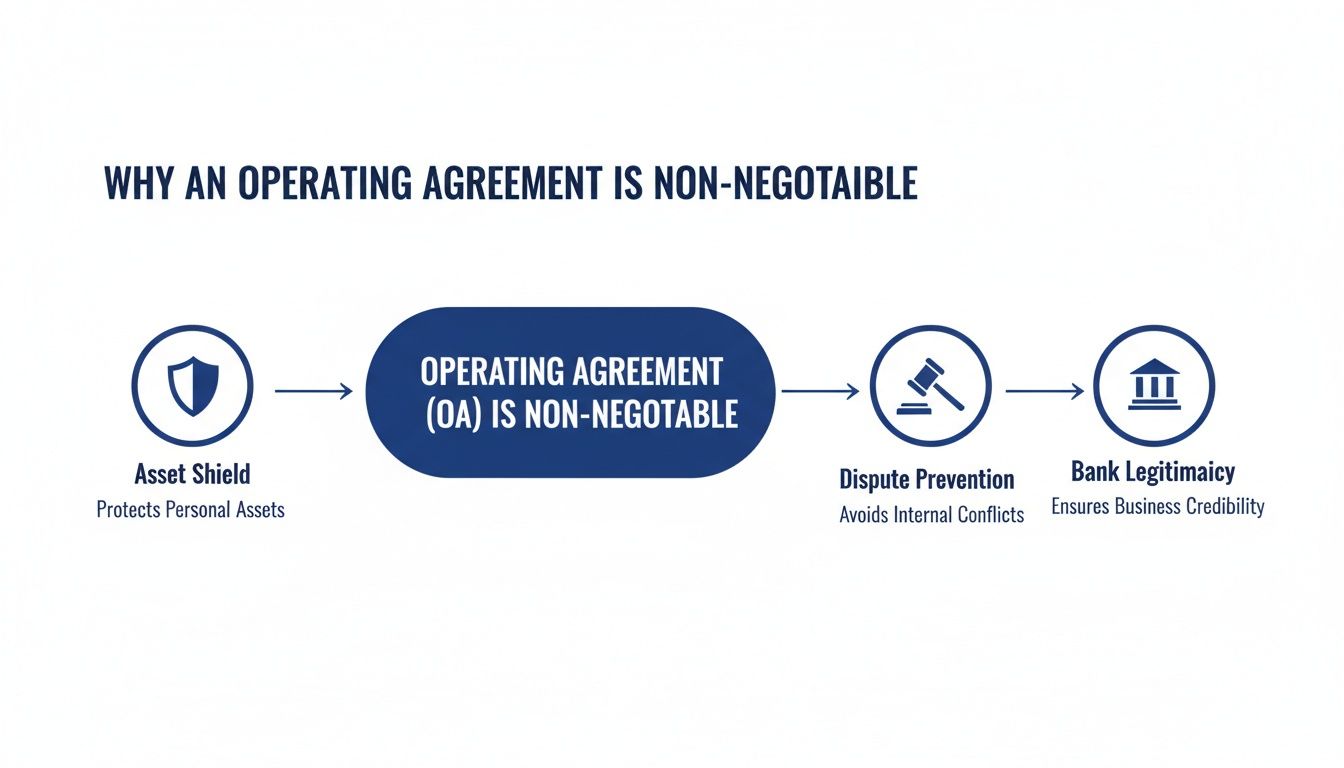
As you can see, a well-crafted agreement acts as a shield for your personal wealth, a rulebook for resolving internal disagreements, and a key that unlocks critical financial services in the U.S.
Membership and Ownership Percentages
This is the bedrock of your entire agreement. It officially lists every member (owner) of the LLC and, most importantly, defines their precise ownership stake as a percentage. For a non-resident founder, this is often the only internal document that proves your ownership of the U.S. entity.
Imagine a UK founder starts a U.S. LLC with a U.S.-based partner. The UK founder puts in 70% of the capital, while the American partner contributes 30% and handles the on-the-ground operations. This clause cements that ownership as a 70/30 split, leaving no room for confusion or arguments down the road.
Capital Contributions
Flowing directly from ownership, this clause details what each member has invested to earn their stake. And it’s not always cash. Capital can be property, services, or even intellectual property—as long as a clear monetary value is assigned to it.
This section should cover two key things:
Initial Contributions: What did everyone put in at the very beginning?
Additional Contributions: Can members be required to invest more money later on (often called a "capital call")? What happens if someone can't or won't chip in?
Getting this right is vital for tracking each member’s financial basis in the company, which has serious tax implications. It’s a transparent record of who funded the business and how.
Profit and Loss Distribution
Here’s where you spell out how the company’s financial gains (and losses) get divided. A lot of founders mistakenly assume profits must be split according to ownership percentage. That's not the case. Your operating agreement gives you the flexibility to do something different.
For instance, you might have that 70/30 ownership split, but you could agree to a 60/40 profit split for the first two years. Why? To reward the U.S. partner for their sweat equity in getting the business off the ground. This kind of custom arrangement is a major advantage of an LLC, but it has to be spelled out in the agreement.
This flexibility is a big reason why LLCs have become the go-to business structure in the U.S. In fact, records from the Texas Secretary of State show that LLCs now account for 73% of new business formations in 2024, easily outpacing corporations. For UK investors, the operating agreement is the document that governs these crucial financial mechanics, from profit allocations to how capital accounts are tracked for tax purposes. You can learn more about how LLC agreements dictate these financial rules on TailorBrands.com.
Management Structure and Voting Rights
This is where you decide who calls the shots and how decisions are made. For partners separated by an ocean, getting this clause right is one of the most important things you can do to prevent conflict.
You essentially have two choices:
Member-Managed: All the owners (members) have a direct say in day-to-day operations and major decisions. This works well for smaller LLCs where everyone is actively involved.
Manager-Managed: The members appoint one or more managers to run the company. These managers can be members themselves or hired outsiders. This structure is perfect for passive investors or when one partner has more operational expertise.
This section also needs to detail voting rights. Is it proportional to ownership (a 70% owner gets 70% of the vote)? Or does each member get one vote, regardless of their stake? What’s needed to pass a motion—a simple majority? You have to define these things.
Pro Tip: Clearly define which decisions require a simple majority (over 50%) versus a supermajority (e.g., 75% or even unanimous consent). You'll want to reserve supermajority votes for game-changing events like selling the company, merging with another, or shutting it down.
Transfer of Interests and Dissolution
Think of this as your business "prenup" and "last will" all rolled into one. The "transfer of interests" section (sometimes called buy-sell provisions) outlines what happens if a member wants to sell their share, passes away, or becomes disabled. It almost always gives the remaining members the right of first refusal to buy the departing member’s interest, which is critical for preventing a total stranger from becoming your new business partner overnight.
The dissolution clause provides a clear roadmap for winding down the business if it comes to that. It specifies the events that can trigger dissolution and outlines the step-by-step process for paying off debts and distributing any leftover assets. Having this all planned out in advance can save you a fortune in time and legal fees during what is already a stressful situation.
Tailoring Your Agreement for Your LLC Type
An operating agreement isn’t a one-size-fits-all document. Think of it this way: a solo guitarist needs a very different setup than a full rock band. The "rulebook" for a single-member LLC (SMLLC) serves a completely different purpose than one for a multi-member LLC. Getting this right is crucial for the agreement to be worth the paper it's written on.
For a UK founder running a solo U.S. venture, the agreement is all about building a rock-solid legal wall between you and the company. But when you have partners, it becomes more of a "business prenup"—a vital document that spells out how you'll work together, make decisions, and, if it comes to it, part ways.
The Focus for Single-Member LLCs
When you're the only owner, you might be thinking, "Why on earth do I need an agreement with myself?" The answer is simple: to prove your LLC is a legitimate, separate business entity.
Without this formal document, a court could decide your company is just an "alter ego" for your personal finances, putting your personal assets on the line. This is a nightmare scenario known as "piercing the corporate veil."
An operating agreement for a solo founder shores up this separation by:
Establishing Formal Procedures: It shows you have clear, documented rules for managing money and making decisions, even if you're the only one involved.
Providing Proof of Ownership: U.S. banks will almost certainly ask for this to open a business account, especially for a non-resident. It's your definitive proof of ownership.
Planning for the Future: It can outline what happens to the business if you become unable to manage it or pass away, giving your family a clear path forward.
For solo founders, this document is less about navigating partner disputes and more about building a legal fortress around your personal wealth. You can learn more about the specific needs of solo ventures in our guide to what a single-member LLC means for UK founders.
A single-member LLC operating agreement is your shield. It’s not for negotiating with partners, but for defending the legal wall between your business debts and your personal bank account.
The Focus for Multi-Member LLCs
For LLCs with two or more owners, the operating agreement takes on a much bigger role. It becomes the foundational text that governs the entire relationship between the members. It’s designed to get ahead of potential disagreements by creating a clear, pre-agreed framework for resolving them, stopping small issues from turning into costly legal battles.
Partnerships are incredibly common. IRS statistics from 2023 show that multi-member LLCs now represent 65% of all LLCs filed. Without a detailed agreement, you're stuck with generic state rules—which might dictate that profits and losses are split equally, even if one partner put in 90% of the capital and another only 10%. A solid agreement lets you define your own terms. The data backs this up: SBA research shows that LLCs with comprehensive agreements have a 40% lower dissolution rate in their first five years.
Operating Agreement Focus: Single vs. Multi-Member LLC
While the core clauses might look similar on the surface, their importance shifts dramatically depending on how many owners are involved. Here’s a quick comparison of the different priorities.
Clause Focus | Importance for Single-Member LLC | Importance for Multi-Member LLC |
|---|---|---|
Asset Protection | Critical. The agreement's main job is to reinforce the corporate veil and protect your personal wealth from business liabilities. | Important. It protects all members' personal assets but shares this priority with dispute prevention. |
Management Structure | Simple. You document your sole authority to make decisions, mainly for the benefit of outside parties like banks. | Critical. This section is heavily negotiated to define voting rights, decision-making powers, and day-to-day responsibilities. |
Profit Distribution | Straightforward. You simply outline how you, the sole owner, will take distributions from the company's profits. | Complex & Vital. This is a key area for defining custom profit and loss splits that may differ from ownership percentages. |
Buy-Sell Provisions | Succession-focused. Outlines what happens upon your death or disability, ensuring a smooth transition for your heirs. | Conflict-focused. A highly detailed "business prenup" that governs member exits, buyouts, and prevents unwanted partners. |
Ultimately, a single-member agreement acts as a declaration of independence for your business. In contrast, a multi-member agreement is a treaty between partners, built to keep the peace and light the way through any challenge that comes your way.
Putting Your Operating Agreement to Work

So, you’ve got this document. Don't just file it away and forget about it. Your operating agreement is a living, breathing tool that opens critical doors for your U.S. business. It’s what transforms your LLC from a piece of paper filed with the state into a legitimate, functional company ready for the real world—from opening a bank account to landing that first big investment.
For founders based in the UK, its practical importance kicks in almost immediately. Many of the first, most essential steps you'll take to get your U.S. operations off the ground will hinge on having this agreement buttoned up and ready to show.
Opening a U.S. Business Bank Account
One of the first, and sometimes most frustrating, tasks for a non-resident founder is getting a U.S. business bank account. You absolutely need one to handle U.S. revenue and expenses cleanly. But U.S. banks are incredibly thorough, especially when dealing with foreign-owned companies, thanks to strict anti-money laundering rules.
They need to know, without a shadow of a doubt, who owns and runs the company. Since the state's LLC registration often doesn't list the owners, your signed operating agreement becomes the primary piece of evidence. It lays out the members, their ownership stakes, and who's in charge, giving the bank the official proof it needs to open your account.
For a U.S. bank, an LLC without an operating agreement is a major red flag. Handing one over shows you're professional and transparent—exactly the kind of client they want to build a relationship with.
Securing Your Employer Identification Number (EIN)
Next up is getting an Employer Identification Number (EIN) from the IRS. Think of it as your company's tax ID number. You’ll need it to file taxes, hire employees, and, you guessed it, open that bank account. While you don’t always have to physically submit the operating agreement with the application, the document is the legal source of truth for the information you provide.
Your operating agreement backs up key details on the EIN form:
It proves how many members you have, which helps the IRS classify your LLC for tax purposes.
It identifies the "responsible party"—the person with ultimate control over the business, a mandatory field on the application.
Having a solid agreement ensures your application is accurate and lines up with your legal structure, heading off potential delays or headaches with the IRS later on.
Attracting Investors and Venture Capital
Down the line, you might start looking for funding from U.S. investors or venture capital (VC) firms. This is where your operating agreement really shines. Let me be clear: serious investors will not put money into a business that has a weak or nonexistent governance structure.
Before they even glance at your pitch deck, savvy investors will start their due diligence, and your operating agreement is one of the very first documents they’ll ask for. They need to see a clear, legally-sound blueprint that defines:
Ownership and Equity: Who owns what percentage of the company.
Decision-Making Authority: How big decisions are made and who gets a vote.
Profit Distribution: How profits are paid out to the members.
Investor Rights: The process for bringing on new members and what rights they'll have.
A well-drafted operating agreement sends a powerful signal that you’re a serious founder who has thought through the hard parts of running a business. It gives investors the legal certainty they demand before cutting a check, making it one of the most important tools you have for growth.
How to Create Your LLC Operating Agreement
So, you need to get your operating agreement sorted. When it comes to actually creating this crucial rulebook for your LLC, you've really got two main options: grabbing a template online or bringing in a professional.
Which path you choose can have a real, lasting impact on your company's health down the road, so it’s worth thinking about carefully.
The Problem with Templates
Look, I get it. A template seems like the quick and easy win. It’s cheap, it’s fast, and it lets you tick a box. But this is often a classic case of "you get what you pay for." A generic template can't possibly understand the specifics of your business, the dynamics between you and your co-founders, or the unique hurdles you'll face as a UK founder setting up in the US.
Think of it like buying a suit off the rack. It might technically fit, but it won't look or feel right.
For a super simple, single-member LLC run by a US resident with no big plans for growth, a template might do the job. But for ambitious founders, especially those of you coming from the UK, the risks can quickly eclipse any initial savings.
Here’s where they really fall short:
One-Size-Fits-None: Templates are notoriously bad at handling anything beyond the absolute basics. Need to set up complex profit-sharing? Define specific management roles? What about a clear, fair process if a partner wants to leave? A template won't help you there.
Blind to Cross-Border Issues: These documents are almost always written with US residents in mind. They completely ignore the tax and legal minefield that non-resident owners have to navigate. This can leave you wide open to serious compliance headaches with both the IRS and HMRC.
A Major Red Flag for Investors: Serious US investors can spot a boilerplate operating agreement from a mile away. It tells them you haven't done your homework or invested in a solid legal foundation. That's not the first impression you want to make when asking for their money.
Why Professional Guidance Is a Smart Investment
Hiring a specialist to draft your operating agreement isn't just another startup cost; it's one of the smartest early investments you can make in your company’s future. It’s about building a document that actively protects you and paves the way for your goals.
For UK founders, this is non-negotiable. A professional will ensure your agreement is set up for dual compliance. For example, they can help you make the right US tax elections—like choosing to be taxed as a partnership and filing a Form 1065—in a way that works seamlessly with your UK tax obligations. You can read more about how these startup documents impact compliance on Carta.com. Getting this right from day one is absolutely critical.
A professionally drafted operating agreement is more than just a legal formality—it’s a strategic asset. It's the key that unlocks your US bank account, helps you secure an EIN, and gives you the credibility to approach investors with confidence.
Ultimately, while a template offers a tempting shortcut, professional guidance gives you a rock-solid foundation. This is especially true when you're navigating the complexities of launching a US company from overseas. It ensures your business is built to last, giving you the peace of mind you need to focus on growth.
This foundational document is also a prerequisite for other essential steps, like getting your tax ID, which you can learn all about in our complete guide to getting an EIN.
Common Questions About Operating Agreements
Even once you grasp the basics, a few specific questions always seem to pop up when it's time to actually create an operating agreement. For founders based in the UK, these questions can feel especially pressing. Let's walk through some of the most common ones so you can move forward with confidence.
Do I Have to File My Operating Agreement With the State?
Nope. This is probably one of the biggest misconceptions out there. The operating agreement is a strictly internal document for your LLC. It doesn't get filed with the Secretary of State or any other government body.
Just keep a signed copy tucked away with your company's official records. This privacy is a huge benefit, as it keeps the sensitive inner workings of your business—like ownership percentages and financial arrangements—out of the public eye.
Can I Change My Operating Agreement Later?
Yes, and you absolutely should. Think of your operating agreement not as a stone tablet, but as a living document. It's meant to grow and adapt right along with your business.
You can—and should—amend it whenever something significant changes. This might happen when you're:
Adding a new partner or buying out an existing one.
Changing how you split up profits and losses.
Shifting management duties or member responsibilities.
Bringing on a major new investor.
A good agreement will spell out the exact process for making these changes, which keeps everything smooth and prevents future arguments.
A well-drafted operating agreement will always include a clause detailing how to properly amend the document. This prevents disputes by ensuring everyone follows the same protocol for making changes.
What Happens if My Agreement Contradicts State Law?
This is a great question. A well-written operating agreement customizes your LLC's rules within the framework of state law. While its job is often to override a state's default rules (like forcing a 50/50 profit split for two members), it can't contain anything illegal or that goes against public policy.
That's why most agreements include what’s called a "severability clause." It’s a smart legal provision that basically says if one part of the agreement is found to be illegal or unenforceable, the rest of the document still stands. This handy little clause protects your entire agreement from being invalidated because of one bad apple.
Navigating the specifics of a U.S. operating agreement from the UK can feel complex, but it's a critical step for protecting your business. The expert team at Set Up Stateside specializes in drafting compliant, strategic agreements for non-resident founders. Learn how we can build a solid foundation for your U.S. success.


Comments