

What Is a Single Member LLC for UK Founders in the US

So, you're a UK founder eyeing the massive U.S. market and wondering how to get started. Let's talk about one of the most popular and practical ways to do it: setting up a single-member LLC (SMLLC).
Think of it like this: an SMLLC is a U.S. business structure owned by just one person (that’s you!) that builds a legal wall between your personal finances and your business debts. It’s conceptually similar to a Limited Company back home in the UK, offering that same crucial peace of mind.
Your US Business Shield Explained

For a UK entrepreneur, getting a handle on what a single-member LLC is isn't just a technicality—it's your first move in building a credible and secure American presence. The whole point of an LLC is to create a legal barrier, treating your business as its own separate "person."
If this business "person" gets into debt or faces a lawsuit, creditors can typically only chase the business's assets. Your personal savings, your home, your car? They're generally off-limits. This is called limited liability protection, and it’s the single biggest reason founders choose an LLC over simply operating as a sole trader, where no such line exists.
The Power of the Business Shield
This separation isn't just some legal footnote; it’s a powerful tool for managing risk. Without this business shield, every business decision is a personal gamble. An SMLLC draws a clear line in the sand, letting you grow your U.S. venture with confidence, knowing you’ve protected what you’ve worked so hard for personally.
Here's a quick rundown of what makes an SMLLC what it is:
One Owner: Just as it says on the tin, it’s built for a solo founder, or "member."
Legal Separation: The law views your business as a distinct legal entity, separate from you.
Asset Protection: This is the big one—it shields your personal assets from business liabilities.
This structure provides a fantastic foundation, but the real magic for UK founders lies in how the U.S. tax system treats it.
A single-member LLC gives you the operational simplicity of a sole proprietorship combined with the powerful liability protection you'd get from a corporation. It's a hybrid that makes it the perfect launchpad for international founders testing the U.S. waters.
To give you a clearer picture, here’s a quick summary of what an SMLLC means for you.
SMLLC at a Glance for UK Founders
Feature | What It Means for a UK Founder |
|---|---|
Liability Protection | Your personal assets (like your home in the UK) are protected from U.S. business debts. |
Ownership | Perfect for solo entrepreneurs, as it's designed for a single owner (member). |
Tax Status (Default) | Treated as a "disregarded entity." Profits pass through to you, avoiding U.S. corporate taxes. |
Credibility | Establishes a formal U.S. business presence, which helps with banking, payments, and partners. |
Flexibility | You can choose to be taxed as a corporation later if it becomes more beneficial. |
This table shows why the SMLLC is such a popular choice, but that "disregarded entity" feature is worth a closer look.
Introducing the Disregarded Entity
Now for the most important concept you need to grasp: the SMLLC's default tax status with the Internal Revenue Service (IRS). For tax purposes, the IRS automatically treats an SMLLC as a "disregarded entity."
It sounds a bit strange, but it’s actually designed to make your life simpler. Being a "disregarded entity" means the IRS essentially looks right through the LLC and sees you, the owner. Your business doesn't file its own separate corporate tax return.
Instead, all profits and losses "pass through" directly to your personal U.S. tax filings. This setup smartly avoids the "double taxation" nightmare common with corporations, where the company is taxed on profits, and then shareholders are taxed again on dividends. For a non-resident founder, this streamlined approach is a huge win, cutting down on paperwork and making your U.S. tax obligations far more manageable right from the start.
How Your Single-Member LLC is Taxed: The “Disregarded Entity”
A single-member LLC gives you that crucial layer of legal protection, but its real magic for a UK founder is how it's treated by the IRS at tax time. By default, the U.S. tax system gives your SMLLC a special status that makes managing cross-border taxes so much simpler. It's called a "disregarded entity."
It's a weird name, I know. But the idea behind it is incredibly straightforward. For tax purposes, the IRS simply pretends your LLC doesn't exist as a separate, taxable thing. It looks right through the business and sees you, the owner.
Think of it like this: your LLC is a transparent vault. The vault itself is tough and secure—it holds all your business assets and liabilities, shielding your personal finances. But when the IRS comes to collect taxes, they can see straight through the vault's walls to the money inside. They don’t tax the vault; they tax you on the income that’s sitting in it.
What “Pass-Through” Taxation Really Means
This "look-through" approach is what's known as pass-through taxation. Your business profits and losses literally "pass through" the LLC and land directly on your personal U.S. tax return.
Unlike a big corporation that has to file its own complex corporate tax return, your SMLLC’s financials are reported by you. As a UK founder, you'll typically handle this using Form 1040-NR (the U.S. Nonresident Alien Income Tax Return). It's the cleanest, most efficient way for most UK entrepreneurs to get started in the States.
The biggest win here? You avoid the dreaded double taxation. With a traditional U.S. C Corporation, your money gets taxed twice:
First, the corporation earns a profit and pays corporate income tax.
Then, when it pays you a dividend from what's left, you get taxed again on that income on your personal return.
The disregarded entity status slices that first layer of corporate tax right off the top. Your profits only get taxed once in the U.S., at your personal rate.
SMLLC vs. Corporate Tax: A Quick Comparison
Let's lay it out side-by-side to see just how different the default SMLLC is from a classic corporation.
Feature | Single-Member LLC (Disregarded Entity) | C Corporation |
|---|---|---|
Business Tax Return | None at the federal level. Everything goes on your personal U.S. tax return. | Files its own corporate return (Form 1120) and pays corporate tax directly. |
Taxation of Profits | Profits "pass through" and are taxed just once on your personal return. | Profits are hit twice: first at the corporate level, then again when paid to you as a dividend. |
Complexity | Far simpler. Fewer forms, less paperwork, and a much more direct process for a solo owner. | Much more complicated. Requires separate accounting and tax filings, driving up admin costs and headaches. |
This default setup is a massive advantage. You get the legal shield of a proper company without the tax nightmare of a full-blown corporation. It's the perfect hybrid for UK founders testing the U.S. market.
What If My Business Grows? You Can Change Your Tax Status
One of the best things about an LLC is its flexibility. That "disregarded entity" status is just the starting point—it's not set in stone. As your business scales and your finances get more involved, there might come a time when the default setup is no longer the most tax-efficient path.
The good news is the IRS lets you elect to have your LLC taxed differently. You can file a form to be treated as an S Corporation or a C Corporation. This can unlock some serious tax savings down the road, especially when your profits start to climb.
For instance, making an S Corp election could let you pay yourself a "reasonable salary" while taking the rest of your profits as distributions, which aren't subject to hefty self-employment taxes. But be warned: this adds a new layer of complexity and isn't the right move for every non-resident founder.
Switching your tax election is a major strategic decision, not something to be taken lightly. Before you even consider it, you absolutely must speak with a tax professional who gets both U.S. and UK tax law. For now, as you're starting out, the simple, powerful, and efficient "disregarded entity" status is almost certainly your best bet.
Weighing the Pros and Cons for UK Founders
Deciding to set up a single-member LLC in the U.S. is a big move for any UK entrepreneur. It's your ticket into one of the world's largest markets, but it comes with its own set of rules and challenges. Let's break down what you’re getting into—the good and the not-so-good—so you can make the right call for your business.
The biggest draw, without a doubt, is the limited liability protection. Think of it as a legal firewall. It separates your U.S. business dealings from your personal life back home. If the American side of your business runs into debt or faces a lawsuit, your house, personal savings, and other assets in the UK are generally kept safe. That peace of mind is huge.
The Upside: Why a US LLC Makes Sense
Beyond just protecting your assets, having a formal U.S. entity gives your business instant credibility. American customers, suppliers, and especially payment gateways like Stripe or PayPal feel much more comfortable dealing with a registered U.S. company. It shows you're serious and established, which can make all the difference when you're trying to win trust from across the pond.
This professional polish isn't just for show—it makes day-to-day operations much easier. Landing U.S. clients or getting approved for essential business tools often goes a lot smoother when you have that ".llc" after your name.
Another major plus is how simple an SMLLC is to run. It was designed for solo operators, so it ditches the stuffy corporate formalities. That means:
No board meetings: You don't have to pretend to hold and minute a board meeting with yourself.
Less paperwork: The record-keeping is far more relaxed than what's required for a full-blown corporation.
You're the boss: Every decision is yours. There are no convoluted approval processes to slow you down.
This simplicity is a lifesaver when you're managing everything from thousands of miles away. It lets you spend your time actually growing the business, not drowning in corporate paperwork.
The Hurdles: What to Watch Out For
Now for the reality check. The journey isn't always smooth sailing. One of the first and biggest headaches for UK founders is opening a U.S. business bank account. While things are getting better with online-first banks, many traditional U.S. banks still insist you show up in person. This takes careful planning, and you'll likely need to lean on modern fintech solutions or specialized services built for international founders.
Then there's the cross-border tax puzzle. The U.S.-UK tax treaty is there to save you from being taxed twice on the same income, but it’s not automatic. You have to navigate the filing rules for both the IRS in the U.S. and HMRC in the UK. Getting this right usually means hiring a professional who understands both systems.
Don’t underestimate the admin. You'll need to keep on top of state annual reports, registered agent fees, and critical U.S. tax deadlines. It's a different system with its own rhythm, and staying organized is key to avoiding penalties.
You're also stepping into a massive and competitive arena. As of May 2025, there are around 10.2 million unincorporated self-employed individuals in the U.S., a group that includes sole proprietors and SMLLC owners. Together, they generated a staggering $410.7 billion in net income. You can get a better sense of this vibrant market by checking out the latest data on the self-employed economy in America.
Ultimately, whether an SMLLC is the right fit depends on your business, your appetite for risk, and your goals for the U.S. market.
Weighing the Pros and Cons of an SMLLC
To help you decide, here’s a straightforward comparison of what you stand to gain versus the challenges you'll need to prepare for.
Key Advantages | Potential Disadvantages |
|---|---|
Protects Your Personal Assets – Keeps your UK home and savings separate from U.S. business debts. | U.S. Bank Account Hurdles – Many banks require an in-person visit, creating a significant logistical challenge. |
Boosts U.S. Credibility – A formal U.S. entity makes it easier to work with American clients and partners. | Complex Cross-Border Taxes – You'll need to navigate both IRS and HMRC rules and correctly apply the U.S.-UK tax treaty. |
Simple to Manage – No mandatory board meetings or excessive corporate paperwork to worry about. | Heavier Admin Load – Requires staying on top of U.S. compliance, including annual reports and registered agent fees. |
Total Control – As the sole owner, you make all the decisions quickly and without formal approval. | Potential for Higher Costs – Professional help for accounting and legal compliance is often necessary and adds to your expenses. |
Flexible Taxation – You can choose how your LLC is taxed, offering potential savings. | Requires a U.S. Presence – You must maintain a registered agent and a U.S. address, which comes with ongoing costs. |
The SMLLC offers a powerful and flexible way to enter the U.S. market. But as you can see, success hinges on being fully prepared for the unique responsibilities that come with operating a business in another country.
How to Form Your US Single-Member LLC from the UK
Taking the leap to form a U.S. business from the UK might sound intimidating, but setting up a single-member LLC is actually a pretty straightforward, step-by-step process. When you break it down into manageable chunks, the guesswork disappears, and you're left with a clear roadmap for a smooth launch.
The whole journey comes down to a specific legal and administrative checklist. Each step builds on the one before it, from picking your LLC’s "home state" to getting that all-important tax ID number. With a bit of planning, you can handle it all efficiently, even from across the Atlantic.
Step 1: Choose the Right State
Your first big decision isn't if you should form an LLC, but where. Every U.S. state has its own unique set of rules, fees, and tax laws, making this a choice with real long-term consequences. The good news? You don't have to choose the state where you plan to do most of your business.
For founders living outside the U.S., a few states are perennial favorites thanks to their business-friendly environments:
Wyoming: A top contender for its strong privacy protections, low annual fees, and the big one—no state income tax on corporate or personal income.
Delaware: Famous for its deeply established and respected corporate law system (the Court of Chancery), which makes it the gold standard for businesses that might seek venture capital down the road.
New Mexico: Gaining popularity for offering excellent privacy and having no annual reporting requirements, which cuts down on your ongoing admin.
Step 2: Appoint a Registered Agent
Since you don’t have a physical address in the U.S., you are legally required to appoint a Registered Agent. Think of this person or service as your LLC's official point of contact on U.S. soil. Their job is to receive legal documents, tax notices, and any official mail from the government on your behalf.
This isn't a job you can give to a friend. Using a professional Registered Agent service is non-negotiable; it ensures that critical, time-sensitive documents are received and forwarded to you immediately. This service is a mandatory part of keeping your LLC in good legal standing.
Step 3: File the Articles of Organization
With your state and Registered Agent sorted, it's time to make it official. You’ll register your LLC by filing a document called the Articles of Organization with the Secretary of State (or an equivalent office) in your chosen state.
This is the foundational document that formally creates your business. It's usually quite simple, including basic info like your LLC's name, its U.S. address (which your Registered Agent provides), and the agent's name. Once the state gives it the green light, your LLC legally exists.
This graphic breaks down the key benefits and potential drawbacks you'll want to weigh.
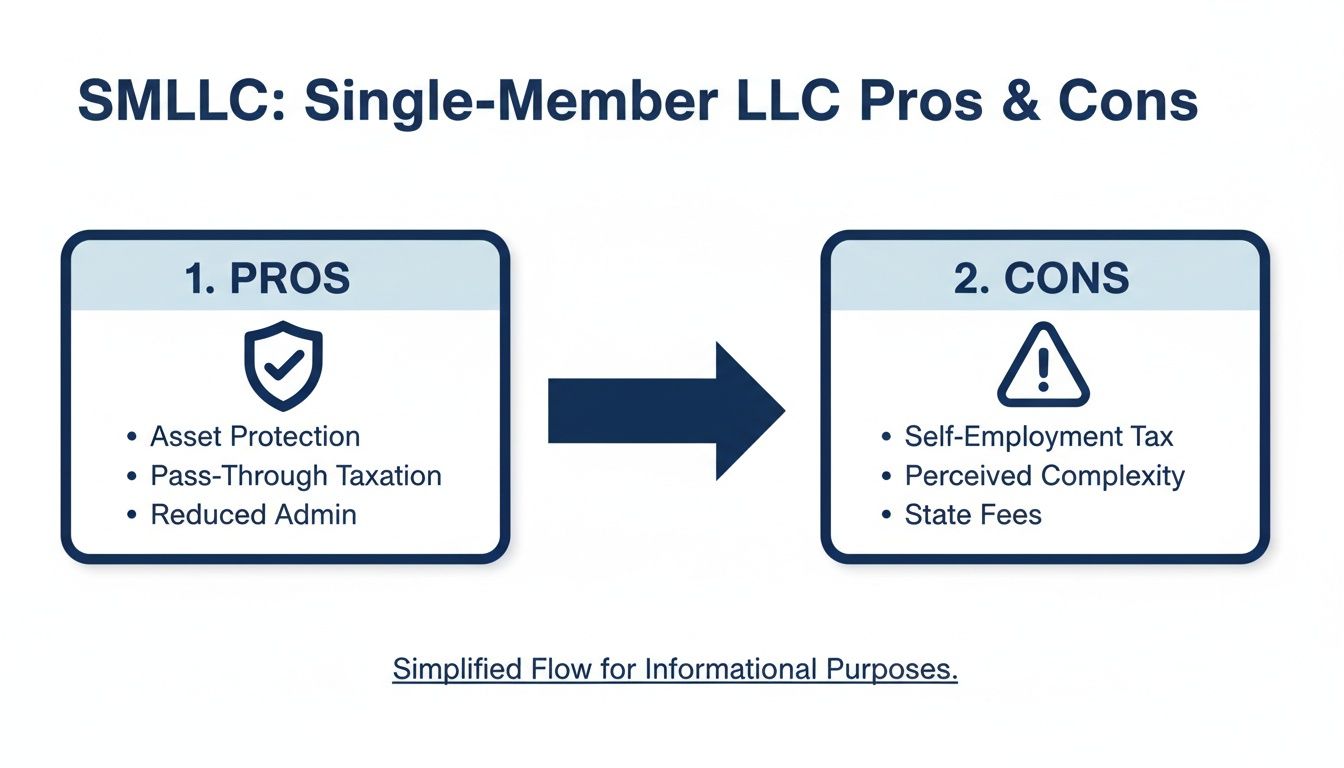
As you can see, the liability protection is the main draw, while the administrative upkeep is the primary trade-off you'll need to manage.
Step 4: Get Your Employer Identification Number (EIN)
As soon as your LLC is approved, you need to get an Employer Identification Number (EIN) from the IRS. An EIN is a unique nine-digit number that works like a Social Security Number for your business. For a non-resident founder, it's absolutely essential.
You'll need an EIN to do just about anything:
Open a U.S. business bank account
File your required U.S. taxes
Work with payment processors like Stripe and other U.S. vendors
The process for a non-resident to get an EIN is different from a U.S. citizen's and involves carefully handling specific IRS forms. It's the critical step that truly unlocks your ability to operate financially in the U.S. market.
Step 5: Draft an Operating Agreement
Finally, even though you're the only owner, you should absolutely create an Operating Agreement. This is an internal document that lays out the rules for how your LLC will be run. It defines your ownership, responsibilities, and how you'll handle key business decisions.
An Operating Agreement is like the constitution for your company. It proves that you are treating the LLC as a separate legal entity, which reinforces the liability protection that is so valuable.
This document is your best evidence for proving the separation between you and your business—a vital piece for keeping your personal assets protected. For a more detailed walkthrough, check out our complete guide to forming an LLC from abroad.
Managing Your US and UK Tax Obligations
Running a US single-member LLC as a UK founder means you'll be dealing with two tax authorities: the IRS in the US and HMRC back home. Getting this right isn’t just about paying what you owe; it’s about correctly reporting your business activities to both countries, even when no tax is due.
Because your LLC is treated as a "disregarded entity" with a non-resident owner, the IRS has specific rules to ensure transparency. Even if your LLC doesn't owe a dime in US tax, you’ll still need to file informational returns.
This is where Forms 1120 and 5472 enter the picture. You file these together to report any transactions between you (the foreign owner) and your US company. Think of it as a disclosure form that keeps the IRS in the loop about your financial relationship and ensures everything is transparent.
Key US Filing Requirements
As a UK founder, you have a few non-negotiable filing deadlines to meet in the US each year. Missing them can lead to hefty penalties, even if you owe zero tax, so it’s something you want to get right from the start.
Your main reporting duties will likely be:
Form 1120 & Form 5472: These are your main informational returns, filed to disclose the foreign ownership of your US LLC and report any relevant transactions between you and the company.
Form 1040-NR: If your business generates income that is "Effectively Connected with a US Trade or Business" (ECI), you'll need to file this non-resident personal tax return to report it.
Remember, getting an Employer Identification Number (EIN) is your first step. It's the key that unlocks your ability to file these forms and operate compliantly. You can dig deeper into what an EIN is and why you need one in our detailed guide.
Preventing Double Taxation with the US-UK Tax Treaty
The biggest worry for most founders expanding internationally is getting taxed twice on the same income. Nobody wants to pay tax to the IRS and then pay HMRC again on the exact same profits.
Thankfully, the US-UK tax treaty is designed to stop this from happening.
The treaty operates on a simple credit system. In most cases, any income tax you pay to the IRS on your US business earnings can be claimed as a foreign tax credit on your UK self-assessment tax return.
In plain English, HMRC gives you a credit for the tax you’ve already paid in the States. This prevents you from being taxed twice on the same pound of profit and makes your cross-border business financially sustainable.
This tax treaty is a major reason why the single-member LLC is such a popular choice for international founders. The numbers tell the story: in 2021, a staggering 3.5 million single-member LLC returns were filed with the IRS. That's a massive leap from just 126,000 back in 2001. You can get more insights on this trend and find out why sole proprietorships are on the rise.
Navigating these forms and treaty rules can feel overwhelming. The smartest move is to work with a tax advisor who knows both the US and UK systems inside and out. They can make sure you stay compliant and use the tax treaty to your full advantage, keeping things clear on both sides of the Atlantic.
Your First Steps After Formation

Congratulations, your LLC is officially formed! You've laid the legal groundwork. But now the real work begins—building the operational side of your business so you can actually get paid and start growing in the U.S. market.
The very first thing you need to tackle is opening a U.S. business bank account. I can't stress this enough: it's not optional. This is what keeps your business funds separate from your personal money, which is the entire point of the liability protection an LLC offers. Don't even think about running business transactions through your personal UK account; you'd be putting that legal shield at risk.
For a founder based in the UK, this step can feel like a huge hurdle. Most traditional American banks will want you to show up in person, which is hardly practical. Thankfully, a new wave of online banking platforms and fintech companies has stepped up to serve international entrepreneurs just like you.
Opening Your US Business Bank Account
To get this done from the UK, you’ll need to have your documents in order. Get your approved Articles of Organization, your EIN confirmation letter from the IRS, and your passport ready. The best modern banking partners know what global founders need and have built their entire onboarding process around it.
These services are designed specifically to get you banking in the U.S. without needing a plane ticket. For a deep dive into the process, check out our guide on how to open a U.S. bank account online as a non-resident, where we walk you through everything.
Once that account is open, it’s time to get your books in order from day one.
Mastering Your Bookkeeping and Sales Tax
Keeping clean, accurate financial records isn't just "good business." It's a legal requirement and your best friend when it comes to proving your LLC is a legitimate, separate entity. Using accounting software like QuickBooks or Xero is the only sane way to track every dollar coming in and going out.
This financial discipline is especially important once you start selling to U.S. customers, because you’re about to meet the wonderful world of American sales tax.
The key concept you need to understand is 'economic nexus'. This is a real game-changer. It means your business can be legally required to collect and pay sales tax in a state even if you have no office or staff there. All it takes is crossing a certain sales or transaction threshold.
Every state makes its own rules, with different rates and thresholds, which creates a messy compliance patchwork you have to navigate. For instance, a state might declare you have nexus if you make over $100,000 in sales or have 200 separate transactions there in a year.
Getting this wrong can lead to a world of pain in the form of back taxes and penalties. Here's what you need to stay on top of:
Track Sales by State: You have to know exactly how much you're selling into each individual state.
Know the Triggers: Research and understand the specific economic nexus thresholds for the states you sell to.
Get Registered: As soon as you hit nexus in a state, you must register for a sales tax permit there.
Collect & Pay Up: You'll then need to correctly calculate, collect, and file sales tax returns on that state's schedule.
For a UK founder, managing U.S. sales tax is a massive operational lift. Getting expert advice right from the start is the smartest investment you can make to avoid costly blunders down the road.
Frequently Asked Questions for UK Founders
It’s completely normal to have a ton of questions when you're in the UK looking to set up a business across the pond. After you’ve gotten your head around what a single-member LLC is, the practical questions start popping up. Let's tackle some of the most common ones we hear from founders just like you.
Can I Add a Business Partner Later?
Yes, absolutely. Starting as a single-member LLC doesn't lock you into a solo venture forever. Think of it as a flexible starting point.
When the time comes to bring on a co-founder, you simply transition your business into a multi-member LLC. This involves filing an amendment with the state and, crucially, drafting a brand-new operating agreement. This new agreement is your partnership playbook—it spells out who owns what percentage, who’s responsible for what, and how profits are shared. Getting that right is key to a healthy partnership.
Do I Need a US Visa to Own an SMLLC?
Nope, not at all. You can legally form and own a US company from your living room in London without needing a visa. Owning a business is a separate issue from your immigration status.
The visa conversation only starts if you plan to move to the US to actively run your company from there. But for managing your LLC remotely from the UK, you’re all clear.
Key Takeaway: Remember, owning a US company and working in the US are two different things. You can own the business from anywhere, but physically working on US soil requires the right immigration papers.
What Are the Ongoing Annual Compliance Costs?
Keeping your LLC in good standing involves a few yearly costs. It's smart to budget for these from the get-go to avoid any surprises and protect your liability shield.
You should plan for three main recurring expenses:
State Annual Report Fee: Most states will ask for an annual or biennial report to keep your company's info current. The fee usually runs between $50 to a few hundred dollars.
Registered Agent Fee: As a non-resident, you must have a registered agent. A professional service for this typically costs $100 to $300 per year.
Tax Preparation Fees: This is a big one. You'll need an expert to handle your US informational returns (like Forms 5472 and 1120) and potentially a non-resident tax return (1040-NR). It's a non-negotiable cost for getting things right with the IRS.
How Exactly Does an SMLLC Protect My Personal Assets?
This is the magic of the LLC. It creates what lawyers call the "corporate veil"—a legal wall between your personal life and your business life.
Imagine your UK home, your personal savings, and your car are all on one side of this wall. Your business, its bank account, and its inventory are on the other. If the business gets into debt or faces a lawsuit, creditors can generally only go after the assets on the business side of the wall. Your personal stuff is protected, as long as you keep that separation clean by never mixing personal and business funds.
Answering these questions is the first step, but it’s just the beginning. The team at Set Up Stateside lives and breathes this stuff, helping UK founders navigate every part of the process, from picking a state to filing the right tax forms. Let us help you build your US business with confidence.


Comments