

Your Expert Guide to Opening a U.S. Bank Account Online for Non-Residents

Absolutely. For international business owners, opening a US bank account online is not just a possibility—it's an achievable goal, even without a Social Security Number (SSN). The key lies in first establishing a U.S. business entity, such as an LLC or a C Corporation. With your company formed, you can secure an Employer Identification Number (EIN) from the IRS. This EIN effectively serves as the business equivalent of an SSN for banking purposes, unlocking access to both traditional U.S. banks and modern fintech platforms designed for global founders.
Your Guide to US Banking for Global Founders
For any international entrepreneur operating a U.S. LLC or corporation, a U.S. bank account is the operational heart of your venture. It is the essential tool for accepting payments from U.S. customers, managing invoices with American vendors, and maintaining a clear separation between your business and personal finances for compliance and tax purposes.
Unfortunately, a common myth stops many founders in their tracks: the belief that you must be physically present in the U.S. or possess an SSN to open an account.
This guide is designed to dismantle that myth. We will provide a clear, step-by-step framework to demonstrate how, with the right strategy and preparation, you can successfully open a U.S. bank account from anywhere in the world.
Busting the Myth of the SSN Requirement
The SSN requirement is the most significant perceived obstacle for non-resident business owners. While having one can simplify the process with legacy banking institutions, it is not an absolute barrier. The financial industry has evolved to accommodate the realities of global commerce, and numerous institutions now offer clear pathways for international entrepreneurs to access the U.S. market.
This evolution is largely driven by advancements in identity verification technology. Modern Know Your Customer (KYC) protocols enable banks to securely confirm your identity without requiring you to ever step foot in a physical branch.
Your Business Entity Is the First Step
Before you begin comparing banking options, the foundational first step is to establish a formal U.S. business entity. This action provides your enterprise with a legal and financial footprint in the United States and is a mandatory prerequisite for obtaining an EIN.
Your U.S. company is the foundation upon which your banking relationship is built. Banks open accounts for legitimate U.S. businesses, and as the owner, you simply need to prove your identity and your connection to that legally formed entity.
For the majority of non-U.S. residents, forming an LLC is often the most efficient and flexible structure. Our firm has assisted countless clients in successfully leveraging this entity type. You can find a detailed breakdown in our complete guide to forming an LLC from abroad.
Once your business is officially registered and you have secured your EIN, you are ready to engage with banks and fintech platforms. This guide will walk you through the remaining steps—from document preparation to selecting the right financial partner—enabling you to confidently access the U.S. financial ecosystem from your home country.
Getting Your Paperwork in Order: Your Application Checklist
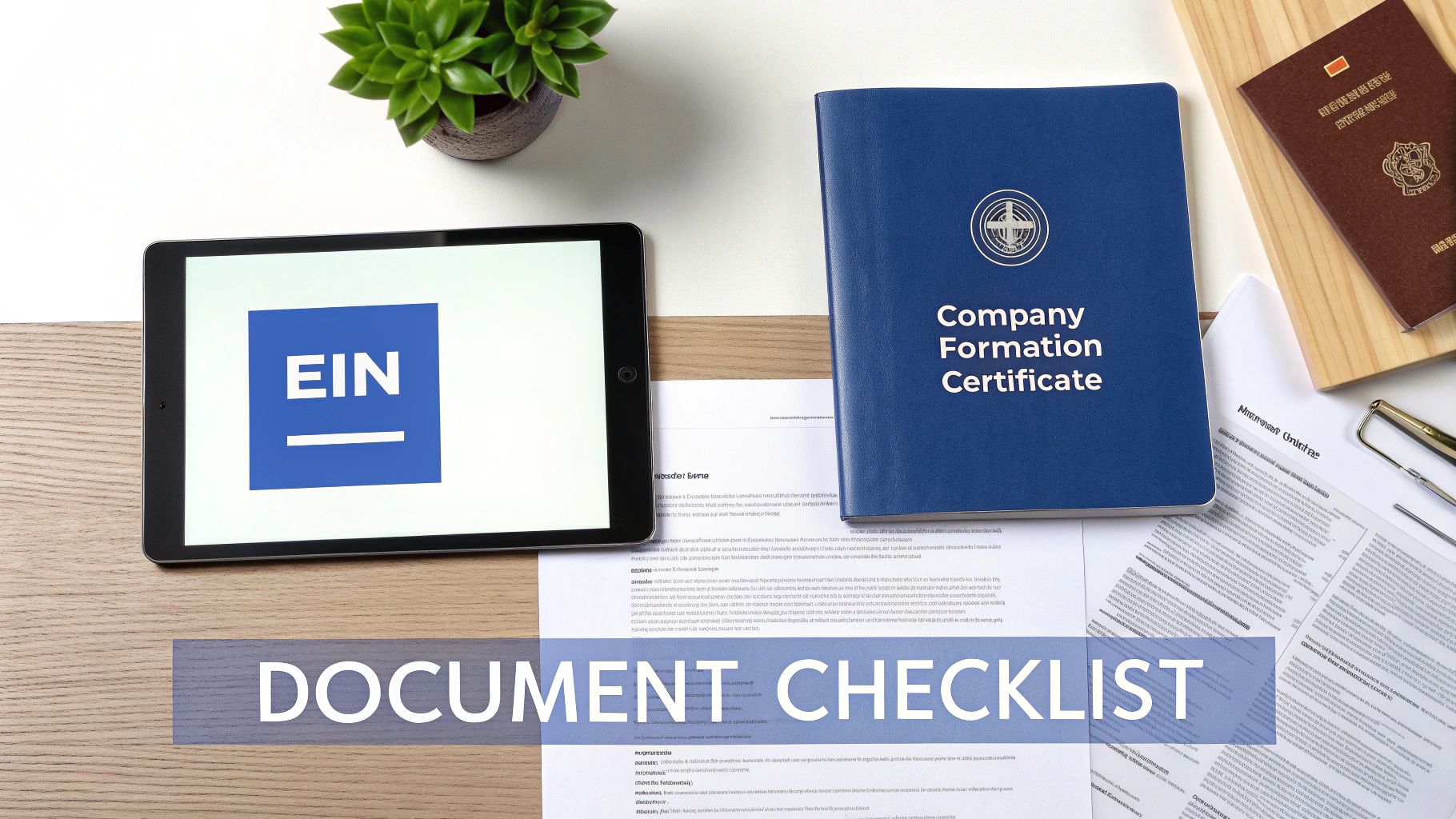
Before initiating any application, meticulous document preparation is the single most critical action you can take. Submitting a request to open a U.S. bank account online as a non-resident is not merely a data entry task; it is about presenting a comprehensive, professional package that establishes immediate credibility and trust with a financial institution.
Consider the process from the bank's perspective: their compliance teams are trained to identify risk and potential red flags. Your objective is to provide them with a flawless application that leaves no room for doubt regarding your business's legitimacy.
Let's review the precise documentation you will need.
Proving Your Business is Real: U.S. Company Formation Documents
The first and most fundamental requirement from any bank is proof that your U.S. company exists and is in good standing with its state of formation. This is the bedrock of your entire application and is non-negotiable.
Depending on your business structure, you will need to provide high-quality digital copies of:
Articles of Organization (for an LLC): This is the official document filed with the state that legally established your LLC.
Certificate of Incorporation (for a Corporation): The corporate equivalent of the Articles, confirming your C Corp or S Corp is legally registered.
Operating Agreement or Bylaws: This internal governance document is crucial. It outlines the ownership structure and, most importantly, identifies who has the legal authority to open a bank account on the company's behalf.
Without these foundational documents, your application cannot proceed.
The Golden Ticket: Your Employer Identification Number (EIN)
If there is one "master key" to U.S. banking for international founders, it is the Employer Identification Number (EIN). This unique nine-digit number is assigned by the IRS to your business for tax identification purposes, effectively functioning as a Social Security Number for your company.
For a non-resident founder, the EIN is indispensable. It allows the bank to verify your business with federal tax authorities without requiring a personal SSN or ITIN from you. An application accompanied by a valid EIN is viewed as significantly lower risk.
We've seen countless applications stall right here. Securing your EIN before you approach a bank is one of the most critical steps for a smooth approval process.
Obtaining this number involves a specific IRS procedure that must be executed correctly. For a thorough overview, our guide explains what an EIN is and the steps to get one.
Verifying You Are You: Your Foreign Passport
Banks operate under stringent Know Your Customer (KYC) regulations designed to prevent fraud and money laundering. To comply, they must verify the identity of every beneficial owner of a business.
As a non-resident, your valid, government-issued foreign passport serves as your primary form of identification. Ensure it is not expired and that you have a high-resolution color scan available. The name on the passport must match the name on your company documents and your bank application perfectly—even a minor discrepancy can lead to rejection.
The Address Conundrum
This is often the most challenging component for remote founders. Banks require verification of both a personal residential address and a U.S. business address, and they have distinct requirements for each.
Your Foreign Home Address: This is your physical residence. You must prove it with a document such as a recent utility bill or a bank statement from your home country (typically dated within the last 90 days). It must clearly display your full name and address.
Your U.S. Business Address: This is a critical detail: a P.O. Box is not acceptable. Banks require a physical street address in the United States to demonstrate that your business has a legitimate presence. This is where services like a virtual business address or a registered agent address become essential.
To streamline your preparation, here is a consolidated checklist of all required items. Having these organized will give you a significant advantage in the application process.
Document Checklist for Non-Resident Bank Account Opening
A summary of required documents and key considerations for each to ensure your application is complete and accurate.
Document | What It Proves | Pro Tip from Read & Associates Inc. |
|---|---|---|
Company Formation Docs | Your U.S. business is a legally registered entity. | Ensure you have the final, state-stamped version. A draft will not be accepted. |
EIN Confirmation Letter | Your business is registered with the IRS for tax purposes. | The official IRS letter (CP 575) is the gold standard. Have a clear PDF copy. |
Valid Foreign Passport | Your personal identity as the business owner. | Check the expiration date! An expired passport means an instant decline. |
Proof of Foreign Address | Your personal residential address outside the U.S. | A utility bill is often best. Make sure the name and address match your passport and application exactly. |
Proof of U.S. Business Address | Your company has a physical presence in the U.S. | Do not use a P.O. Box. Use your registered agent or virtual address service invoice as proof. |
With this complete documentation package, you can approach the application process with confidence. You are not just filling out a form; you are presenting a clear, verifiable case that your business is legitimate and ready to operate within the U.S. financial system. This preparatory work can save you weeks of delays and frustration.
Choosing Your Banking Partner: Traditional vs. Fintech
With your documents in order, you face a crucial decision: where to bank. This choice is as vital as having the correct paperwork, as it will shape your entire financial operating experience in the U.S.
For international founders, the options primarily fall into two categories: established, traditional U.S. banks and the new generation of digital-first fintech platforms. The right choice is not about selecting the most feature-rich option, but rather making a strategic decision that aligns with your business model, your tolerance for bureaucracy, and your future operational needs.
Let's analyze the key differences to help you determine the optimal path for your U.S. enterprise.
The Case for Traditional US Banks
Major institutions like Bank of America, Chase, or Wells Fargo project an image of stability and have extensive physical branch networks. This can be a significant advantage if your business anticipates handling physical cash or requires in-person services like cashier's checks or notary signatures.
However, for a founder applying remotely, this route is almost always more challenging. These institutions operate on legacy systems and underwriting rules that often classify international founders as higher risk. Their online application processes can be cumbersome, and many still require an in-person visit to a branch to finalize account opening—a non-starter for a remote business.
Furthermore, many traditional banks are rigid in their requirement for a Social Security Number (SSN) or an Individual Taxpayer Identification Number (ITIN). While some may make exceptions for a business account with a valid EIN, the process is rarely straightforward and often depends on the discretion of individual branch managers.
The Rise of Fintech Banking Platforms
This is where the landscape has fundamentally shifted in favor of international entrepreneurs. Platforms like Mercury, Relay, and Wise are not technically banks. They are financial technology companies that provide FDIC-insured banking services through partner banks. This model allows them to be exceptionally agile and design their services specifically for a global, digital-first clientele.
Here’s why they are often a better fit:
Truly Remote Applications: Fintechs are built for a 100% online application. Their platforms are intuitive and modern, allowing you to complete the entire process from your laptop, regardless of your location.
No SSN/ITIN Needed: This is the most significant advantage. Most leading fintechs do not require a personal SSN or ITIN. Their verification process is built around your company’s EIN and your foreign passport, as they cater specifically to international founders.
Plug-and-Play Integrations: These platforms are designed to integrate seamlessly with the tools modern businesses use. Connecting your account to accounting software like QuickBooks or Xero, payment gateways like Stripe, or e-commerce platforms like Shopify is typically a simple, one-click process.
This digital-first approach has become essential. The average American manages multiple financial accounts, a complexity fintechs are designed to simplify. For non-residents, managing all business finances from a single, powerful app isn't just a convenience—it's a necessity. You can see more on these trends in this deep dive into American banking practices.
Comparing Traditional Banks and Fintech Platforms for Non-Residents
To clarify the choice, let's compare them directly. This table highlights the key differences that matter most to international founders establishing their U.S. business operations.
Feature | Traditional US Banks | Fintech Banking Platforms |
|---|---|---|
Application Process | Often requires an in-person visit; online process can be clunky. | 100% remote, streamlined online application. |
SSN/ITIN Requirement | Usually required for the primary account holder. | Not required; an EIN and foreign passport are sufficient. |
Approval Time | Can take weeks, with potential for back-and-forth. | Typically fast, often within a few business days. |
Monthly Fees | Common, unless high minimum balances are maintained. | Often $0 monthly fees with no minimum balance. |
Software Integrations | Limited and often require manual setup. | Seamless, one-click integrations with tools like Stripe, Shopify, Xero. |
In-Person Services | Full-service branches for cash deposits, notary, etc. | Digital-only; no physical branches. |
International Friendliness | Can be wary of non-resident owners; higher wire fees. | Designed for global founders; lower fees for international transfers. |
Ultimately, the right banking partner depends entirely on your business needs. While traditional banks offer a physical presence, fintechs provide the speed, flexibility, and remote access that most modern online businesses demand.
Real-World Scenarios: Which is Right for You?
Let’s apply this to practical business cases. The optimal choice is dictated by your operational reality.
Scenario 1: The E-commerce Store OwnerAn entrepreneur in Spain sells handmade goods to U.S. customers on Shopify. All revenue is processed through Stripe, and she needs an account to receive payouts, pay U.S.-based marketing contractors, and manage her bookkeeping in Xero.
Our Recommendation: A fintech platform is the clear choice. The direct integrations with Stripe and Xero will automate administrative tasks, saving significant time. Furthermore, fintechs typically offer much lower international wire fees, providing a substantial cost-saving when paying overseas suppliers or repatriating profits.
Scenario 2: The SaaS Startup FounderA founder in India has developed a B2B SaaS product and established a Delaware C Corp to seek funding from U.S. investors. She needs a bank account that projects credibility to venture capitalists and can efficiently handle large wire transfers from funding rounds.
Our Recommendation: Again, a fintech platform is the ideal solution. Many are specifically designed for the startup ecosystem, offering features like venture debt, high-yield treasury accounts for idle capital, and virtual debit cards for team members. These are sophisticated financial tools that a growing technology company requires—features not typically found in a standard business checking account from a traditional bank.
For the vast majority of non-resident founders operating a digital business, a fintech platform represents the path of least resistance. It is faster, more flexible, and purpose-built for the modern global entrepreneur.
Choosing your banking partner is a foundational business decision. If you are unsure which platform best aligns with your specific business model and long-term objectives, this is an ideal topic for a professional consultation. We can help you evaluate the options based on our experience with hundreds of founders in your position.
Mastering the Remote Application Process
You have selected a banking partner. Now it is time to execute the application. The good news is that the process to open a US bank account online for non resident founders is more accessible than ever. However, do not mistake accessibility for a lack of rigor; success lies in the details. This is not just about completing a form—it is about presenting your business as a credible, professional entity from the very first interaction.
Let's examine what the modern application journey entails so you can navigate it with precision.
This flowchart breaks down the decision-making path for international founders choosing between traditional banks and modern fintechs.
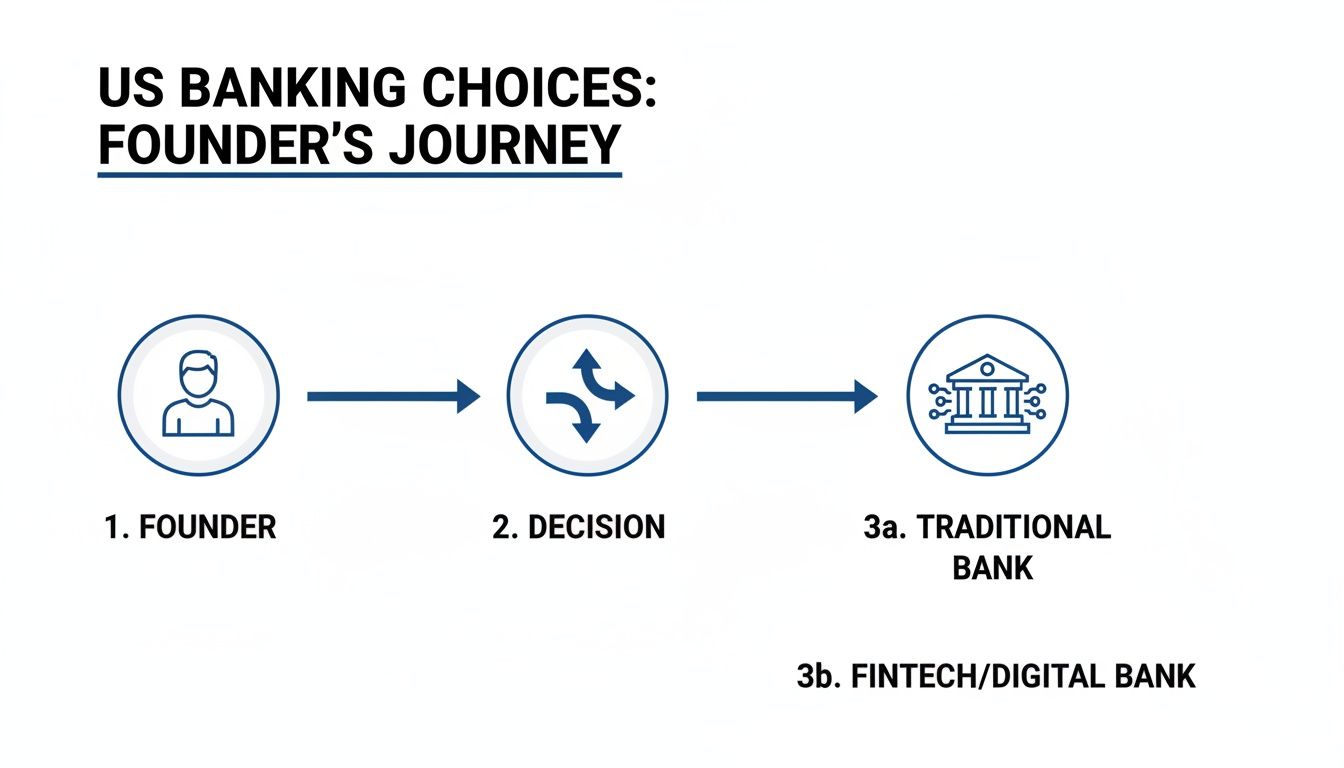
As you can see, your choice of banking partner sets the tone for the entire application experience.
Organizing Your Digital Documents
Before clicking "Apply," organize your digital documentation. This simple preparatory step can prevent the stress of searching for a file while a banking portal's session timer is active.
Create a dedicated folder on your computer and collect clear, high-resolution scans of all required documents.
Smart File Naming: Use a consistent and clear naming convention, such as "Jane_Doe_Passport.pdf" or "My_LLC_Articles_of_Org.pdf." This seems elementary, but it prevents costly errors during the upload process.
Check Your Scans: Ensure every document is perfectly legible. Avoid blurry images, shadows, or cropped edges. A bank's compliance officer or their automated system will immediately reject a poor-quality scan.
File Formats Matter: Most platforms require PDF or JPG formats. A quick review of the bank's FAQ page can prevent last-minute file conversion issues.
This level of organization sends a powerful signal: you are a serious and professional business owner.
Navigating the Online Portal
Modern banking applications are designed for user-friendliness, but they are also exceptionally thorough. They must collect comprehensive information about your U.S. business and you as the owner to meet regulatory requirements.
You will be required to provide specifics such as:
Your full legal name, exactly as it appears on your passport.
Your date of birth and country of citizenship.
Your foreign home address.
Your company’s official name, EIN, and U.S. business address.
The U.S. business address is a critical, non-negotiable detail. Banks must see a legitimate physical U.S. address for your company, which is where a reliable professional partner is invaluable. You can learn more about how a registered agent service provides this crucial address and ensures your business remains compliant.
Pro Tip: Keep a separate document open with all this information copied and ready. It's the best way to avoid typos, a surprisingly common reason for application delays. Even one wrong digit in your EIN can trigger an automatic rejection.
Preparing for Modern Identity Verification
This is where the remote process truly shines. Instead of booking international flights for an in-person visit, modern "Know Your Customer" (KYC) checks are conducted through your device's camera, but they are no less stringent.
Be prepared for one of these common verification methods:
The "Liveness" Check: You will likely be prompted to use your webcam or phone to take a live photo of your face, followed by a photo of your passport. The software uses biometric analysis to match you to your ID in real-time.
A Quick Video Call: Some banks, particularly more traditional ones, may request a brief video call with a representative. This is typically a short process where they ask you to hold your passport up to the camera and answer a few basic questions to confirm your identity.
Third-Party Verification: Many banks utilize specialized services for identity verification. You may be temporarily redirected to a secure third-party platform to complete this step before returning to the bank's application.
The key to successfully navigating these checks is simple: conduct them in a well-lit environment, ensure you have a stable internet connection, and have your physical passport on hand.
From Submission to Your Debit Card
Once you submit your application, the process is typically swift. With most fintechs, you can expect an approval decision within 24-72 hours. Traditional banks often take longer, sometimes up to one or two weeks, due to more manual review processes.
Upon approval, you will receive a welcome email with access to your online banking dashboard. Your account and routing numbers will be available immediately, allowing you to start accepting funds. The final step is the arrival of your physical business debit card, which will be mailed to your U.S. business address—a tangible confirmation that you are officially open for business in the United States.
How to Avoid the Most Common Application Rejections
Opening a U.S. bank account from abroad is a critical milestone, but it is also a point where many international founders encounter obstacles. A rejection is more than a minor setback; it can disrupt your launch timeline and force you to restart the entire process.
Having guided hundreds of entrepreneurs through this exact procedure, we have identified the common pitfalls that lead to denials. A rejection is rarely a matter of bad luck; it is almost always due to a lack of preparation and a misunderstanding of the bank's compliance perspective. Let's review the most frequent mistakes so you can avoid them.
Mismatched or Incomplete Paperwork
This is, without question, the #1 reason applications are rejected. Banks are legally obligated to verify every detail, and their systems are designed to flag inconsistencies. Even a minor discrepancy can halt the process.
Here are the most common errors we observe:
Name Game: Your full legal name on your passport, your LLC formation documents, and the bank application itself must be identical. Using a middle initial in one place and a full middle name in another is sufficient grounds for denial.
Expired Documents: An expired passport will result in an automatic rejection. Verify the expiration date before you begin.
Bad Scans: Submitting a blurry, dark, or cropped image of a document is functionally the same as not submitting it at all. Ensure every scan is high-resolution, in full color, and captures the entire page.
Your complete document package tells a story. If the details do not align perfectly, the bank will not assume the associated risk.
Banks don’t give you points for getting it almost right. An application that's 99% complete is still 100% rejected. Taking five extra minutes to triple-check every field and document is the best investment you can make in this process.
Failing the Address Verification Test
For remote founders, address verification is a significant hurdle. Banks must verify two distinct addresses and have specific rules for acceptable proof.
Your Personal Address Abroad: This must be your physical residence, not a P.O. Box. The gold standard for proof is a recent utility bill or a bank statement from your home country showing your full name and address.
Your U.S. Business Address: This is a classic tripwire. Using a P.O. Box or a basic mail forwarding service is an immediate dealbreaker. Banks require a legitimate physical U.S. address to confirm your business has a genuine presence.
This is precisely why securing a professional U.S. virtual business address is non-negotiable. It is not merely a mailing address; it is a critical piece of business infrastructure that provides the credibility banks require.
Picking a Bank That's a Bad Fit
Not all banks are equipped to serve international founders. Some traditional institutions have rigid internal policies that are not designed to accommodate non-resident applicants, regardless of their marketing claims.
This is particularly true if your business operates in an industry that banks deem "high-risk," such as cryptocurrency, dietary supplements, or certain e-commerce models like dropshipping. Approaching a conservative, traditional bank with a business model they do not understand is a recipe for rejection.
The U.S. banking system can be challenging for international founders to access. In fact, recent data shows that foreign-born non-citizens are only three-fifths as likely to have a bank account as non-immigrants, which underscores the systemic challenges. You can read more about these disparities in U.S. household banking on FederalReserve.gov.
Transforming a potential "no" into a confident "yes" often comes down to expert knowledge. If you are concerned about how a bank will perceive your business, obtaining professional guidance can be the difference between approval and rejection. Our expertise lies in helping you construct an application that meets all compliance requirements from the outset.
Your Questions on US Banking for Non-Residents Answered
Even with a clear roadmap, you likely have questions about the practical application of this process. This is understandable. Navigating the intersection of U.S. legal, financial, and logistical requirements can be complex.
To provide clarity, we have compiled the most common questions we receive from international founders daily. These are not hypotheticals but real-world challenges that arise when you aim to open a US bank account online for non resident business owners.
Do I Absolutely Need an SSN or ITIN?
This is a major point of confusion, so let's be unequivocal: no, it is not an absolute requirement.
While a Social Security Number (SSN) or an Individual Taxpayer Identification Number (ITIN) will certainly provide more options with traditional banks, it is not a dealbreaker. Fortunately, many modern fintech platforms have been specifically architected for global entrepreneurs.
For these forward-thinking companies, your business's Employer Identification Number (EIN) and a valid foreign passport are typically sufficient to satisfy their identity and business verification requirements. The key is to select a financial partner that understands the unique needs of an international founder.
Can I Use My Foreign Address for the Business?
This is a frequent point of error. While you will use your foreign residential address for your personal identity verification, your U.S. business entity must have a U.S. address. This is a non-negotiable requirement.
Large traditional banks are particularly strict, often demanding a physical U.S. business address. Even the more flexible fintechs, which accept your foreign home address for KYC purposes, will still require a U.S. address for the company entity itself.
This is precisely why establishing a professional virtual business address is not just an option—it's a foundational step. It provides the bank with the necessary proof of your legitimate presence in the United States.
How Long Does the Entire Process Take?
Your timeline is primarily determined by two factors: your choice of financial institution and your level of preparation.
Fintech Platforms: With all documents prepared and organized, you can receive approval in as little as 24-72 hours.
Traditional Banks: These institutions operate on a longer timeline. Their manual review processes can mean a waiting period of 1-2 weeks, and sometimes longer.
Your preparedness is the single biggest factor you can control. I've seen a simple missing document or a small mistake on an application add weeks of frustrating back-and-forth. A clean, complete submission is always the fastest way to get your account up and running.
My Account Is Open—What's Next for Taxes?
Congratulations on this significant achievement. Obtaining your U.S. bank account is the key to operating effectively in the American market. However, this access comes with new responsibilities, specifically regarding U.S. tax and compliance.
As a non-resident owner of a U.S. company generating income, you are now under the purview of the IRS. You must adhere to all federal and, where applicable, state tax filing regulations to maintain your business's good standing. Our strongest recommendation is to act proactively. Engage a qualified tax professional immediately to establish proper bookkeeping, understand your specific tax obligations, and plan for your annual filings from day one.
Navigating U.S. banking and tax compliance can be a complex endeavor, but you do not have to undertake it alone. Read & Associates Inc. specializes in guiding international founders through this entire journey, from company formation to ongoing tax and compliance management. If you want to ensure every step is handled with expert precision, schedule a consultation with our team today.


Comments