

UK Founder's Guide to the Alabama Business Entity Search
- Read & Associates
- Feb 2
- 12 min read

Before you can even think about launching your US company, your journey starts with a simple but critical check: the Alabama business entity search. This is your foundational first step, the one that ensures your chosen business name is actually available. It’s a mandatory pre-flight check that can save you from costly headaches and delays down the road.
Your First Step to US Expansion in Alabama
For any UK founder looking to break into the American market, picking the right state is a huge decision. Alabama makes a strong argument, not just for its welcoming business climate but also for its surprisingly energetic entrepreneurial scene. The state is a true engine for small businesses, making it an ideal landing spot for new ventures.
Consider this: Alabama is home to 401,717 small businesses. That accounts for a staggering 99.4% of all businesses in the state. These companies aren't just statistics; they're the lifeblood of the local economy, employing over 802,000 people, which is nearly half of Alabama's entire private workforce. This bustling environment is precisely why a thorough name search is so important—you need to carve out your own unique space.
Why the Name Search Is Non-Negotiable
Running an Alabama business entity search isn't just a good idea; it's a legal requirement. State law is very clear: your company name must be "distinguishable upon the records" from any other registered business.
If you try to file your formation documents with a name that’s already taken or even just too similar to an existing one, the Secretary of State will reject it flat out. That means wasted time, lost filing fees, and a frustrating start to your US expansion.
Think of the business entity search as securing your legal and digital real estate. It’s just like checking if a domain name is available. This search confirms your brand's unique identity in Alabama's official records, helping you steer clear of legal battles and brand confusion later on.
Your go-to tool for this is the search portal on the Alabama Secretary of State's website. It’s a straightforward system that lets you check for name availability before you get too attached to one.
This portal is your gateway to verifying your name and even doing a bit of research on existing companies. For a complete walkthrough of the entire setup process, from name search to final registration, be sure to read our comprehensive guide on how to register a company in the USA as a UK founder.
A Practical Guide to the Alabama Secretary of State Search Portal
The Alabama Secretary of State’s website is your official starting point for all business filings and records. For UK founders, it's a critical tool, but let's be honest—like many US government sites, its layout can be a bit clunky and unintuitive at first glance. I'll walk you through how to run an effective Alabama business entity search so you can confidently check if your desired company name is up for grabs.

The portal gives you a few different ways to search, but we'll focus on the three you’ll actually use for your initial research: by Entity Name, by Entity ID, and by Officer/Agent Name.
Searching by Entity Name
This is where everyone starts. You’ll use this to see if the business name you’ve dreamed up—or something frustratingly close to it—is already registered in Alabama.
Let’s say you’re bringing your successful UK e-commerce brand, "Brummie Bakes Ltd," across the pond. Your first search should be simple and direct.
Start with the obvious: Search for "Brummie Bakes."
Widen the net: What if someone else is "Brummie Bakery" or "Brummie Baking Co."? Check those too.
Think defensively: Search for common misspellings that could cause brand confusion, like "Brummy Bakes."
The real goal here isn’t just to see if the exact name is taken. It’s to make sure your name is distinct enough that the state won’t reject it and, just as importantly, that future customers won't get you mixed up with someone else.
My best tip: Search for the core words of your brand ("Brummie Bakes") without adding suffixes like "LLC" or "Inc." The system will return every entity with those words, regardless of their legal structure. This gives you a much better lay of the land.
Navigating the Entity ID Search
The Entity ID search is for when you need to be precise. Every business registered in Alabama gets a unique ID number. You won't use this for a new name search, but it's an absolute lifesaver for due diligence.
For instance, if you're exploring a partnership with an Alabama-based logistics company, just ask for their Entity ID. Popping that number into the portal pulls up their official record instantly. It's the cleanest, fastest way to verify a company's status and filing history without any guesswork.
Using the Officer or Agent Name Search
This is a seriously powerful research tool for getting a feel for the business ecosystem and potential partners. It lets you find all the businesses connected to a specific person.
Imagine you're an investor from London vetting a serial entrepreneur in Birmingham, Alabama. By searching their name, you can see every business where they're listed as an officer or a registered agent.
This gives you a clear window into their professional background and current projects. It can help you spot potential conflicts of interest or simply confirm their track record, adding a crucial layer of transparency to your vetting process. Each search method is a different tool in your belt, taking you from broad name-checking to laser-focused investigation.
Understanding Your Alabama Business Search Results
You’ve run your search on the Alabama Secretary of State’s portal—great. But clicking on a business name is where the real detective work begins. The details page throws a lot of official jargon at you, and if you're coming from the UK, it's not always intuitive. Let’s walk through what you're seeing and why each piece of information is a critical part of the puzzle.
Think of this page as the official public story of a business. Getting comfortable reading this story will help you make much smarter decisions, whether you're sizing up a competitor or, down the line, double-checking your own company's details are correct.
First Things First: Entity Type and Status
Right at the top, you'll see two of the most important fields: Entity Type and Entity Status. Don't skim past these.
Entity Type: This tells you the company's legal DNA. You'll see things like "Domestic Limited Liability Company" or "Foreign Corporation." It's simple, really: "Domestic" means it was formed right here in Alabama. "Foreign" means it was originally formed in another state (or country) and then registered to operate in Alabama. When you form your company, it will be a "Domestic" LLC or Corporation.
Entity Status: This is the big one. It’s a real-time check on whether the company is in good standing. "Exists" is what you want to see—it means they're active and compliant. If you see "Dissolved," the business has been legally shut down. This is a crucial distinction. An "Exists" status on a name you want is a dead end, but a "Dissolved" one might just be the opening you need.
Understanding these statuses is key, as they dictate your next move. I've put together a quick cheat sheet to help you decode what you're seeing.
Decoding Alabama Business Entity Status
This table breaks down the common statuses you'll encounter in the search results and explains what they actually mean for a founder like you.
Entity Status | What It Means | Action for UK Founders |
|---|---|---|
Exists | The company is active, compliant, and legally recognized in Alabama. | If the name is similar to yours, you'll almost certainly have to pick another one. |
Dissolved | The company has been officially closed and is no longer operating. | The name might be up for grabs, but you still need to check for lingering trademark issues. |
Cancelled | A previous name reservation or registration was withdrawn. | This is good news. The name is usually free for you to reserve and register right away. |
Think of this as your first filter. The status tells you whether a name is a hard "no" or a "maybe" that's worth a closer look.
The Registered Agent: Your US Point of Contact
As you scroll down, you’ll find the Registered Agent. In Alabama, and every other US state, this is not optional—it's a legal requirement. A registered agent is simply a person or a dedicated company whose job is to receive official mail and legal notices on behalf of your business.
For a UK founder without a physical US address, this is one of your first and most important hires. They must have a physical street address in Alabama (no P.O. boxes) and be available during normal business hours to sign for documents.
Expert Tip: Finding a reliable registered agent service is a foundational step. Their name and address are public record, which is why you see them listed in the search results. This underscores their official role in keeping your company compliant with state law.
Digging into the Filing History
Finally, you’ll see a Filing History section. This is a chronological log of every document the company has ever filed with the state, from its initial formation papers to amendments and annual reports.
This timeline is surprisingly insightful. It can tell you a lot about a company's stability and how diligent they are with their paperwork. Once your own company is up and running, this section will become the official record of your business journey in Alabama.
What to Do When Your Search Hits a Snag
So, you've run your search on the Alabama Secretary of State's portal and hit a roadblock. It happens more often than you'd think, especially for UK founders navigating this for the first time. Maybe your ideal name is already in use, or you've found a dozen variations that are uncomfortably similar.
Don't worry. Let's walk through the most common issues I see and how to handle them.
The Name is Taken, But the Status is "Dissolved"
One of the most frequent things people run into is finding their perfect name, but it’s attached to a business with a "Dissolved" status. It’s tempting to see this as a green light, but I always advise a bit of caution here.
While it's true the state no longer formally recognizes that company, the name could still carry baggage. The previous owners might still have a common law trademark, a lingering online presence, or a brand reputation you don't want to be accidentally associated with. Before you claim it, do a quick Google search and check social media. If it looks like the old company has completely vanished, you're likely in the clear. Just know it’s a calculated risk.
Navigating Deceptively Similar Names
What about when your search for "Apex Global Solutions" pulls up results like "Apex Solutions Global" and "Apex Global Services"? This is a classic problem. Alabama law requires a business name to be "distinguishable upon the records," and small tweaks usually don't cut it.
Things like adding "The," swapping the word order, or changing the suffix (from "Inc." to "LLC," for example) are almost always rejected. This is where you need to get a little more creative.
Try a geographic anchor: "Apex Global Solutions Alabama" could work.
Add an industry keyword: "Apex Global Logistics" is more specific and likely available.
Inject a unique word: Something like "Apex Horizon Global Solutions" can set you apart.
The key is to find a name that is both legally distinct and helps customers understand what you do, all while avoiding any brand confusion.
A quick but important reminder: Getting your name approved by the Alabama Secretary of State only protects it within Alabama's business registry. It offers zero protection against a company in another state using a similar name and filing for a federal trademark. This is a separate, crucial step for brand protection.
What If an Active Business Has Your Name?
This one is straightforward: if an active, registered business already has your name, it's off-limits. It's a dead end.
My best advice? Don't waste your time or money trying to find a clever workaround with a slight misspelling or a minor variation. The state will almost certainly reject it. Instead, take this as an opportunity to go back to the drawing board and brainstorm something even better.
Starting fresh with a truly unique name is a huge advantage for your long-term branding and marketing. It ensures you’re building your US presence on a solid, distinct foundation from day one.
From Search to Setup: Your Next Steps in Alabama
Finding out your ideal business name is available on the Alabama business entity search is a huge win. It's the green light you’ve been waiting for, a clear signal to shift from planning to actually doing. Now, the key is to move quickly to secure that name and officially get your US company off the ground.
This next phase is all about turning that search result into a real, legally recognised business. For a UK founder, this means tackling a few critical steps in the right order to build a solid foundation for your American operations. You'll be filing specific documents with the state, appointing a mandatory local representative, and getting ready for federal requirements like your tax ID.
First, Secure Your Name Immediately
Don't wait on this. The very first thing you should do is lock down your chosen name. In Alabama, you accomplish this by filing a Name Reservation Request with the Secretary of State. This isn't just an informal placeholder; it's a formal, legal claim.
Once approved, the state issues a Name Reservation Certificate. This officially secures your name exclusively for one year, giving you plenty of breathing room to get your formation documents in order without the stress of someone else snagging your name. Think of it as putting a deposit down on your brand's new American home.
Next, File Your Formation Documents
With your name safely reserved, it's time to file the official paperwork that brings your company to life. For most UK founders launching in the US, this will be the Certificate of Formation for a Limited Liability Company (LLC).
This is the document that formally registers your business with the state of Alabama. You'll need to provide some key details, including:
Your LLC's name (it must match your reservation certificate exactly)
The name and physical street address of your Registered Agent
A statement confirming your LLC has at least one member
Filing this document is the exact moment your US company legally comes into existence.
Then, Appoint Your Alabama Registered Agent
Every single business in Alabama is required to have a registered agent. This is non-negotiable and a crucial piece of the compliance puzzle, especially when you're running the business from overseas. Your registered agent serves as your company's official point of contact in the state for receiving legal notices and government mail.
A registered agent must have a physical street address in Alabama—not a P.O. Box—and be available during normal business hours. Their core job is to ensure you receive important, time-sensitive documents promptly, which is vital for keeping your company in good standing.
If you ran into any snags during your name search, this quick flowchart can help you figure out what to do before you get to this stage.
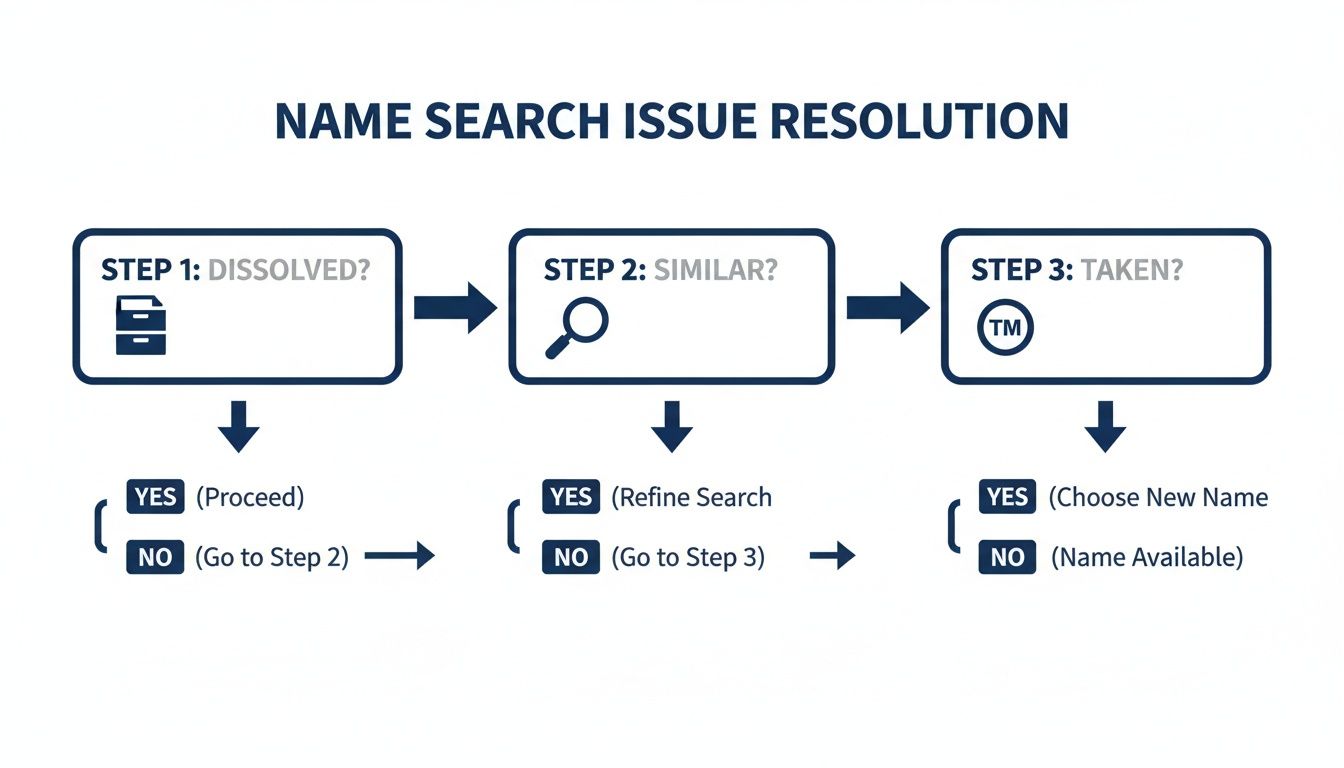
This visual is a handy guide for quickly assessing whether a name conflict is a hard stop or just a small hurdle you can work around.
It's also worth noting that Alabama lawmakers recently updated over 60 provisions in the state's business entity laws, which directly affects how new businesses are formed. These changes touch on critical areas like registered agents and corporate names, reinforcing why it's so important to get things right from day one. For instance, the law now explicitly requires every new LLC to have a registered agent with a physical Alabama address—a detail you absolutely must provide in your formation documents. You can read more about the updates to Alabama's business entity laws on lexisnexis.com.
Getting these initial state-level filings done correctly paves the way for the next phase of federal setup, like getting your Employer Identification Number (EIN) from the IRS and opening a US bank account. To really understand this crucial requirement, check out our guide on what a registered agent is and why your U.S. business needs one.
Common Questions from UK Founders About the Alabama Business Search
Setting up a business in a new country naturally comes with a lot of questions. When UK founders start digging into the Alabama business entity search, a few key points tend to trip them up. Let's clear up the most common ones so you can move forward with confidence.
First off, how much does it cost? The great news is that searching on the Alabama Secretary of State’s website is completely free. You can run as many searches as you need while brainstorming company names, all without spending a penny.
How Long Can I Reserve a Name in Alabama?
Found the perfect name? Fantastic. You can lock it down by filing a Name Reservation Request. In Alabama, this holds your name exclusively for one year.
This gives you a really generous amount of time to get your formation documents in order without the stress of someone else grabbing your name. The filing fee is small, but the peace of mind is invaluable.
Do I Need an Alabama Address to Search or Reserve a Name?
No, you don't. This is a big one for international founders. You can handle these initial steps—searching for and reserving your name—entirely from the UK. You won't need a U.S. or Alabama address for this part of the process.
You will, however, need a physical Alabama address for your Registered Agent, which is a required step when you officially form your company.
Alabama has made ongoing compliance remarkably simple. They got rid of the state's annual report requirement thanks to House Bill 230, which was a real game-changer. Now, you can just use the entity search tool to confirm a company is in good standing (you'll see the status 'Exists') without digging through other reports. You can read up on this update to Alabama's business reporting requirements on legalzoom.com.
Is an EIN the Same as a State Entity ID?
This is a crucial point to understand. The Entity ID you see in the state search results is purely for Alabama's administrative tracking. It’s a state-level number.
An Employer Identification Number (EIN) is completely different. That's your federal tax ID number, issued by the IRS. Think of it like your company's Social Security Number.
You absolutely need an EIN to do business—it's essential for opening a U.S. bank account, hiring employees, and filing your federal taxes. Getting your EIN is a separate but vital step that comes after your company is formed at the state level. We walk through the details in our guide on what an EIN number is and how to get one.
Launching a U.S. company from the UK has a lot of moving parts. At Set Up Stateside, we take care of the entire formation, accounting, and tax compliance process so you can focus on what you do best: growing your business. Let us manage the complexities for you.


Comments