

How to Calculate Estimated Tax Payments for Your U.S. Business

At its core, calculating estimated tax is a four-part process. You'll need to project your total annual income, subtract all your business deductions to find your net profit, figure out the tax you'll owe on that profit, and then divide that total by four. These become your quarterly payments. For business owners new to the U.S. market, mastering this pay-as-you-go system is a critical compliance task.
Understanding U.S. Estimated Taxes for Business Owners
If you're establishing a business in the U.S., the American tax system can present a few surprises. The biggest for many is the requirement to proactively pay your income taxes throughout the year. It’s a world away from a typical salaried job where an employer handles tax withholding for you. When you own a business operating in the U.S., the responsibility for calculating and sending in these payments rests squarely on your shoulders.
This "pay-as-you-go" system is how the IRS ensures everyone, from self-employed individuals to large corporations, meets their tax obligations gradually, preventing a single massive bill at year-end. As a rule of thumb, the IRS expects you to make these payments if you anticipate owing at least $1,000 in tax for the year.
Why Estimated Taxes Are Crucial for Your Business
Getting your estimated tax payments right is about more than just checking a compliance box—it's vital for your company's financial stability. If you don't pay enough tax through these quarterly installments, you can be hit with underpayment penalties, even if you settle the full amount when you file your annual return.
For business owners, particularly those expanding into the U.S., the stakes are high. Successfully navigating the system means you must get comfortable with a few key areas:
Accurate Income Projection: Forecasting your revenue and expenses in a new market is challenging, but it's the bedrock of your tax calculation.
Understanding Taxable Income: You're not taxed on every dollar that comes in. You must identify and meticulously track all allowable business deductions to reduce your taxable profit.
Navigating Different Entity Rules: The process varies significantly depending on your business structure. A single-member LLC's income passes through to you personally, while a C-Corporation pays tax at the company level.
This simple flowchart breaks down the basic loop of the estimated tax process.
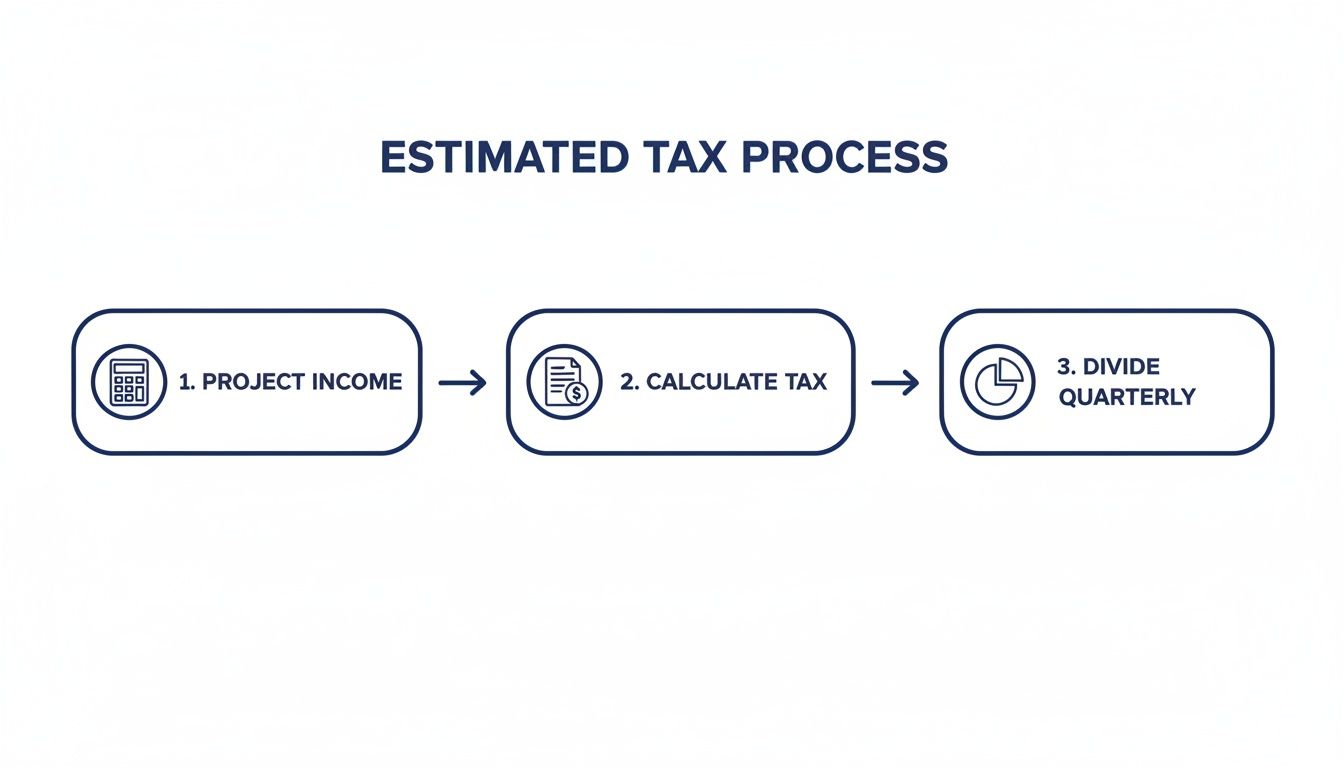
As you can see, the entire system is a cycle. You project, you calculate, and you divide your total tax liability into more manageable quarterly chunks.
To put it simply, calculating your estimated tax payments involves four main actions. Each step has its own nuances, especially when you're managing a U.S. entity.
The Four Core Steps to Calculate Estimated Taxes
Action | Description | Key Consideration for Business Owners |
|---|---|---|
1. Project Total Income | Forecast your gross income for the entire tax year based on current earnings and market trends. | Unfamiliar market dynamics can make this particularly challenging for new U.S. ventures. |
2. Subtract Deductions | Identify and subtract all anticipated business expenses to determine your net profit or taxable income. | Understanding which deductions are allowable under U.S. law is critical. Not all expenses are deductible. |
3. Calculate Total Tax | Apply the appropriate tax rates to your projected net profit to find your total estimated annual tax liability. | You must determine the correct federal and state tax rates based on your entity type and location. |
4. Divide by Four | Split your total annual tax liability into four equal payments for the quarterly deadlines. | Be aware that missing a deadline can trigger penalties. Plan payments well in advance. |
This table provides a high-level overview. The real work is in the details of each step, which we'll dive into next.
Key Takeaway: The U.S. estimated tax system is designed to collect tax revenue as income is earned. For business owners, mastering this process is essential for avoiding penalties and maintaining good standing with the IRS.
Handling these obligations correctly often requires professional guidance. A partner like Read & Associates Inc. brings the clarity and hands-on expertise you need to manage your U.S. tax duties with confidence, letting you get back to what you do best—growing your business.
Calculating Payments for Individuals and Single-Member LLCs
For many founders, the single-member LLC is the go-to structure for their U.S. venture, largely due to its simplicity. The IRS treats it as a "disregarded entity" for tax purposes.
This means the business's profits and losses flow directly onto your personal tax return. You're paying tax as an individual, not as a separate corporation. This pass-through nature simplifies one part of the process but makes the estimated tax calculation a deeply personal affair. Your business income gets combined with any other U.S.-sourced income, and all your personal deductions and credits come into play.
Your main tool for this job is IRS Form 1040-ES, Estimated Tax for Individuals.

Think of this form less as a simple payment coupon and more as a worksheet—a guide to forecasting your entire financial year. Let's walk through how this works with a real-world scenario.
A Real-World Example: A U.S.-Based SaaS Founder
Meet Sofia. She’s a software developer who just launched a U.S.-based SaaS company, structured as a single-member LLC. She’s using QuickBooks to keep her books in order and now needs to figure out her first quarterly estimated tax payment.
Here’s a breakdown of how she'd approach the calculation:
Project Annual Revenue: Sofia looks at her first few months of sales and current market trends. Based on her subscription numbers and growth rate, she projects her U.S. LLC will bring in $120,000 in gross revenue for the year.
Tally Up Business Expenses: Using her QuickBooks reports, Sofia totals all her expected business deductions. This isn't just a guess; it includes actual costs like software subscriptions, marketing campaigns, payment processing fees, and contractor payments. She projects these will hit $30,000.
Determine Net Profit: She then subtracts her projected expenses from her revenue ($120,000 - $30,000), landing on a projected net profit of $90,000. This is the amount that will "pass through" to her personal tax calculation.
This initial projection gives Sofia her business's taxable income. It’s the starting point for the Form 1040-ES worksheet, but it's far from the final number she'll be taxed on.
Factoring in Total Income and Deductions
The 1040-ES worksheet requires your entire expected adjusted gross income (AGI) for the year. For an owner, this includes business profit and any other income that might be subject to U.S. tax.
Next, she subtracts any deductions she's eligible for. The standard deduction is a fixed amount set by the IRS that taxpayers can use if they don't itemize things like state taxes or mortgage interest. For 2024, let's assume the standard deduction for a single filer is $14,600.
Pro Tip: Your ability to claim certain deductions can be limited based on your residency status and other factors. It's crucial to understand exactly what you qualify for, as this directly impacts your tax bill. This is one area where getting professional guidance can prevent very costly mistakes.
After subtracting the standard deduction from her projected AGI, Sofia has her estimated taxable income. She then uses the official IRS tax brackets to calculate her total estimated tax for the year. Let's say her final estimated tax liability comes out to $15,000.
She would simply divide this by four, making her required quarterly payment $3,750.
The Importance of Quarterly Re-Evaluation
The biggest mistake business owners make is to "set it and forget it." Your initial estimate is just that—an estimate. Business is never static, and your finances will absolutely change throughout the year.
What happens if Sofia lands a huge enterprise client in July, suddenly bumping her projected annual revenue to $180,000?
Her net profit forecast would jump significantly.
Her total estimated tax for the year would increase.
Her remaining quarterly payments must be adjusted upward to cover this new, higher liability.
Failing to make these mid-year adjustments is a direct path to an underpayment penalty from the IRS. We always advise clients to review their income and expenses at the end of each quarter before making the next payment. This proactive approach keeps you on track and helps you avoid a nasty surprise tax bill (and penalties) when you file your annual return.
Calculating estimated taxes for your LLC isn't about filling out a form once. It’s an ongoing process of financial forecasting and adjustment. Getting it right demands diligence and a solid grasp of U.S. tax rules. For founders navigating this for the first time, partnering with an expert at Read & Associates Inc. can provide the structure and peace of mind you need.
A Guide to Corporate Estimated Taxes for C-Corps
When your U.S. business is set up as a C-Corporation, the estimated tax framework changes completely. Unlike a single-member LLC where profits pass through to your personal tax return, a C-Corp is its own separate taxpayer in the eyes of the IRS. This is a common structure for U.S. businesses, including subsidiaries of foreign companies, precisely because it creates a clean legal and financial separation.
Forget about Form 1040-ES. For a C-Corp, your main tool is Form 1120-W, Estimated Tax for Corporations. This is the worksheet you'll use to map out the corporation's projected net taxable income and figure out what you owe based on the current flat federal corporate tax rate. The process is entirely distinct from individual taxes and requires a sharp eye for corporate-specific rules.
Projecting a Corporation's Taxable Income
At its core, the principle is the same: you have to forecast your income and expenses for the year. The big difference for a C-Corp is that this calculation is entirely self-contained within the business’s own books. You'll start by projecting gross receipts, then back out the cost of goods sold and every single allowable business deduction to land on your estimated taxable income.
This is where having meticulous, up-to-date bookkeeping moves from a "nice-to-have" to absolutely non-negotiable. Every dollar you track for payroll, rent, marketing, or software directly reduces your taxable income and, by extension, your final tax bill.
A Worked Example: A U.S. Tech Company
Let's walk through a real-world scenario. Imagine a new U.S. C-Corporation has been launched to manage North American sales and support operations. It's their first year, and the leadership team needs to figure out how to calculate estimated tax payments.
Here's how their financial controller might break it down:
Project Gross Income: Based on their initial signed contracts and solid market research, they forecast $2,000,000 in U.S.-based revenue for the year.
Estimate Deductions: Pulling reports from their Xero accounting software, they project all their annual operating costs. This bucket includes everything from U.S. employee salaries and office lease payments to marketing campaigns and software licenses, which adds up to $500,000.
Calculate Net Taxable Income: It's simple math from here. They subtract the expected deductions from the projected income ($2,000,000 - $500,000) to get an estimated net taxable income of $1,500,000.
This $1,500,000 figure is the key number they'll use to calculate the actual tax.
Thanks to the 2017 Tax Cuts and Jobs Act, the federal corporate rate is a flat 21%. This has simplified things for many companies operating in the U.S. For our example company, that $1,500,000 in taxable income translates to an annual federal tax liability of $315,000. This amount is then split into four equal quarterly payments of $78,750. You can dive deeper into U.S. tax considerations for global businesses to get a more complete picture of these requirements.
Understanding Corporate Due Dates
Another critical difference that often trips up new C-Corp owners is the payment schedule. Individuals pay on the 15th of April, June, September, and January, but corporations march to a slightly different beat.
Important Distinction: Corporate estimated tax payments are generally due on the 15th day of the 4th, 6th, 9th, and 12th months of the corporation's tax year. For a business using a standard calendar year, that means payments are due on April 15, June 15, September 15, and December 15.
Did you catch that? The fourth payment is due in December, not January of the next year as it is for personal estimated taxes. Missing this subtle shift is a common—and completely avoidable—mistake that can lead to penalties.
The Added Complexity of State Taxes
Of course, federal taxes are only half the battle. Almost every state has its own corporate income tax, complete with unique rates, forms, and payment deadlines. If your corporation operates in more than one state, you suddenly have to navigate a complicated web of tax obligations, a concept known as nexus.
This is where multi-state tax planning becomes essential. Getting your federal payments right is one thing; layering on varying state requirements significantly dials up the complexity and the risk of making a costly error.
For business owners, getting this right from the very beginning is paramount. The team at Read & Associates Inc. specializes in building these tax projections and managing both federal and state compliance to ensure your U.S. entity is accurate and penalty-free from day one. If you're ready for that level of professional support, schedule a consultation with our experts.
How to Use Safe Harbor Rules and Avoid Penalties
Let’s be realistic: when you’re projecting your U.S. business income for the first time, getting it perfect is nearly impossible. The IRS understands this. They don't expect you to have a crystal ball, but they absolutely expect you to pay enough tax throughout the year.
This is where the safe harbor rules become your best friend.
Think of them as a financial safety net. If you follow the rules, you’re protected from underpayment penalties, even if your final tax bill is much higher than you guessed. For any business owner, mastering these rules is non-negotiable for staying compliant and managing cash flow.
There are two main ways to stay in the “safe harbor,” and understanding which one fits your business is the first step to penalty-proof tax planning.
The Two Main Safe Harbor Strategies
The IRS gives you two paths to avoid penalties. You only need to meet one of these thresholds.
The 90% Rule: This is the forward-looking approach. You need to pay at least 90% of the tax you'll actually owe for the current year. This relies heavily on your ongoing income projections.
The 100% (or 110%) Rule: This is the backward-looking approach. You pay at least 100% of the total tax you owed in the prior tax year. This gives you a predictable, fixed target, making it a favorite for businesses with stable or growing income.
Now, there’s a critical catch on that second rule. If your Adjusted Gross Income (AGI) from the previous year was over $150,000, your target isn't 100%—it's 110% of last year's tax bill.
Critical Point for New Businesses: If you're a new U.S. business with no prior tax history, your choice is made for you. You can't use the 100% rule because you don't have a prior-year tax return to reference. You must use the 90% rule.
This is a classic tripwire for new business owners. Without that prior-year benchmark, the pressure is on to forecast revenue and expenses with reasonable accuracy from day one.
What if Your Income Is All Over the Place?
For many businesses, income isn't a steady, predictable stream. Maybe you run a seasonal e-commerce store or a startup that lands sporadic, large contracts. In these cases, paying four equal tax installments can put a serious strain on your cash flow during the leaner months.
This is where the annualized income method comes in. It’s a more involved calculation, but it’s a game-changer because it lets you match your tax payments to when you actually earn the money.
Instead of projecting for the full year and dividing by four, you figure out your tax liability at the end of each quarter based on the income you've earned to date.
So, if your business has a slow Q1 but a monster Q2, your Q1 payment would be small. Your Q2 payment would then be much larger to catch up, reflecting that huge income spike. This method is brilliant for preserving your working capital when you need it most.
The IRS safe harbor rule lets you avoid penalties by paying 90% of the current year's tax or 100% (or 110%) of the prior year's tax—whichever is smaller. For a startup with uneven income, the annualized method shines. For instance, if Q1 nets $100,000, which annualizes to $400,000, the tax at the 21% corporate rate would be $84,000 for the year, and your payment is prorated accordingly. Underpayment penalties have been hovering around 4-5% annualized, which you can see in the penalty rate trends on the St. Louis Fed's website.
Choosing the right safe harbor strategy is a critical decision. While the 100% rule offers simple, predictable targets, the 90% rule and its more flexible cousin, the annualized method, are essential tools for new and growing businesses. Here at Read & Associates Inc., our accounting team lives and breathes these projections, helping clients select the best method to make sure they meet IRS thresholds without tying up a single dollar more than necessary.
Meeting Deadlines And Making Payments As A Non-Resident
Figuring out what you owe in estimated taxes is one thing. Actually getting those payments to the IRS on time, especially when you're living outside the U.S., is a whole different challenge. It can feel a bit overwhelming, but with a clear system, you can handle it without any issues.
The IRS runs on a tight ship. Miss a payment deadline, and you'll likely get hit with penalties and interest, even if you eventually pay every dime you owe. It’s crucial to know the schedule, and it’s important to realize that the deadlines for individuals and corporations aren't exactly the same.

Federal Estimated Tax Due Dates
Here’s a quick breakdown of the key quarterly deadlines you need to mark on your calendar.
Payment Period | Deadline for Individuals (Form 1040-ES) | Deadline for Corporations (Form 1120-W) |
|---|---|---|
Q1: January 1 – March 31 | April 15 | April 15 |
Q2: April 1 – May 31 | June 15 | June 15 |
Q3: June 1 – August 31 | September 15 | September 15 |
Q4: September 1 – December 31 | January 15 (of the next year) | December 15 |
Pay close attention to that fourth-quarter payment. This is a classic trip-up for founders who are new to the U.S. tax system. Corporations owe their final installment by December 15, but individuals get an extra month, with a deadline of January 15 of the following year.
How To Make Your Payments From Abroad
Once the dates are on your radar, you need a plan for actually sending the money. The easiest way to pay really hinges on whether or not you have a U.S. bank account.
If you have a U.S. bank account:
IRS Direct Pay: This is a free, secure portal right on the IRS website. You can pay directly from your checking or savings account. It’s simple and perfect for one-off payments.
EFTPS (Electronic Federal Tax Payment System): Another free government service, but this one is a bit more powerful. EFTPS lets you schedule all your payments in advance, check your payment history, and handle different tax forms. I usually recommend clients set up an EFTPS account—the reliability and record-keeping alone make it worthwhile.
If you do not have a U.S. bank account:
Wire Transfer: You can wire the funds from a foreign bank account. This requires some careful coordination. You have to make sure the money arrives on time and is credited correctly, which can sometimes be tricky.
Debit/Credit Card or Digital Wallet: The IRS partners with third-party processors to accept these. It's convenient, but just be ready for a processing fee, which varies by provider.
Expert Insight: Honestly, the best first step for most non-residents is to open a U.S. bank account. It makes paying federal taxes via Direct Pay or EFTPS a breeze and vastly simplifies state payments and other day-to-day business operations.
Integrating Payments With Your Bookkeeping
Making the payment is only half the job. You also have to track it properly. It's absolutely essential to log every estimated tax payment in your accounting software, whether you use QuickBooks or Xero.
This isn't just about tidy bookkeeping. When these payments are recorded correctly, your accountant can easily reconcile your books and confirm that what you've paid lines up with your tax projections. When we handle bookkeeping for our clients, we make sure to categorize these payments specifically so they're never confused with deductible business expenses.
Don't Forget About State-Level Payments
Finally, keep in mind that federal taxes are just one piece of the puzzle. If your business has a connection (or "nexus") to a state with an income tax, you'll probably have state estimated tax obligations as well. Every state has its own forms, its own rules, and its own deadlines. It can get complicated, fast.
This is where having a dedicated partner really pays off. A firm like Read & Associates Inc. can take this entire process off your plate—managing your federal and state tax calendar, ensuring every deadline is hit, and recording every payment accurately. If you’re ready to stop worrying about tax compliance, schedule a consultation with our team.
Need an Expert to Handle Your U.S. Tax Planning?
Figuring out estimated taxes is tough enough, but for a founder establishing a business in the U.S., it's a whole different ball game. You're trying to project income in a new market, make sense of confusing IRS forms, and maybe even deal with multiple state tax laws. It’s a lot to handle on your own, and frankly, it's a distraction from your real job: growing your business.
At Read & Associates Inc., we take this entire burden off your plate. Think of us as your in-house U.S. tax team. We manage the whole process, from getting your books set up on QuickBooks or Xero to running tax projections throughout the year and handling all your annual filings. We get rid of the guesswork so you can get back to work.
Your U.S. Tax Compliance Partner
We know the specific challenges business owners run into when learning how to calculate estimated tax payments. Our job is to give you the clarity and confidence to operate in the U.S. without constantly looking over your shoulder. We make sure every deadline is hit and every payment is spot-on.
Partnering with a dedicated U.S. tax firm turns a headache of a compliance task into a simple, background business process. You'll sidestep costly penalties and stay in good standing with the IRS and state authorities right from the start, building a strong foundation for your company's growth.
We're in it for the long haul with our clients, becoming a trusted advisor you can count on. If you're looking for a partner to simplify your U.S. tax obligations and support your growth, we're ready to jump in.
Ready to feel confident about your U.S. tax compliance? Schedule a consultation with our expert team today, and let's put a plan in place that lets you focus on your business.
Common Questions Answered
When you're dealing with U.S. tax rules for the first time, it's natural to have questions. Here are some of the most common ones we hear from founders, along with straightforward answers from our experience.
What If My Business Has a Loss for the Year?
If you're projecting a net loss for your U.S. business, you generally won't have to make federal estimated tax payments. It's simple, really: estimated taxes are for paying your income tax bill, and if you don't have taxable income, there's no bill to pay.
But don't get too comfortable. A business's fortunes can change quickly. A surprisingly good quarter could flip you from a loss to a profit, and suddenly, you're on the hook for a payment. Always keep an eye on your projections.
Can I Pay All My Estimated Tax at Once?
Technically, yes. You could pay your entire year's estimated tax bill by the first deadline in April. However, from a cash flow perspective, this is rarely a good move.
The whole point of the IRS's "pay-as-you-go" system is to let you pay tax on the income as you earn it. Tying up all that capital in one lump sum is a big ask for any business. Sticking to the four quarterly payments is almost always the smarter way to manage your finances.
Do I Have to Pay Estimated Taxes If I'm an Employee Too?
It's a definite possibility. When you have a W-2 job, your employer withholds taxes from your paychecks. The problem is, that withholding is only calculated for your salary—it doesn't know about your business income.
If your side business is pulling in good money, your W-2 withholding probably won't be enough to cover your total tax liability. The rule of thumb is if you expect to owe $1,000 or more in tax for the year after your withholding, you'll need to make estimated payments.
Expert Tip: A handy alternative is to ask your employer to withhold more tax from your W-2 paycheck. You can use Form W-4 to specify an additional amount to cover the liability from your business. It streamlines things into one payment system but requires you to do the math carefully to avoid under- or over-paying.
What Is the Difference Between Estimated Tax and Self-Employment Tax?
This is a mix-up we see all the time, but the distinction is critical.
Estimated tax isn't a type of tax. It’s the method you use to pay your taxes throughout the year on income that doesn't have withholding.
Self-employment tax is a specific tax you owe. It’s your contribution to Social Security and Medicare, which for W-2 employees is handled by FICA taxes.
When you calculate your quarterly estimated tax payment, the amount you figure for self-employment tax gets bundled into the total you send to the IRS.
Getting these details right is what separates a smooth tax season from a stressful one. At Read & Associates Inc., we specialize in helping founders make sense of their U.S. tax obligations so they can stay compliant and focus on their business. Schedule a consultation with our team to get the clarity and peace of mind you need.


Comments