

How to Form an LLC in Washington State for UK Founders

So, you’re a UK entrepreneur ready to tap into the massive US market. Your first big decision? Where to plant your flag. Forming an LLC is the smart move, but choosing the right state is what sets you up for success. While everyone talks about Delaware and Wyoming, I’m seeing more and more savvy UK founders looking west—specifically, to Washington State.
It’s a strategic choice that offers a powerful mix of liability protection, serious tax advantages, and a direct line to one of America’s most vibrant economies. This guide breaks down exactly why Washington is such a compelling option and how you, as a non-resident, can get your US venture off the ground there.
Why Washington State is a Smart Play for UK Founders

When you’re operating from across the pond, your choice of state isn’t just a box-ticking exercise. It has real-world consequences for your taxes, operations, and growth potential. Washington State has quietly become a go-to for founders in tech, e-commerce, and consulting because it offers a practical, powerful launchpad without the hype of other states.
This isn't just a trend; the data backs it up. Washington State has seen the highest growth in new business formations in the entire country, jumping by an incredible +78.4%. That’s around 14,495 new businesses opening their doors every month. Something big is happening there, and it’s creating a fantastic environment for new ventures. You can dig into the small business statistics for 2025 to see why it’s consistently ranked as a top spot for entrepreneurs.
For UK founders looking to make a smart, informed decision, it helps to see the key benefits laid out clearly. Here’s a quick breakdown of why Washington State stands out.
Washington State LLC at a Glance for UK Founders
Feature | Benefit for UK Founders | Key Consideration |
|---|---|---|
No State Income Tax | No state-level tax on corporate or personal income. This means your LLC's profits aren't taxed by Washington, simplifying your US tax obligations. | You will still have federal US tax obligations and UK tax responsibilities. Gross receipts are subject to Washington’s B&O tax. |
Business-Friendly Climate | A streamlined, efficient formation process and a state government that actively supports new business growth and innovation. | The state has a strong focus on compliance, so staying on top of filings like the Annual Report is crucial. |
Access to a Tech Hub | Proximity to giants like Amazon and Microsoft fosters a rich ecosystem of talent, partners, and B2B customers. | This creates a competitive market, but also immense opportunity for businesses that can tap into the local supply chain and talent pool. |
Liability Protection | The LLC structure separates your personal assets (your house, car, savings) from your business debts and legal liabilities. | This protection is only valid if you maintain the "corporate veil" by keeping business and personal finances separate. |
Credibility | Having a registered US entity in a reputable state like Washington boosts trust with American customers, vendors, and partners. | You’ll need a physical US address for official mail, typically through a Registered Agent and virtual mailbox service. |
This combination of features makes Washington a uniquely practical and powerful choice for international founders.
The Real-World Advantages for Your UK Business
Let's get straight to the point: the biggest draw is Washington's tax setup. The state has no corporate or personal state income tax. For a UK founder, this is huge. It means the profits that pass through your LLC to you aren't hit with an extra layer of state tax in Washington, which makes cross-border accounting much cleaner and leaves more money in your business.
But it’s not just about saving on taxes. You're also tapping into a world-class business ecosystem. Washington is home to global players like Amazon and Microsoft, and their presence has created a ripple effect—a deep pool of tech talent, a culture that embraces innovation, and an incredible network of potential partners and clients. Even if you're running the show from Manchester or London, being part of this ecosystem gives you instant credibility and access.
Choosing a state isn't just a legal formality; it's a strategic business decision. Washington's combination of zero corporate income tax, a pro-business climate, and access to the tech-heavy West Coast market provides a distinct competitive edge for non-resident founders from day one.
Finally, the LLC structure itself is perfectly suited for this. It gives you the same robust liability protection as a big corporation, shielding your personal assets if the business runs into trouble. At the same time, it’s far more flexible and has simpler tax reporting than a traditional C Corp. It’s the ideal middle ground, especially when you’re navigating the complexities of a new legal system like the US.
Naming Your LLC and Appointing a Registered Agent
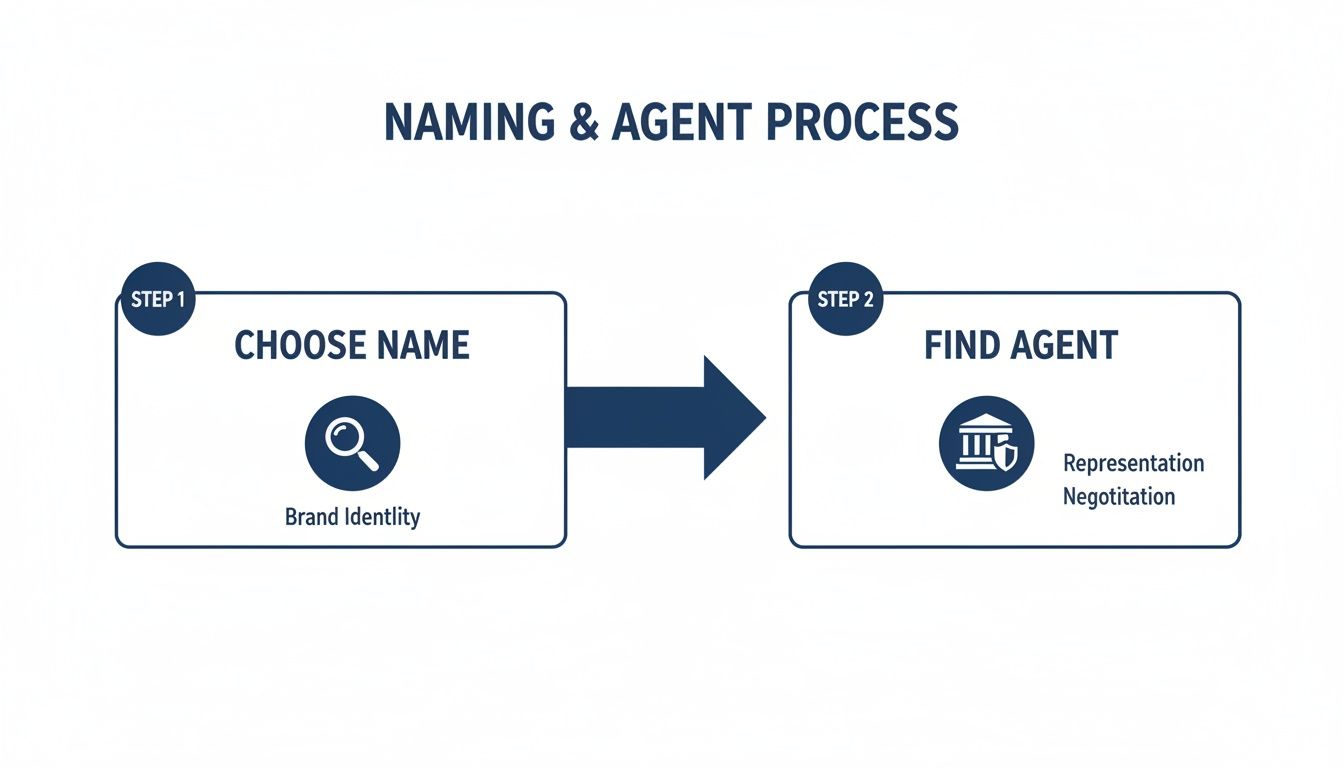
Once you’ve settled on Washington State for your LLC, the first two items on your to-do list are choosing a name and appointing a Registered Agent. These might feel like simple admin tasks, but for a UK founder managing things from across the pond, they're foundational.
Getting these right from day one is about more than just ticking boxes—it's about setting up your brand identity and ensuring you can legally operate in the US without hitting frustrating and costly roadblocks later.
Choosing a Compliant and Memorable Name
Your business name is your first handshake in a brand-new market. In Washington, it legally has to be unique and distinct from any other business registered with the Secretary of State. It also must end with a designator like "Limited Liability Company," "L.L.C.," or the most common, "LLC."
Before you fall in love with a name, you need to check if it's available. The Washington Secretary of State has an online database that makes this fairly easy. You're not just looking for an exact match; you're checking for anything that could be considered "deceptively similar." If "Puget Sound Tech LLC" is already registered, your "Puget Sound Technical LLC" will almost certainly be rejected.
Here’s how to approach it practically:
Have a few names ready. Your first choice might be taken, so have backups to avoid delays.
Check the domain name at the same time. You want your online presence and your legal name to match perfectly.
Do a quick trademark search. A quick look at the U.S. Patent and Trademark Office (USPTO) database can save you a world of hurt down the line.
A classic mistake we see is picking a name that's available in Washington but is already trademarked nationally. This can force you into an expensive rebrand or a legal fight you really don't need when you're just getting started.
Once you’ve found a name that’s free and clear, you can lock it in and move to the next critical piece of the puzzle.
The Non-Negotiable Role of a Registered Agent
Every single LLC in Washington is required by law to have a Registered Agent. This is simply a person or a company with a physical street address in Washington—not a P.O. Box—who agrees to accept official mail and legal documents on your company's behalf.
For a founder in the UK, this isn't a formality. It's your official, physical link to the US legal system.
This agent is your point of contact for receiving crucial documents, including:
Service of process (if someone sues your company)
Official state mail (like reminders to file your annual report)
Tax notices from the Washington State Department of Revenue
If you fail to maintain a Registered Agent, the state can declare your LLC to be in "bad standing," hit you with penalties, or even dissolve it. Worse, you could miss a lawsuit notice, leading to a default judgment against your company before you even knew there was a problem.
Why a Commercial Registered Agent is a Smart Investment
Theoretically, you could ask a friend in Washington to do it, but that's a risky and unprofessional approach for a serious business. The industry standard, and by far the smartest choice, is to use a professional commercial Registered Agent service.
These services are built specifically for situations like yours and offer real advantages. A commercial agent guarantees someone is available during all business hours to receive time-sensitive documents. They also help protect your privacy by listing their address on public records, not a personal one.
But for UK founders, the killer feature is the mail forwarding and scanning. A good agent will scan any official mail they receive and upload it to a secure online portal, giving you immediate access from anywhere in the world. This digital delivery system is what makes managing a US company from the UK not just possible, but straightforward.
If you're looking for more details, you can learn more about what a registered agent service does and why it's so vital for your U.S. business formation in our complete guide.
Making It Official: Filing Your Formation Documents and Getting Your EIN
You've picked a great name and lined up a Registered Agent. Now for the exciting part—officially bringing your Washington State LLC to life. This is a two-step dance: first, you file the core legal document with the state, and second, you get your federal tax ID number from the IRS. This tax ID is the golden key that unlocks your ability to do business in the US, from opening a bank account to filing taxes.
This is the moment your LLC legally comes into existence. Precision is key. Small mistakes on these forms can lead to frustrating delays, and for a UK founder, navigating the IRS without a US Social Security Number adds a unique layer of complexity.
Let's break down how to get it done right.
With those initial decisions sorted, you're ready to tackle the official filings.
Submitting the Certificate of Formation
The Certificate of Formation is the birth certificate for your LLC. You'll file this document with the Washington Secretary of State, and once they approve it, your company is officially on the map.
Washington gives you two options: file online or by mail. For an international founder, the online route is a no-brainer. It's significantly faster, you get an immediate confirmation that they've received it, and it helps prevent common errors. Online filings are typically processed in just a few business days, while mail can stretch into weeks.
You'll need a few key pieces of information handy for the form:
Your LLC Name: Make sure it's exactly as you reserved it, complete with the "LLC" or "L.L.C." at the end.
Registered Agent Details: You'll need their name and their physical Washington street address. This is why you sort out your agent before this step.
Principal Office Address: This is a crucial point for UK founders. This address doesn't need to be in Washington, but it must be a physical street address—no P.O. Boxes. A virtual address is perfect for this.
Governor Information: For an LLC, "governor" usually means the members (owners) or managers. You'll need their names and addresses.
The state filing fee is $200 for the standard online service. Once it's approved, congratulations—your Washington LLC is legally formed!
A quick pro tip on addresses: Using a professional virtual business address for your principal office, separate from your Registered Agent’s address, looks far more credible and keeps your personal home address out of the public record.
The EIN Hurdle: Getting Your Tax ID Without an SSN
Once Washington State gives you the green light, your next mission is to obtain an Employer Identification Number (EIN) from the IRS. An EIN is basically a tax ID number for your business. It's non-negotiable; you need it for almost everything, including opening a US bank account, hiring anyone, or filing federal tax returns.
For US citizens, getting an EIN is a quick online affair that takes about 15 minutes. For a UK founder without a Social Security Number (SSN) or Individual Taxpayer Identification Number (ITIN), the process is completely different and, frankly, much slower. The online system is off-limits.
You'll have to manually complete and submit Form SS-4, Application for Employer Identification Number. This form demands careful attention.
A few key boxes for non-residents to watch out for:
Item 7a/7b (Responsible Party): That’s you. You'll enter your name and leave the SSN/ITIN field blank.
Item 9a (Type of Entity): Check "Limited Liability Company" and fill in the number of members.
Item 10 (Reason for Applying): For most, this will simply be "Started a new business."
The real challenge is how you submit it. Without an SSN, your only options are fax or mail. Fax is by far the better choice; mail can take months to even be processed. Once you fax the form, you're looking at a wait time of four to eight weeks, and that’s if the IRS isn't backlogged.
This delay is often the single biggest source of frustration for international founders. One tiny mistake on the form can get it rejected, sending you right back to the start of that long waiting period. We've seen it happen. To get a more detailed look at this specific process, check out our guide on how to apply for an EIN number as a non-resident.
Honestly, this is where getting expert help really pays off. A service like Set Up Stateside can handle the Form SS-4 preparation and submission, chase the IRS on your behalf, and make sure everything is done correctly the first time. It helps you avoid the common pitfalls that can bring your US launch to a grinding halt.
Building Your Operational Foundation
Your Certificate of Formation is approved and the EIN application is in the mail. Legally speaking, your LLC now exists. But right now, it's just an empty shell. It’s time to build the internal rules and financial plumbing that turn your new LLC from a piece of paper into a real, functioning American business.
For a UK founder, two things should jump to the top of your to-do list: drafting a rock-solid Operating Agreement and cracking the code on opening a US bank account. Get these right, and you're truly in business.
Why Your Operating Agreement is Non-Negotiable
The Operating Agreement is your LLC's internal playbook. It’s the legal document that spells out exactly how your business will run, how decisions get made, and where the money goes. While Washington State won't chase you down if you don't have one, operating without it is a massive, unnecessary risk—especially as an international founder.
Think of it this way: your formation certificate proves the company exists, but the Operating Agreement proves it's your company and you're in control. It's your primary defence for maintaining the "corporate veil," that all-important legal wall between your personal assets and the business's liabilities.
Even if you're the sole owner, this document is critical. It provides the kind of clarity and structure that becomes indispensable in all sorts of situations. We go into a lot more detail on this topic, and I highly recommend you read our guide on what an Operating Agreement for a U.S. LLC is to understand its importance for non-resident owners.
A common mistake is thinking an Operating Agreement is only for multi-member LLCs. For a solo UK founder, it's the single best piece of evidence you have to prove the LLC is a legitimate, separate entity—something that's crucial for both liability protection and getting a bank account.
Your agreement needs to lay out a few key things, which are especially important when you're running the show from across the pond.
Management Structure: Will your LLC be member-managed (by you) or manager-managed? Nailing this down confirms your authority to sign contracts, open accounts, and act on the company's behalf.
Capital Contributions: This section formally documents your initial investment into the LLC. It's the first official step in separating your business funds from your personal money.
Succession Planning: What happens to your US company if something happens to you? A good Operating Agreement can name a successor, creating a clear plan for your US-based assets.
A well-drafted agreement designed for a non-resident founder gives you the internal governance that US banks, partners, and legal systems expect to see.
The Great Hurdle: Opening a US Bank Account
This is often the single biggest headache for UK entrepreneurs setting up in the US. You simply can't run a proper American business without a US bank account. It's how you keep your finances clean, pay US vendors, and get paid by US customers in dollars. It’s non-negotiable.
The problem? Since the Patriot Act, most traditional US banks have very strict "Know Your Customer" (KYC) rules that demand an in-person visit to open a business account. For a founder based in London or Manchester, that's a serious logistical and financial pain.
Before you even start, you'll need a standard packet of documents ready to go:
LLC Formation Documents: Your state-approved Certificate of Formation.
EIN Confirmation Letter: The official CP 575 notice from the IRS with your tax ID number.
Your Operating Agreement: Banks need to see who has the authority to open an account.
Personal ID: Your valid passport is the standard here.
A US Business Address: The virtual address you set up earlier is perfect for this.
But here's the frustrating part: even with all this paperwork perfectly in order, many brick-and-mortar bank branches will show you the door if you don't have a Social Security Number (SSN) and can't be there in person.
Modern Banking Solutions for the Remote Founder
Thankfully, the explosion in fintech has created new options designed for international founders just like you. While the big high-street banks can be a dead end, several modern platforms are built from the ground up for remote, global businesses.
Fintech Banking Platforms Companies like Mercury, Relay, and Brex have become the go-to solutions. They offer fully online account opening designed for tech-forward companies. Crucially, they provide FDIC-insured accounts through partner banks, so you get the security of a traditional bank with the slick, digital convenience you need.
Traditional Banks with an International Arm Some of the big players like HSBC or JP Morgan Chase can be more helpful, especially if you already have a relationship with them in the UK. This isn't a guaranteed slam dunk, though. It often involves more paperwork and trying to get a hold of someone in their international business banking division who understands your situation.
Getting that US bank account opened is a huge milestone. It cements your company's financial independence and gives you the tools to operate fully in the US market. Taking the time to get your documents in order and exploring these remote-friendly banking options will save you a world of frustration and set your Washington LLC on a solid financial footing.
Keeping Your Washington Business in Good Standing

Getting your Washington LLC officially formed is a massive milestone, but it’s really just the beginning. To keep your business running legally and, crucially, to maintain that all-important liability protection, you have to stay on top of your ongoing state-level compliance. For a founder based in the UK, getting a handle on these local rules is every bit as important as navigating federal tax laws.
Think of it as switching gears from setup to operations. Washington has a clear playbook for businesses, and following the rules keeps your company in "good standing." Slip up, and you could face penalties or, in a worst-case scenario, have the state dissolve your company entirely.
Your UBI Number: The Key to Doing Business
Once your LLC is formed, your next immediate task is registering with various state agencies. Washington streamlines this with a single Business License Application. Completing this gets you a state business license and, most importantly, your Unified Business Identifier (UBI) number.
This nine-digit number is your LLC’s unique ID for every state agency. You'll need it for just about everything—from filing tax returns to hiring staff. It's essentially Washington's universal account number for your business. Applying for it is a non-negotiable step to form an LLC in Washington State and must be done before you start trading.
Getting to Grips with Washington's B&O Tax
This is where Washington's system often throws a curveball at newcomers. The state is famous for having no corporate or personal income tax, but it makes up for it with a Business and Occupancy (B&O) tax. Here's the critical part: this is a tax on your gross receipts, not your profit.
That means the tax is calculated on the total revenue your business earns from its Washington-based activities, long before you deduct any of your costs or expenses. The specific rate you pay depends on your business classification—retailing, wholesaling, and services all have different rates. For most UK founders selling services or products into Washington, this will be a major compliance point.
Key Takeaway: The B&O tax is a fundamental difference in Washington's business landscape. Forgetting that it’s based on gross revenue, not net profit, is a common and costly mistake for founders accustomed to UK or standard US income tax systems.
It’s vital to figure out if your business activities create a "nexus" (a significant connection) with Washington, which will trigger your obligation to register for and pay state taxes.
Sales Tax: A Must for E-commerce and Retail
If your UK-based LLC sells physical goods or certain digital products to customers in Washington, you'll almost certainly have to deal with sales tax. Washington uses "economic nexus" laws. This means that even without a physical footprint, you’re required to collect sales tax if your sales into the state cross a certain threshold—currently $100,000 in a calendar year.
This is especially critical for e-commerce businesses. You’ll be on the hook for:
Registering for a sales tax permit with the Department of Revenue.
Calculating the correct sales tax rate, which changes depending on the local jurisdiction.
Collecting that tax from your customers in Washington.
Filing regular sales tax returns and sending the collected money to the state.
The state has seen a massive influx of new businesses navigating these rules. Between March 2023 and March 2024, small businesses drove the economy by creating 22,873 new openings and adding a net 27,671 jobs. You can learn more about this growth in Washington's thriving small business economy, which really highlights why staying compliant is key to tapping into this market.
The Annual Report: Your Yearly Check-In
Finally, every single LLC in Washington has to file an annual report with the Secretary of State. This is a straightforward filing that just confirms or updates basic company details, like your principal office address and the names of your members or managers.
Your first one, the Initial Report, is due within 120 days of forming your LLC. After that, an Annual Report is due every year by the last day of your formation anniversary month. The fee is currently $60. Don’t be tempted to let this slip—missing the deadline leads to penalties and can eventually cause the state to dissolve your LLC, wiping out your liability protection. It’s a simple but absolutely critical piece of yearly admin.
Got Questions? We Hear These a Lot from UK Founders
Taking your UK business into the US market is a big move, and it's totally normal to have a ton of questions. The legal and financial systems are just different, and trying to piece it all together from thousands of miles away can feel overwhelming.
Let's break down the most common—and practical—questions we get from UK founders gearing up to launch their Washington State LLC.
Do I Actually Have to Fly to Washington to Set This Up?
This is hands-down the number one question we hear, and I've got good news: the answer is a firm no. You don't need to set foot in Washington, or anywhere in the US for that matter, to form your LLC, get your tax ID, or keep your company compliant. The entire system is built to be handled remotely.
Think about it this way—modern business is global. Here’s how it works on the ground:
The Filing: Your formation documents get filed online directly with the Washington Secretary of State. No paper, no queues.
The In-State Address: A commercial Registered Agent gives you the required physical address in Washington for any official legal notices.
The Business Mail: A virtual address service provides a professional US mailing address, so your mail is received, scanned, and sent to your inbox.
The Bank Account: Fintech banks like Mercury and Relay were practically built for international founders, allowing for 100% remote account opening.
By using these services, you can build and run a legitimate, fully operational US company right from your desk in the UK.
Seriously, How Long is This Whole Thing Going to Take?
Patience is a virtue here, especially for non-US residents. The process has a few key stages, and one of them is notoriously slow. The main bottleneck for any UK founder is waiting on the IRS to issue your EIN (Employer Identification Number).
Here’s a realistic timeline for forming your Washington LLC:
Getting the LLC Approved (2-3 business days): This part is incredibly fast. The Washington Secretary of State's online portal is efficient, and you'll typically get your approved documents back in just a few days.
Waiting for the EIN (4-8 weeks): Here’s the big wait. Because you don't have a Social Security Number (SSN), your application (Form SS-4) has to be faxed to the IRS. It's an old-school, manual process, and there's a significant backlog.
Opening the Bank Account (1-2 weeks): Once that EIN confirmation letter is in your hands, you're on the home stretch. Applying for a business bank account is quick, with most online platforms giving you the green light within a week or two.
All told, you should plan for a two to three-month journey from the moment you file your LLC to having a bank account ready to accept payments. Trying to rush the EIN or getting the form wrong will just send you to the back of the line and drag this out even longer.
That multi-week wait for the EIN is often the most frustrating part for founders who are itching to get going. It’s just one of those non-negotiable bureaucratic hurdles. That’s why getting the Form SS-4 filled out perfectly the first time is absolutely critical.
My LLC is Approved! Now What?
Seeing that official approval email from the state is a fantastic milestone, but don't pop the champagne just yet. Your LLC now exists as a legal entity, but it’s not quite ready to do business.
As soon as you get that confirmation, your immediate priorities should be:
Get Your EIN: This is priority number one. Nothing else happens without it—no bank account, no employees, no tax filings.
Draft an Operating Agreement: This is your company's internal rulebook. It outlines ownership, how decisions are made, and protects your personal assets. It's a must-have.
Register for a UBI Number: You'll need to get a Washington Business License, which assigns you a Unified Business Identifier (UBI). This number is essential for all state-level tax accounts.
Open Your US Bank Account: The moment your EIN arrives, open that business bank account. Keeping your US and UK finances separate is non-negotiable for clean bookkeeping and liability protection.
File Your Initial Report: Don't miss this first, crucial deadline. You have 120 days from your LLC's formation date to file an Initial Report with the Secretary of State. Put a reminder in your calendar!
Ticking off these foundational tasks is what turns your new LLC from a piece of paper into a fully compliant and functional American business.
Juggling state filings, IRS quirks, and ongoing compliance rules from the UK is a lot to handle. At Set Up Stateside, we manage every single step of this process for you. We make sure your Washington LLC is formed correctly and efficiently, leaving you free to focus on what you do best—growing your business. https://www.setupstateside.com


Comments