

How to Get an EIN Number for UK Founders

So, you're a UK founder ready to take on the American market. It’s a massive step, and one of the very first hurdles you'll encounter is a nine-digit number called an Employer Identification Number, or EIN. The catch? The easy online application is off-limits because it requires a U.S. Social Security Number. Don't worry, you can still get your EIN by submitting Form SS-4 to the IRS via phone, fax, or mail.
Think of this number as your company's official key to the U.S. economy—it unlocks everything that comes next.
Your First Step in U.S. Business Expansion

Getting this sorted out is absolutely non-negotiable for any UK entrepreneur serious about operating in the States. It's so much more than a tax ID; it's the bedrock of your business's legitimacy and operational capacity on American soil.
Without an EIN, you're essentially locked out of the system. You simply can't perform the most basic, essential functions needed to run a business. This single number is the gatekeeper to nearly every major business activity you'll need to undertake.
Why an EIN is Your Business Passport
Let's break down exactly what an EIN allows you to do. It’s the foundational piece that lets your U.S. entity stand on its own two feet, legally and financially. Without it, your grand expansion plans are dead in the water.
Here are the key doors your EIN opens:
Opening a U.S. Business Bank Account: American banks won't even talk to you about a commercial account without an EIN. This is critical for managing U.S. revenue and expenses cleanly.
Hiring U.S.-Based Employees: Planning to build a team in the States? You absolutely must have an EIN to handle payroll and report employment taxes to the IRS.
Filing Federal Tax Returns: This is how the IRS tracks your business for all tax matters. It’s the only way to stay compliant.
Building Business Credit: A U.S. business credit profile can only be built once your company has its own federal tax ID.
The sheer volume of these applications tells a story. Just look at the numbers: in December 2025 alone, the U.S. processed 497,046 business applications for EINs. While that was a small dip from the month before, it shows the relentless drive of businesses to get established. With over 5.5 million EINs issued annually in recent years, you can see the system is built for volume—which is both a good thing and a sign of the competition you're up against.
The EIN isn't just another piece of paperwork. It's the official signal to the U.S. government and financial institutions that your UK-owned company is a distinct, legitimate entity ready to do business.
Choosing Your Path to an EIN
As a founder from the UK, you don't have a U.S. Social Security Number (SSN) or an Individual Taxpayer Identification Number (ITIN). That means you have three main routes to get your EIN, each with its own quirks and timelines.
Choosing the right one really depends on how quickly you need to get moving.
To help you decide, here’s a quick rundown of your options.
EIN Application Methods at a Glance for UK Founders
Application Method | Typical Processing Time | Key Requirement | Best For |
|---|---|---|---|
Online | Instant | U.S. SSN or ITIN | UK founders with an existing U.S. tax ID. |
Phone | Instant (if eligible) | Direct call to the IRS | Speed, if you're comfortable on an international call. |
Fax | 4-7 Business Days | Access to a fax machine | A good balance of speed and documentation. |
8-10 Weeks | Patience! | Founders who aren't in a rush. |
Ultimately, the path you take will shape your first few weeks of U.S. operations. For a deeper dive into the setup process, you might also want to check out our guide to forming an LLC as a non-U.S. resident.
Preparing Your Application: A Pre-Filing Checklist
Before you even touch a form, let's talk prep. A little groundwork now can save you weeks of headaches and back-and-forth with the IRS later. Getting your EIN application right the first time really comes down to having all your ducks in a row.
Think of it like getting your passport in order before a big trip. You wouldn't just show up at the airport with a half-filled form, right? The same logic applies here. The IRS is notoriously detail-oriented, and even a tiny mistake can flag your application for a manual review, pushing you to the back of the line.
Get Your Entity Details Exactly Right
First things first: you need to be crystal clear on the details of your U.S. company. This isn't a time for "close enough." The information must be a perfect match to what's on your official state formation documents.
Exact Legal Name: What is the full, legal name of your LLC or C Corporation as it appears on your Certificate of Formation or Articles of Incorporation? To the IRS, "My UK Shop LLC" and "My UK Shop, LLC" are two completely different companies. That comma matters.
Entity Type: Double-check whether you set up a Limited Liability Company (LLC) or a C Corporation. This is a critical distinction with major tax consequences, so you have to get it right.
Any discrepancy here is an instant red flag. It's the foundation of your entire application, so make sure it's solid.
Identify Your "Responsible Party"
The IRS requires every foreign-owned U.S. company to name a "responsible party." This is simply the one individual—the human being—who ultimately controls the business. Crucially for UK founders, this person does not need to be a U.S. citizen.
This is typically a director of the UK parent company, a primary owner, or a key shareholder. You'll need their full legal name and personal address. Remember, you can't list another company here; it absolutely must be a person.
Key Takeaway: The responsible party is the person the IRS holds accountable. This is one of the most closely examined boxes on the Form SS-4 for international applicants, so choose this individual carefully and ensure their details are 100% accurate.
Sort Out a U.S. Mailing Address
You absolutely need a reliable U.S. mailing address. This is where the IRS will send your official EIN confirmation letter (the CP 575 notice) and all future tax documents. Relying on your UK address is a recipe for lost mail and major delays.
For most UK founders, this is easily solved in one of two ways:
Your Registered Agent's Address: The company that acts as your registered agent already provides a U.S. address for official state and legal notices. In many cases, you can use this same address for your IRS mail. If you're new to this concept, our essential guide to registered agent services breaks it all down.
A Virtual Mail Service: This is a fantastic modern solution. You get a unique U.S. street address, and the service scans your mail so you can access it digitally from anywhere.
Be Ready to Describe Your Business
Finally, you need to be able to clearly and concisely explain what your U.S. company actually does. Think in simple terms, like "e-commerce sales of handmade jewellery" or "providing B2B software-as-a-service."
You’ll also need to pick the main industry you operate in. This isn't just busywork; it helps the IRS categorize your business for statistical purposes. In fact, IRS data, which has been tracked since 2004, provides fascinating insights into business trends. For UK investors, these stats show that around 95% of non-residents who apply by mail with precise entity details are successful. This is a critical process for the hundreds of thousands of ventures launched between the UK and U.S. each year. You can dig into these U.S. business formation statistics yourself.
Once you have these four pieces of the puzzle—your entity details, responsible party info, U.S. address, and business activity—you're genuinely ready to start the application.
A Line-by-Line Guide to IRS Form SS-4
For any UK founder setting up shop in the U.S., the Form SS-4 is your golden ticket. It's the official application for your Employer Identification Number (EIN), and while it might look like just another piece of government paperwork, getting it wrong can set you back weeks. A tiny mistake here can lead to a rejection letter and force you to start the whole process over.
This guide breaks down the most important lines on the form, specifically from the perspective of a UK applicant. We'll focus on the spots where we see international founders get tripped up the most, so you can fill it out with confidence and get it right the first time.
Before you even touch the form, make sure you have your ducks in a row. This quick visual shows the three non-negotiables you need to have sorted out first.
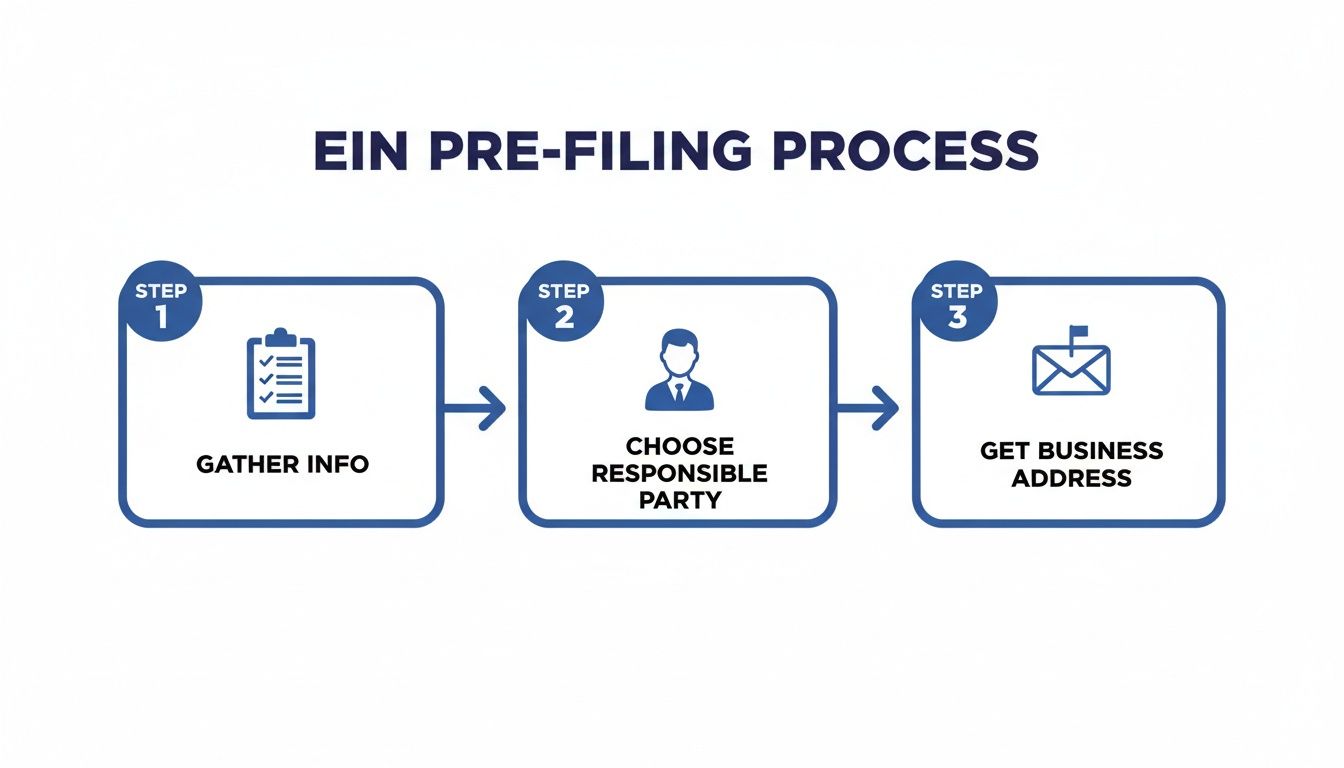
Honestly, having these things ready beforehand makes filling out the SS-4 a hundred times easier.
Navigating the Key Sections of the Form
Every line on the form matters, but a few carry extra weight for international applicants. These are the fields where a simple error can get your application tossed out or sent to a pile for a long, manual review.
Line 1: Legal Name of Entity This needs to be an exact match to your official formation documents. If your company is registered as "UK Tech Solutions LLC," don't shorten it to "UK Tech Solutions." The IRS is incredibly literal here—every character, comma, and space counts.
Lines 4a, 4b, 5a, and 5b: Mailing Address This is where you'll put the U.S. mailing address you've arranged, whether it’s from your registered agent or a virtual mail service. This address is critical because it's where the IRS will mail your official EIN confirmation letter, the CP 575. Don't risk using your UK address; critical documents can easily get lost or delayed in international post.
Line 7a and 7b: Responsible Party Pay close attention here—this is probably the most common stumbling block for UK founders. The "responsible party" has to be an individual person, not another company. It's typically a director or the main owner of the U.S. entity.
The crucial part is box 7b, which asks for an SSN, ITIN, or EIN. You must write the word "Foreign" in this box. Don't leave it blank. This one word is a direct signal to the IRS agent that you're a non-resident. We see this mistake all the time, and it’s a surefire way to get your application delayed.
Defining Your Business for the IRS
The next few lines are about giving the IRS a clear picture of what your business does and why you need an EIN. How you answer these can influence how your company is viewed for tax purposes, so clarity is essential.
Line 9a: Type of Entity Check the box that matches your U.S. business structure. For most UK entrepreneurs, this will be "Corporation" (if you've formed a C Corp) or "Limited Liability Company." If you have an LLC, you'll also have to state the number of members.
Pro Tip for LLCs: If you're a single-member LLC, you'll almost certainly need to file Form 8832, Entity Classification Election, to have your LLC treated as a corporation for tax purposes. This is a standard move for non-resident LLC owners to create a clean tax separation between their personal and business finances.
Line 10: Reason for Applying This section is simpler than it looks. For most UK founders, the reasons are straightforward:
Started a new business: This is the default choice for most startups launching a new U.S. company.
Banking purpose: If your main goal right now is to open a U.S. bank account, this is a perfectly acceptable reason.
Hired employees: Only check this if you intend to hire and pay U.S.-based employees immediately.
Just be honest. The IRS just wants to know the primary motivation behind your application.
Finalizing Your Details
The last part of the form gathers a few more operational details. Getting these right ensures your application is complete and prevents the IRS from having to send follow-up questions, which can add weeks to the timeline.
Line 11: Date Business Started This should be the official formation date of your U.S. entity. You'll find this on your state-issued documents, like a Certificate of Incorporation for a Delaware C Corp.
Line 16: Principal Activity Be specific but brief. Instead of just "Retail," write something like "E-commerce retail of clothing." If you're a SaaS company, "Software as a Service for B2B marketing" is much better than a vague term like "Technology."
Line 17: Principal Products or Services Here's your chance to add a bit more detail. Building on the examples above:
Clothing retailer: "Online sales of women's apparel."
SaaS business: "Subscription software for social media analytics."
Third-Party Designee This section is a lifesaver. It lets you authorize someone else—like a formation agent or a law firm—to communicate with the IRS about your application. If you’re working with a service like Set Up Stateside, this is where you’d put our details. It’s incredibly useful because it means a U.S.-based expert can quickly resolve any issues that come up, saving you the headache and cost of international phone calls with the IRS.
By taking the time to carefully fill out these key lines, you proactively answer all the main questions the IRS has about foreign-owned businesses. You’re clearly stating your non-resident status, identifying who is in control, and painting a clear picture of your U.S. operations, which is the fastest way to a smooth approval.
How to Apply: Phone, Fax, or Mail
Since the IRS's slick online EIN application is off-limits unless you have a U.S. Social Security Number (SSN), UK founders have to go old-school. But don't worry, the IRS gives you three solid alternatives: phone, fax, and mail.
Your choice here isn't just a matter of preference; it directly impacts how quickly you can get your U.S. business off the ground. Getting that nine-digit number is the key that unlocks everything else—opening a U.S. bank account, hiring staff, and signing with American clients. Let's break down the real-world pros and cons of each path.
The Phone Call: Your Fastest Route to an EIN
Want your EIN right now? The phone call is your best bet. It's hands-down the quickest way for any international founder to secure their number, often giving you the EIN verbally before you even hang up.
You’ll need to dial the IRS Business & Specialty Tax Line at +1 267-941-1099. Keep in mind, this is a standard international call, not a toll-free line. You’ll also need to time it right, calling during U.S. Eastern Time business hours—that’s 7:00 AM to 7:00 PM, which is roughly noon to midnight in the UK.
Before you even think about dialing, have your completed Form SS-4 printed and sitting right in front of you. The IRS agent on the other end will walk you through the form, line by line, so you need to be ready with the answers. If all your information is correct, they'll issue your EIN on the spot. Jot it down carefully and you're good to go.
The Fax Machine: A Reliable Middle Ground
For many UK entrepreneurs I've worked with, faxing the Form SS-4 hits the sweet spot between speed and having a paper trail. It’s much faster than snail mail but lets you avoid the potential hassle of a live IRS call across time zones.
Simply fax your signed and completed Form SS-4 to the dedicated international number: +1 304-707-9471. Once you hit send, you can typically expect to hear back within 4 to 7 business days, though it can sometimes take a bit longer if the IRS is swamped.
A huge plus for the fax method is the proof of delivery. Your fax service will generate a transmission report, giving you concrete evidence that the IRS received your application, stamped with the exact date and time. This little piece of paper can be a lifesaver if you ever need to follow up.
The Mailbox: The Slow and Steady Option
Mailing your Form SS-4 is the most traditional route, but it’s also by far the slowest. Honestly, this option only makes sense if you are in absolutely no rush to get your U.S. venture moving. We're talking weeks, and sometimes even months, of waiting.
If you do go this route, you'll send your signed Form SS-4 to this specific address:
Internal Revenue Service Attn: EIN International Operation Cincinnati, OH 45999 USA
Patience is the name of the game here. There's no immediate confirmation that it arrived, so you just have to wait for the official EIN confirmation letter, known as the CP 575, to show up in the mail.
Real-World EIN Application Timelines for UK Applicants
Timelines published by the IRS are one thing, but real-world experience is another. Based on the hundreds of applications we've handled, here’s a more realistic look at what to expect for each method, from the moment you submit your form to getting that official confirmation.
Application Method | Best Case Scenario | Average Wait Time | Worst Case Scenario (e.g., IRS delays) |
|---|---|---|---|
Phone | Instant | Instant (during the call) | Connection issues, long hold times |
Fax | 4 business days | 7 business days | 2–3 weeks |
4 weeks | 8–10 weeks | 12+ weeks |
These numbers can shift based on IRS backlogs, but they provide a solid benchmark for planning your next steps.
Using a Third-Party Designee to Skip the Hassle
Here’s a pro tip that can save you a world of trouble: use the "Third-Party Designee" section on Form SS-4. By filling this out, you give a trusted partner—like your formation agent here at Set Up Stateside—legal permission to talk to the IRS for you.
This is a game-changer. It means an expert based in the U.S. can make that international call, follow up on your fax, and sort out any minor questions from the IRS on your behalf. No more wrestling with time zones or trying to explain your business structure over a crackly phone line.
This strategy is common among the 10-15% of business applicants who are non-U.S. founders. Partnering with a professional firm is a proven way to speed things up, a tactic that became essential during events like the late December 2025 online system outage which pushed every single application into manual review. You can discover more insights about these business start metrics directly from the U.S. Census Bureau. For a UK entrepreneur, a designee ensures your U.S. launch is smooth, efficient, and compliant with both IRS and HMRC rules from day one.
You've Got Your EIN—Now What?

Holding that EIN confirmation letter in your hand is a great feeling. It’s the official nod from the U.S. government that your business is real, recognised, and ready to go. But that nine-digit number isn't the finish line. Think of it as the starting pistol for the next phase of your American expansion.
Now the real work begins. Your EIN is a tool, and to build a successful U.S. operation, you need to know exactly how to use it. There are a few immediate and critical steps you have to take to get your company fully operational, compliant, and ready for growth.
Open Your U.S. Business Bank Account
This should be your absolute first priority. Without a U.S. business bank account, your American company is really just a name on a piece of paper. It’s the only way to manage U.S. revenue, pay local suppliers, and keep a clean financial separation between your UK and U.S. operations.
Trying to run a U.S. business through your UK bank account is a recipe for an accounting nightmare. It can also create some serious compliance headaches with both the IRS and HMRC. U.S. banks simply won't open a business account without an EIN, which is why getting this number is such a crucial first step.
Your EIN is the key that unlocks the U.S. financial system. A dedicated U.S. bank account is essential for financial clarity, simplifies tax reporting, and establishes your company's legitimacy with American customers and partners.
Finding the right bank can be tricky. Some traditional U.S. banks are still wary of non-resident founders, but thankfully, many modern financial institutions and fintechs are specifically designed to serve international entrepreneurs. To get a better handle on your options, check out our expert guide to opening a U.S. bank account online for non-residents.
Set Up U.S. Payroll and Tax Withholding
Planning to hire a team in the States? If so, your EIN is the foundation of your entire payroll system. You cannot legally pay an employee in the United States without one. This is the number you'll use to report wages and send payroll taxes to the IRS.
Setting up payroll involves more than just wiring salaries. You’ll be on the hook for:
Withholding Taxes: You must withhold federal income tax, Social Security, and Medicare taxes from your employees' paychecks.
Filing Payroll Reports: You'll need to file specific forms with the IRS, like Form 941 (Employer's Quarterly Federal Tax Return), to report the taxes you’ve withheld.
Paying Employer Taxes: On top of what you withhold from employees, your company must also pay its own share of Social Security and Medicare taxes.
This is a complex area, and the penalties for getting it wrong can be steep. For most UK founders, using a reputable U.S. payroll provider is the smartest move you can make.
Register for State-Level Taxes
Your federal EIN is just one piece of the compliance puzzle. Depending on where your business operates and what it sells, you’ll likely need to register for various state-level taxes, too. And you guessed it—your EIN is almost always required for these state registrations.
Common state tax obligations include:
Sales Tax: If you sell products or certain services to customers in a state, you may need to get a sales tax permit and start collecting tax on behalf of that state. This is especially critical for e-commerce businesses.
State Payroll Taxes: Beyond federal rules, most states have their own payroll taxes, such as state unemployment insurance (SUI).
Franchise or Corporate Income Tax: Many states impose their own corporate income or franchise taxes, which are completely separate from your federal tax bill.
Figuring out where you have a business connection, or "nexus," can be complicated. It’s vital to understand your obligations in every state where you do business to avoid nasty surprises from state tax agencies down the line.
Establish Your Bookkeeping System
Finally, don't put off setting up your accounting system. From your very first transaction—whether it’s paying a formation fee or receiving your first U.S. dollar—you need to be tracking everything. This isn't something you can just sort out later.
Proper bookkeeping is the backbone of financial compliance and smart decision-making. Using a cloud-based accounting platform like QuickBooks or Xero is a great place to start. It allows you to monitor your company's financial health in real-time and makes year-end tax preparation infinitely less painful.
Getting your EIN is a huge milestone, but it’s the actions you take immediately after that will determine whether your U.S. venture is built on a solid, compliant foundation.
Common Questions from UK Founders
Getting a U.S. EIN from across the pond in the UK naturally brings up some very specific questions. Having walked countless founders through this exact process, I've seen the same worries and points of confusion crop up again and again. Let's tackle them head-on.
This is all about clearing up those nagging "what if" scenarios so you can move forward with confidence.
Can I Get an EIN Without a U.S. Company or Address?
This is probably the most common question I hear, and the short answer is a firm no. The IRS issues an EIN to a legally formed business entity, not to an individual founder or a promising business idea. You absolutely must form your U.S. entity first—whether it's an LLC or a C Corporation—in a specific state.
A U.S. mailing address is also non-negotiable for the IRS.
Why it's needed: The IRS sends your official EIN confirmation letter (the CP 575 Notice) and all future tax documents to this address. You can't just use your UK address for this.
Your solution: Don't worry, you don't need a physical office. A virtual mailing address or using your registered agent's address are both standard, perfectly legitimate solutions. This ensures you receive every important piece of mail digitally and on time.
How Much Does an EIN Actually Cost?
Here’s some surprisingly good news: applying for an EIN directly with the IRS is completely free. The U.S. government doesn't charge a fee for issuing this number, no matter how you apply.
So why do services charge for it? Many UK founders wisely choose to use a formation service to handle the application. The fee you pay is for the expertise—knowing how to complete Form SS-4 correctly for non-residents, managing the back-and-forth with the IRS, and ensuring a smooth, timely approval. It’s an investment in saving yourself the time and headache of dealing with an unfamiliar government agency from thousands of miles away.
Be wary of any website that looks like it's "selling" you an EIN. Legitimate services are crystal clear that they're charging for their time and expertise, not for the government number itself.
What if I Make a Mistake on My SS-4 Application?
Mistakes happen, but the fix depends on when you catch it. If you spot an error after submitting the form but before the IRS has issued an EIN, you might have to send a corrected form, which will definitely slow things down.
If an EIN has already been assigned with the wrong information, you'll need to send a formal letter to the IRS. In it, you'll need to clearly explain the error and provide the correct details, making sure to reference your new EIN. Honestly, this is a prime example of where an expert partner saves the day, first by preventing these mistakes and then by managing the correction process if one slips through.
Do I Need a New EIN if I Change My Business Structure?
Yes, in most cases, a major change to your business's legal DNA requires a brand new EIN. The IRS essentially sees it as a new entity being born. For instance, if you convert your single-member LLC into a C Corporation to take on investors, you will have to apply for a new EIN for that corporation.
Minor changes, on the other hand, usually don't require starting over. Things like changing your business name or updating your address can typically be handled by just notifying the IRS in writing. This keeps their records current without forcing you to re-apply and rebuild your business's financial identity from the ground up.
Navigating the EIN application and U.S. compliance can feel like a maze, but you don't have to figure it out alone. Set Up Stateside specializes in helping UK founders just like you establish and grow their business in the United States with confidence. From formation and EIN acquisition to accounting and tax compliance, we're your dedicated U.S.-based partner.


Comments