

Opening Foreign Subsidiary Companies in the USA: A Founder's Guide

Expanding your international business into the United States is a significant step, and one of the first and most critical decisions you'll make is how to structure your American presence. For serious, long-term growth, the most robust and common approach is to create a U.S. foreign subsidiary.
Think of it this way: your parent company is the main tree, and the U.S. subsidiary is a new tree planted in American soil. While it grew from your seed, it stands on its own, subject to local conditions and laws. This structure provides the security and scalability that global businesses need to build a secure and lasting foothold in the U.S. market.
What Is a US Foreign Subsidiary Company?

Simply put, a U.S. foreign subsidiary is a legally distinct American company owned or controlled by a parent business located in another country. It's not just a satellite office; it’s a fully-fledged U.S. business, usually established as a Limited Liability Company (LLC) or a C Corporation.
The most powerful feature of this structure is liability protection. A subsidiary builds a legal "firewall" between your global operations and your new U.S. venture. If the American entity incurs debt, faces a lawsuit, or suffers financial losses, the parent company's assets back home are shielded.
This corporate separation is a powerful risk management strategy, making it the preferred route for any serious, long-term expansion. For the international business owners we work with, this peace of mind is the single biggest reason they choose a subsidiary over other setups.
The Core Identity of a US Subsidiary
To truly understand why this structure is so popular, it's important to grasp its fundamental design. A U.S. subsidiary is engineered to blend seamlessly into the American business landscape, even with its international ownership.
The U.S. remains the world's premier destination for business investment. The latest figures show that cumulative foreign direct investment in the U.S. has hit an incredible $5.7 trillion. A significant portion of that comes from long-standing economic partners like Japan ($819 billion) and Canada ($812 billion), which speaks volumes about the trust global companies place in the American market. You can explore these global investment trends for more context.
A foreign subsidiary operates like any other local company but has international backing. It hires American talent, serves U.S. customers, and pays U.S. taxes. Crucially, it builds its own brand identity and credit history, separate from its parent.
To make this crystal clear, here’s a quick rundown of the key characteristics that define a U.S. subsidiary.
Key Characteristics of a U.S. Foreign Subsidiary
Characteristic | Description |
|---|---|
Legal Status | A separate legal entity formed under U.S. federal and state law, typically an LLC or Corporation. |
Ownership | Majority-owned or wholly-owned by a parent company headquartered outside the United States. |
Liability | The parent company is protected from the debts and legal liabilities incurred by the U.S. subsidiary. |
Operations | Governed by U.S. regulations, with its own management team, assets, and bank accounts. |
Taxation | Subject to U.S. federal, state, and sometimes local taxes on its income and business activities. |
Market Perception | Seen as a legitimate, permanent U.S. business, which builds immense trust with customers, banks, and partners. |
This table neatly sums up why the subsidiary model offers such a powerful combination of local integration and global protection. It allows you to operate with the credibility of an American company while keeping your core business secure.
Why Choose a Subsidiary Over a Branch Office

When you're ready to expand into the U.S. market, your first major decision is choosing the right legal structure. For most international businesses, this boils down to two paths: setting up a foreign subsidiary company or just opening a U.S. branch office. They might sound similar on the surface, but the legal and financial reality couldn't be more different.
Here’s a simple way to think about it. A branch office is just an extension of your parent company—like adding a new desk to your existing office. A subsidiary, on the other hand, is like building a whole new, independent house right next door. You own it, but it stands on its own foundation. That single distinction is what gives it a massive advantage in security and opportunity.
The Critical Difference: Legal Liability
If there’s one reason business owners overwhelmingly choose a subsidiary, it’s liability protection. By forming a U.S. subsidiary (like an LLC or a C Corporation), you create a legally separate entity. This builds a powerful firewall between your U.S. operations and your global headquarters.
Imagine your American business faces a lawsuit or runs into financial trouble. With a subsidiary, the risk stops there. The problem is contained within the U.S. entity, and your parent company's assets—your headquarters, your international bank accounts, everything—are shielded from the fallout.
A branch office offers zero protection. Since it’s legally the same entity as the parent, any debt or lawsuit originating in the U.S. puts your entire global business on the line. A legal dispute in California could suddenly threaten your assets back home in London or Singapore. For any serious entrepreneur, that's a risk not worth taking.
A subsidiary contains risk, while a branch office multiplies it. By creating a separate legal entity, you ensure that a problem in one market doesn't jeopardize your entire international enterprise.
Enhancing Credibility and Operational Freedom
Beyond the legal shield, how your business is perceived in the U.S. matters immensely. American partners, banks, and customers are far more comfortable dealing with a formally incorporated U.S. entity.
Setting up a subsidiary sends a strong signal that you're here to stay. It shows commitment. This U.S. company can open its own bank accounts, build its own credit history, and sign contracts under its own name, which smooths out day-to-day business and builds crucial trust.
Banking and Finance: U.S. banks are often wary of opening accounts for a foreign branch, seeing them as less permanent. A subsidiary, as a domestic company, can access banking and financing far more easily.
Customer Trust: American customers feel more confident buying from a U.S. company. It makes everything from payments to customer support feel local and secure.
Operational Autonomy: A subsidiary can have its own management team that adapts quickly to the local market. A branch often needs a green light from headquarters for every big decision, which can seriously slow you down.
A Clear Comparison: Subsidiary vs. Branch Office
To make this crystal clear, let's put these two structures side-by-side. Seeing the differences laid out like this really drives home why foreign subsidiary companies are the go-to choice for ambitious founders looking for secure, long-term growth in the American market.
Subsidiary vs. Branch Office Key Differences
Feature | U.S. Subsidiary (LLC/Corporation) | U.S. Branch Office |
|---|---|---|
Legal Liability | Contained within the U.S. entity, protecting the parent company's global assets. | Unlimited, exposing all of the parent company's global assets to U.S. risks. |
Legal Status | A separate and distinct U.S. legal company. | An extension of the foreign parent company; not a separate legal entity. |
Market Perception | Viewed as a stable, permanent U.S. business, building high trust. | Often seen as temporary or foreign, which can create friction with banks and partners. |
Operational Ease | Can open U.S. bank accounts, build credit, and operate independently. | Faces significant challenges with banking and may have limited autonomy. |
Growth Potential | Can raise capital from U.S. investors and is structured for long-term scalability. | Limited ability to attract U.S. investment and can be complex to manage. |
Choosing a subsidiary isn't just a box to check—it's a foundational strategic decision. The experts at Read & Associates can help you navigate this choice and ensure your U.S. entry is built on solid ground.
Cracking the Code on U.S. Tax and Compliance
For many international business owners, the American tax system looks like a labyrinth. But once you set up a subsidiary, you're not lost in a maze—you're playing on a field with a clear set of rules. The key is knowing those rules from the start to avoid costly surprises down the road.
Think of your new U.S. subsidiary as a local American company in the eyes of the IRS. It’s subject to the same tax obligations as any other business operating in the States, which is actually a good thing—it levels the playing field. Your main job will be paying corporate income tax on the profits your company generates in the U.S.
But it’s not just one tax. You’ll be dealing with a layered system, starting with federal taxes and then, depending on your location, state taxes.
Federal and State Corporate Income Taxes
First up is the federal government. Your U.S. subsidiary has to file an annual tax return (Form 1120 for a C Corporation is the most common) and pay federal income tax on its net profits. This is why clean, consistent bookkeeping isn't just a good habit; it's essential for tracking every dollar of revenue and every deductible expense.
Next, you have state taxes. Most states have their own corporate income tax, and the rules and rates vary widely. Some states, like Texas, have no corporate income tax at all, while others have rates that can take a real bite out of your profits. Where you choose to incorporate and operate has a massive impact here.
Good tax planning isn’t about dodging what you owe; it’s about legally minimizing your combined federal and state bill so you're not overpaying.
Getting Profits Home: Withholding Taxes
So, how do you get your U.S. profits back to the parent company? When you send money home as a dividend, the U.S. government typically takes a cut first. This is called a withholding tax.
The default withholding rate is a steep 30%. This is where tax treaties become your best friend. The U.S. has agreements with dozens of countries specifically to prevent profits from being taxed twice and to make investing in the U.S. more attractive.
A tax treaty can slash that 30% withholding tax rate down to something much more manageable, often between 5% and 15%. For a growing company, this simple provision can mean saving tens or even hundreds of thousands of dollars.
Taking advantage of these treaties is a core financial strategy for any international business. It requires some careful setup and paperwork, but the payoff is huge.
Transfer Pricing: Playing by the "Arm's Length" Rule
What happens when your U.S. subsidiary and its foreign parent do business with each other? Maybe the parent company licenses software to the subsidiary or provides management services. The IRS wants to make sure these internal transactions are priced fairly, and they have a rule for it: transfer pricing.
The whole point is to stop companies from artificially moving profits to countries with lower taxes. You can't have the parent company charge the U.S. subsidiary a ridiculously high fee for services just to shrink the U.S. profit and lower the tax bill. The guiding concept is the "arm's length principle."
What it means: You must price transactions between your related companies as if they were two strangers negotiating on the open market.
Why it matters: The IRS watches these intercompany dealings closely. Getting it wrong can lead to large tax adjustments, painful penalties, and years of interest payments.
How to comply: Keep detailed records that prove your pricing is fair and justifiable. As you grow, a formal transfer pricing study becomes a must-have.
Must-Do Reporting for Foreign Owners
On top of paying taxes, the U.S. government requires specific informational reports from companies with foreign ownership. These aren't suggestions—they're mandatory. The penalties for failing to file are severe, often starting at $25,000 for each missed form.
Two of the most critical forms for foreign subsidiary companies are:
Form 5472 (Information Return of a 25% Foreign-Owned U.S. Corporation): This is where you report any and all transactions between your U.S. subsidiary and its foreign parent or affiliates. It’s the IRS's primary tool for monitoring your transfer pricing.
FBAR (Report of Foreign Bank and Financial Accounts): If your U.S. company holds more than $10,000 in bank accounts outside the U.S., you must report it every year to the Financial Crimes Enforcement Network (FinCEN).
Even with some global economic uncertainty, the U.S. remains a top destination for investment. While global foreign direct investment recently dipped to $1.5 trillion, the total stock of FDI in the U.S. climbed to a record $5.7 trillion. You can dig into these trends in the full UNCTAD World Investment Report. This massive inflow of capital keeps regulatory scrutiny high, which means getting compliance right is more crucial than ever.
These rules might seem strict, but they are predictable. The trick is to be proactive, not reactive. Having an expert team on your side to manage the filings gives you the peace of mind to focus on what you do best: building your business.
A Practical Roadmap to Setting Up Your US Subsidiary
Let's move from theory to action. This is where your US expansion gets real. We'll walk you through the core steps for getting your foreign subsidiary off the ground, turning that strategic plan into a legitimate, operational American business.
Think of this as your setup checklist. We’ll start with the big, foundational decisions and work our way down to the nitty-gritty details of opening your doors for business. The first two choices—your business structure and state of incorporation—are the most critical, as they set the stage for everything that follows.
Choosing Your US Entity Type: LLC vs. C Corporation
Your first major decision is choosing between a Limited Liability Company (LLC) and a C Corporation. An LLC often gets attention for its simplicity and "pass-through" tax structure, where profits flow directly to the owners. But for a foreign parent company, this can actually create a tangled mess of tax reporting obligations back home.
For this reason, a C Corporation is almost always the best choice for a subsidiary. It’s a completely separate legal and tax entity. This means its profits are taxed in the US first, and then funds are sent to the parent company as dividends. This clean separation makes international tax compliance much simpler and is the structure that US investors and partners expect to see.
Selecting the Right State for Incorporation
Once you’ve settled on a C Corp, you have to decide where to incorporate it. You could technically choose any of the 50 states, but a couple of them are clear favorites for international founders for very good reasons.
Delaware: This is the undisputed champion for corporations. Why? Because Delaware has a deep, predictable, and business-friendly body of corporate law. Its specialized Court of Chancery handles business disputes, offering stability that you just don't find elsewhere. If you ever plan to seek venture capital funding, Delaware is the standard.
Wyoming: A fantastic, cost-effective alternative. Wyoming is known for strong privacy protections and minimal red tape. It's an excellent option for businesses that are more focused on protecting assets and keeping administrative overhead low.
This isn't just about comparing filing fees. It's a strategic move based on your vision—whether that's chasing investment, shielding assets, or simply keeping things simple.
Executing the Setup Process Step-by-Step
With your entity type and state picked out, it's time to make it official. This part of the process involves filing paperwork with state and federal agencies to bring your company to life.
File Formation Documents: This is the moment your company is legally born. You'll file either "Articles of Incorporation" (for a C Corp) or "Articles of Organization" (for an LLC) with the Secretary of State in your chosen state.
Appoint a Registered Agent: Every single company in the US needs a registered agent. This is a person or a service that agrees to receive official legal mail and government notices on your company's behalf. Crucially, they must have a physical street address in the state where you’re incorporated.
Obtain an Employer Identification Number (EIN): Think of the EIN as a Social Security Number for your business. It’s your federal tax ID, and you absolutely need one. As a non-resident, you can get an EIN without a US Social Security Number, but it requires careful completion of Form SS-4 and a direct application to the IRS.
This flowchart gives you a clear picture of how money and reporting will move through your new subsidiary.
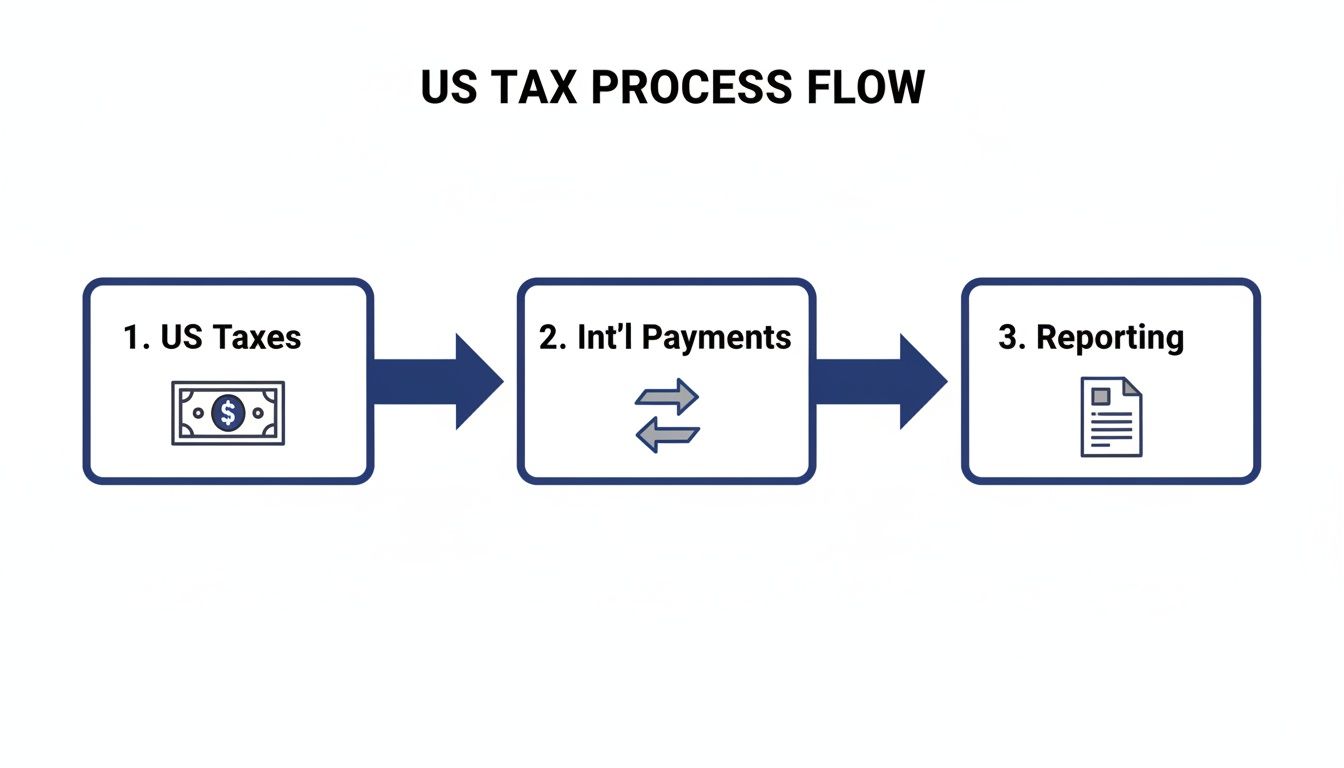
As you can see, running the business is a constant cycle of managing US taxes, handling international payments, and staying on top of mandatory reporting. Getting this right requires professional oversight from day one.
Critical Post-Formation Tasks
Once the state approves your filing, your company legally exists. But hold on—you’re not ready to do business yet. A few more steps are essential to get you fully operational and compliant.
Setting up the entity is just the first checkpoint. The steps you take immediately after—opening a bank account and establishing a clean accounting system—are what truly prepare your subsidiary for sustainable growth and financial clarity.
Opening a US business bank account is priority number one. While this has become more challenging for non-residents, it's completely achievable with the right documents and guidance. A US bank account is non-negotiable for taking payments from American customers, paying local vendors, and building a financial footprint here.
Finally, set up a professional accounting system immediately. Use software like QuickBooks or Xero right from the start. Clean bookkeeping is the backbone of your business's financial health. It lets you track income, manage expenses, and prepare for tax season without any last-minute panic. This early work prevents massive headaches down the road. Partnering with a firm like Read & Associates can ensure every one of these steps, from formation to ongoing accounting, is handled perfectly.
Keeping Your US Operations Compliant and Growing
Launching your US subsidiary is a huge milestone, but it's really just the starting line. What comes next—the day-to-day work of keeping your new American company healthy and compliant—is what truly determines its long-term success.
Think of it like buying a brand-new car. The purchase is exciting, but the real ownership experience depends on regular maintenance. If you skip the oil changes and tire rotations, you're setting yourself up for a breakdown. The same is true for your subsidiary.
The Non-Negotiable Annual Compliance Tasks
Every state has a set of rules to ensure companies operating there remain in "good standing." These are not just suggestions; they are legal requirements with hard deadlines. Missing them can lead to hefty fines or, in the worst-case scenario, the state could dissolve your company.
The most common requirement is the Annual Report. This is essentially a yearly check-in with the state where you confirm or update essential details like your registered agent's address or the names of your directors. It's a simple but vital step to show your company is still active and legitimate.
You'll also need to renew your registered agent service every year. This service is your official point of contact on US soil, ensuring you receive critical legal notices and government mail without delay.
Building a Strong Financial Foundation
Beyond the state-level paperwork, the financial backbone of your subsidiary has to be solid. This all starts with disciplined, ongoing bookkeeping from day one. Every single transaction, from a major sale to a minor expense, needs to be recorded accurately in a professional accounting system.
This isn't just about making tax time easier. Clean, up-to-date books give you a clear dashboard of your company's performance. It's how you make smart, data-driven decisions on everything from pricing and budgeting to your next big expansion move.
Excellent bookkeeping is what makes proactive tax planning possible. It helps you see your tax liabilities coming, find eligible deductions, and avoid that gut-punch of an unexpected tax bill. This is how you master your cash flow and reinvest your profits intelligently.
Scaling Operations and Navigating New Hurdles
As your US business grows, so will your list of responsibilities. For foreign subsidiary companies, two major milestones are hiring employees and selling into new states—and each one introduces a new layer of compliance.
Hiring a US Team: The moment you hire your first US employee, you're officially in the world of payroll. This means registering with state labor departments, setting up withholding for federal and state taxes, and filing regular payroll tax returns. US labor laws can be complex, so getting this right from the start is absolutely critical.
Understanding Sales Tax Nexus: If you're selling goods or certain services, you need to get familiar with sales tax. The key concept here is "nexus," which is a significant connection between your business and a state that obligates you to collect and remit their sales tax. This can be triggered by having a physical presence or, more commonly for online businesses, by crossing a state's sales threshold (like $100,000 in sales).
Trying to manage all these ongoing duties can quickly distract you from what you do best: growing your core business. This is exactly why so many international founders choose to work with an advisory firm. We can take care of the annual reports, bookkeeping, tax strategy, and payroll, leaving you free to focus on the big picture.
This model is a well-worn path for a reason. American multinational companies alone hold $6.83 trillion in direct investments abroad, proving that subsidiaries are the engine of international business. You can dive deeper into these powerful global growth trends to see how it's done. By outsourcing your compliance, you’re not reinventing the wheel—you’re following a blueprint used by the world's most successful companies.
Your Expert Partner for US Market Entry
As this guide makes clear, setting up a U.S. subsidiary is a serious undertaking. It’s the most robust and scalable way for an international business to plant its flag in the American market, but it comes with its fair share of complexity.
The good news? You don't have to navigate the maze of U.S. legal, tax, and compliance rules by yourself. That's where our team of experts comes in.
Our firm was built from the ground up to serve international business owners. We've designed a complete, end-to-end service that takes you from the initial "what if?" conversations all the way to managing a thriving U.S. operation.
We Handle the Details, You Handle the Growth
We take care of every last detail of the setup and ongoing management so you can pour your energy into what you do best: growing your business. Think of us as your integrated U.S. launch team, giving you total peace of mind that everything is built on a solid foundation.
The Right Structure: We'll walk you through choosing the right entity—usually a C Corporation—and help you decide on the most strategic state to incorporate in.
Getting Your EIN: Our team will manage the IRS application to get your federal Employer Identification Number (EIN), an absolutely essential step for any foreign subsidiary.
Keeping the Books Clean: From day-to-day bookkeeping on platforms like Xero or QuickBooks to preparing and filing federal and state taxes, we keep your financial house in order all year long.
Strategic Growth Advice: As your business evolves, we're right there with you, providing expert guidance on everything from sales tax nexus to setting up payroll and making smart financial decisions.
Navigating the American market takes more than just a checklist. It demands a strategic partner who has been in the trenches and truly understands the unique hurdles international entrepreneurs face. We are that partner.
Ready to make your U.S. expansion a reality? Let’s map out a successful market entry plan together.
Schedule a consultation with our team today. We'll handle the complexities so you can focus on the opportunity ahead.
Got Questions? We've Got Answers
When you're looking to expand into the U.S., a lot of questions come up. Here are a few of the most common ones we hear from international business owners, along with straightforward answers to help you see the path forward.
What's the "Best" State to Form a U.S. Subsidiary?
Honestly, there's no single "best" state. The right choice really comes down to your business goals.
For instance, Delaware is the go-to for founders who plan on raising venture capital. Its corporate law is well-established and predictable, which is exactly what investors want to see.
On the other hand, a state like Wyoming is often a great fit for entrepreneurs who are more focused on privacy and strong asset protection. The key is to think about your long-term vision first and then pick the state that helps you achieve it.
Do I Actually Have to Fly to the U.S. to Get This Done?
No, you do not. You can set up your entire U.S. subsidiary without ever leaving your home country. Every part of the process, from filing the formation documents to getting a registered agent, can be managed completely remotely.
While opening a U.S. business bank account has definitely gotten trickier for non-residents in recent years, it's far from impossible. We've built relationships and streamlined the processes that work, helping business owners open accounts without the need for a trip.
How Long Does It Take to Set Up a U.S. Subsidiary?
The timeline can shift a bit depending on which state you choose and whether you form an LLC or a C Corp. The state's own processing time can be anywhere from a few days to a couple of weeks.
The biggest variable for most non-residents is getting an Employer Identification Number (EIN) from the IRS, which can easily take several weeks. All in, you should probably budget for a 4-8 week process from the day you start to the day you're fully up and running.
This timeframe gives you enough runway to make sure the legal and financial foundation of your foreign subsidiary company is solid, setting you up for success from day one.
Expanding into the U.S. is a huge step, and you shouldn't have to navigate it alone. At Read & Associates Inc., we specialize in handling the entire journey for international founders—from formation and EINs to your ongoing accounting and tax compliance. Let us manage the details so you can focus on growing your business. Schedule your consultation today at https://www.readandassociates.us.


Comments