

A Founder's Guide to Moving an LLC to Another State
- Read & Associates
- 6 days ago
- 17 min read

Deciding to move your LLC is a significant strategic shift, not just a pile of paperwork. Usually, the push comes from seeking a better tax environment, simpler regulations, or a direct path into a new market. Understanding why you're moving is the first, most critical step in executing the process correctly. This guide will walk you through the strategic decisions and practical steps required for a successful relocation, helping you make informed choices that benefit your business in the long run.
Why Would a Founder Move Their LLC to Another State?
Relocating an LLC isn’t a decision made on a whim. It’s a calculated move designed to optimize operations, reduce costs, and position the company for long-term success. For international founders navigating the complexities of the U.S. market, these reasons are even more critical—the right state can make or break your profitability and ease of doing business. The motivations vary, but they generally boil down to a handful of core business drivers.
Aligning with Your Actual Business Operations
One of the most practical reasons to move your LLC is that your business's center of gravity has shifted. As your company grows and evolves, the state where you first filed your paperwork might no longer be the best fit.
Consider a tech startup that launched in California. Fast forward a few years, and the entire team is now remote, spread across the country. Sticking with a California LLC means paying the $800 minimum annual franchise tax and navigating complex regulations, all for a state where you have no physical footprint. In this scenario, moving to a state like Wyoming or Texas—with no state income tax and simpler reporting requirements—is a logical business decision. It reduces administrative burdens and cuts unnecessary costs.
The key term here is nexus. This legal concept defines the connection between your business and a state that triggers a tax obligation. Moving your LLC can be a strategic way to simplify your nexus situation, especially if you no longer have employees, offices, or significant sales in your original state.
Hunting for a Friendlier Tax Environment
Let’s be direct: state taxes are a huge motivator. As a business owner, you're always looking for ways to keep more capital working for your business, and relocating to a state with a more favorable tax structure is a direct path to achieving that goal.
The most common tax-driven reasons for a move include finding a state with:
No state income tax: States like Florida, Nevada, and South Dakota are popular destinations because they don't tax LLC profits at the state level, which can lead to substantial savings.
Lower franchise taxes: Some states impose significant annual fees just for the privilege of being registered there. A move can drastically reduce these fixed costs.
Simpler compliance rules: Less complicated reporting requirements mean less time and money spent on accounting and legal services.
Making a strategic move like this frees up capital that would have otherwise gone to the state, allowing you to reinvest it into growth, product development, or marketing. For an international founder, this financial efficiency provides a significant competitive advantage. While the process requires careful planning, the long-term payoff is often well worth the effort. If you're weighing these factors, a consultation can help you pinpoint the best state for your business.
Choosing Your Relocation Strategy
Once you've decided that moving your LLC to another state is the right move, the next critical question is how to execute it. You have four primary options, and your choice will directly impact your business continuity, costs, and the administrative workload involved. Making the right decision at this stage is crucial for avoiding significant complications later on.
Each option—domestication, foreign qualification, merging, or dissolving to start over—serves a distinct purpose. Your choice should align with whether you are making a permanent move, simply expanding your operations, or pursuing a more favorable business climate.
Understanding Your Four Main Options
The path you choose should align with your company's long-term vision. Domestication is typically the most efficient route for a complete relocation, while foreign qualification is designed for expansion. Let’s break down what each of these options entails for your business.
Domestication (or Conversion): This is the process of officially moving your LLC's legal home. It transfers your registration from the original state to the new one. Your business is effectively "re-domiciled" in the new state while retaining its original identity, history, and, most importantly, its federal Employer Identification Number (EIN).
Foreign Qualification: This isn't a move but an expansion. You register your existing LLC to legally conduct business in a second state, where it will be classified as a "foreign LLC." This means you will be responsible for compliance and fees in both states.
Dissolving and Re-forming: This is the "start from scratch" approach. You legally terminate your LLC in the original state and form a brand-new one in the new state. While it provides a clean break, it comes at a significant cost: you lose your business's operational history and its original EIN.
Merging: This is a more complex strategy. It involves creating a new LLC in your target state and then legally merging your original LLC into it. The new company absorbs all the assets, liabilities, and history of the old one.
This flowchart provides a quick visual guide to help you determine which strategy makes the most sense for your specific situation.
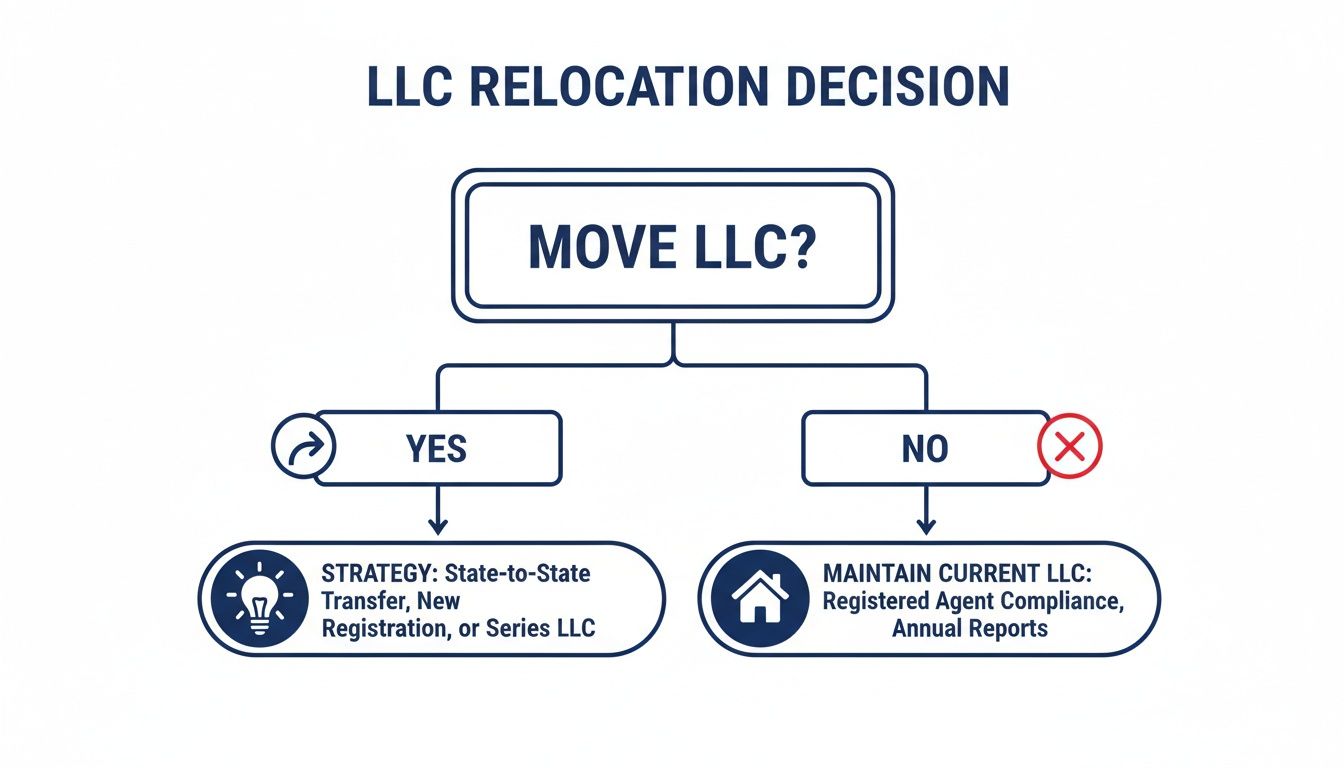
As you can see, the first critical question is whether you are relocating permanently or simply expanding your operational footprint. The answer will guide you toward the most appropriate strategy.
Comparison of LLC Relocation Methods
To make an informed decision, you need to compare how these options stack up. Each path has a different impact on your business's continuity, tax identity, and the overall complexity of the process. For international founders, in particular, preserving the business history and an established EIN is often non-negotiable for maintaining crucial banking and credit relationships in the U.S.
This decision is more relevant than ever. The U.S. has experienced a surge in new business formations, reaching a record 478,800 per month in 2025—a staggering 435% increase since 2004. This boom underscores how common multi-state operations have become. You can explore more of this data in this report on small business statistics from kaplancollectionagency.com.
To clarify the legal jargon, here’s a table that lays out the key differences.
Method | Business Continuity | EIN Status | Typical Complexity | Best For |
|---|---|---|---|---|
Domestication | Seamless. Preserves original formation date, credit history, and contracts. | Keep Existing EIN. The LLC is considered the same entity. | Moderate. Requires filings in both states, but is a streamlined process where allowed. | Permanently relocating the entire business to a state that permits domestication. |
Foreign Qualification | Maintained. Operates as one entity across two states. | Keep Existing EIN. No new entity is formed. | Low. Involves a straightforward registration in the new state. | Expanding operations into a new state while maintaining a presence in the original one. |
Dissolve & Re-Form | Interrupted. The original LLC ceases to exist, and a new one is created. | Need New EIN. The new LLC is a separate legal entity. | High. Involves two separate legal processes: dissolution and formation. | When domestication isn't an option and you need a clean break from the original state. |
Merge into New LLC | Seamless. Assets and history are absorbed by the new entity. | Need New EIN. The surviving LLC is a new entity. | Very High. The most complex and costly option, often requiring legal assistance. | Complex business structures or when acquiring another entity as part of the move. |
Expert Insight: In our experience, especially with non-resident founders, domestication is the gold standard. It protects the operational history that is critical for U.S. banking and vendor relationships. Dissolving and re-forming should always be the last resort, as it effectively resets your entire business identity and can disrupt established financial relationships.
Ultimately, your choice is a balance between cost, complexity, and continuity. If your business has existing contracts, a solid credit history, and established banking, preserving that continuity with domestication is almost always the superior choice. However, if you are just testing a new market, foreign qualification offers a lower-commitment path to expansion.
Navigating these state-specific rules can be challenging. If you are unsure which path best protects your company's interests, seeking expert advice is a wise investment. Our team can help you map out the most effective strategy for your move—feel free to schedule a consultation with us to discuss your options.
How to Actually Domesticate Your LLC
If you've determined that domestication is the best path forward, you've made a smart choice. It is often the most efficient way to relocate an LLC because it preserves your business history, credit, and that crucial federal EIN. Think of it as your company moving to a new house, not starting a new life from scratch.
However, this process involves more than just a change-of-address form. It's a formal legal conversion that must be handled with precision. You'll be dealing with official state filings, internal company agreements, and formally ceasing operations in your old state. An error in any part of this process can lead to serious complications, such as compliance fines or even jeopardizing your limited liability protection.

First Things First: Can You Even Domesticate?
Before you invest time or money, you must answer one critical question: do both the origin and destination states permit LLC domestication? Not every state has a statutory process for it. While a majority of states now support domestication, laws are subject to change.
Your first action should be to visit the Secretary of State's website for both your current and new states. Search for terms like "domestication," "conversion," or "continuance" to find the relevant statutes and procedures. This is a non-negotiable first step. Misunderstanding this can lead to wasting significant time and money on an unviable path.
Once you confirm domestication is possible, investigate the specific requirements for each state. You'll need to know:
The Paperwork: What exact forms are required? Typically, you'll need to file Articles of Domestication, obtain a Certificate of Good Standing from your original state, and sometimes submit new Articles of Organization in the new state.
The Cost: Filing fees vary widely. They can range from less than $100 to over $500 per state. Be sure to budget accordingly.
The Wait: Government processing times differ. It can take a few business days or stretch into several weeks. Understanding these timelines helps you set realistic expectations for the transition.
Draft a Plan of Domestication
Next, you'll need an internal but crucial document: the Plan of Domestication (sometimes called a Plan of Conversion). This document serves as your company's official internal roadmap for the move.
The plan should clearly state that your LLC is moving from State A to State B and agrees to be governed by the laws of the new state. If your LLC has multiple members, your operating agreement will specify the procedure for approving such a plan. It is always best practice to formalize this approval in writing through a member resolution—this creates a clear legal record and protects all parties involved.
Expert Tip for International Founders: If you are running your U.S. company from abroad, business continuity is paramount. Domestication is your best option because it ensures your U.S. bank accounts, contracts, and credit history all move seamlessly with the same legal entity, preventing the disruption of starting over with a new LLC.
Making it Official: The State Filings
With your internal plan approved, it's time to file with the states. The process almost always begins with the state you're moving to. You will submit the Articles of Domestication and any other required paperwork.
A key document you'll need is a Certificate of Good Standing from your original state. This proves that your LLC is compliant and has paid all its taxes and fees. Pay close attention to the date—most states require this certificate to be recent, typically issued within the last 30 to 90 days.
Once the new state approves the domestication, you have one final, critical task: officially terminating your registration in the old state. A surprising number of founders overlook this step, leaving them liable for old taxes and annual reports. You will file Articles of Dissolution (or a similar document) to inform the old state that you have permanently relocated. Timing this correctly is key to ensuring there is no gap—or overlap—in your LLC's legal registration.
Juggling the unique forms and deadlines for two different states can become complex quickly. To ensure your LLC domestication is handled correctly from start to finish, our team at Read & Associates is here to help.
What About Taxes, Banking, and Your EIN?
Receiving the state's approval for your LLC's move is a major accomplishment, but your work isn't done. The administrative tasks—updating your tax status, bank accounts, and federal ID—are where the real work often begins. This is where many business owners encounter challenges, and getting these details right is essential for maintaining compliance and operational continuity.
The first question we are always asked concerns the Employer Identification Number (EIN). What happens to it? Your EIN is your business's federal tax ID, and its status depends directly on the relocation method you chose.

Will You Need a New EIN?
The rule of thumb is straightforward: if your LLC is considered the same legal entity after the move, you keep your EIN. If it becomes a new legal entity, you must obtain a new EIN.
Here’s how this applies to each relocation method:
Domestication: You keep your existing EIN. This is a major advantage of domestication. Your business is legally the same entity, just with a new home state. Its history and tax ID remain intact.
Foreign Qualification: You keep your existing EIN. You are not creating a new company; you are simply registering your original LLC to operate in another state.
Dissolving and Re-forming: Yes, you absolutely need a new EIN. You have legally terminated the old LLC. The new one you formed is a completely separate business in the eyes of the IRS.
Merging: You will likely need a new EIN. In this scenario, your old LLC is absorbed into a newly created LLC. The surviving entity is considered a new business and requires its own tax ID.
For international founders, retaining the original EIN through domestication is almost always the primary objective. That number is tied to your business credit history and banking relationships—valuable assets that are incredibly difficult to rebuild from scratch.
Updating the IRS and State Tax Agencies
With the legal move filed, it is time to notify the tax authorities. This is not optional; it is a critical compliance step.
Your first communication should be with the IRS. You must file Form 8822-B, Change of Address or Responsible Party, to officially report your new business address. This ensures you receive all federal tax correspondence at the correct location. If you kept your EIN, this is the primary action required at the federal level.
Next, you'll need to engage with state tax agencies, which involves a two-part process of closing old accounts and opening new ones.
Shut Down Old State Tax Accounts: You must formally close all tax accounts in your original state, including sales tax, payroll tax, and any state-specific franchise or income tax accounts. Neglecting this step could result in penalty notices for unfiled returns long after you have moved.
Register for Taxes in the New State: Now, you must register for all required taxes in your new home state. This may include sales and use tax, withholding tax for employees, and unemployment insurance. Each state has its own registration process, so check with its Department of Revenue to identify your obligations.
A Word of Caution: Do not assume that filing domestication or dissolution paperwork with the Secretary of State automatically updates the tax agencies. These are almost always separate government bodies that must be contacted directly.
Handling Your Business Bank Account
Your bank account is the final critical piece of the administrative puzzle. As with your EIN, the required actions depend on how you moved.
If you domesticated your LLC and kept your EIN, the process is usually simple. You will need to contact your bank, provide them with your updated Articles of Organization, and verify your new address. Most major U.S. banks can update an address without requiring you to open a new account, but it is always wise to confirm their specific process in advance.
However, if you dissolved and re-formed your LLC, you will have no choice but to open a brand new business bank account. Since the new LLC has a new EIN, it is a completely different entity. Banks cannot transfer an account from one EIN to another. You will have to go through the entire account opening process again, which can be a significant challenge, especially for non-resident founders.
Moving an LLC triggers a chain reaction of administrative tasks that are easy to overlook. Getting these details right is just as important as the legal filings themselves. If you need help ensuring every tax and banking detail is handled correctly, our team can provide the clarity and support you need.
Your Relocation Checklist and a Realistic Timeline
Moving an LLC is not a project to be completed over a weekend. It's a structured process with distinct phases, and executing them in the correct order is crucial to avoiding complications and maintaining business continuity. Think of it as a strategic roadmap—from the initial "should we move?" analysis to being fully operational in your new state.

You are not alone in making this type of strategic move. In 2023, a staggering 5.5 million new business applications were filed in the U.S. We saw states like Ohio attract 148,623 applications and Louisiana receive 80,457, indicating that founders are actively seeking the best tax and regulatory environments. This trend highlights how important a solid plan is when you decide to join them. If you're curious, you can discover how business formation patterns vary by state and see the data for yourself.
Pre-Move Planning Phase
This is the research and preparation stage. Getting this part right will save you significant trouble and expense down the line. It is all about due diligence and getting your internal affairs in order.
Confirm State Laws: First, verify that both states permit your chosen relocation method. This is especially critical if you plan to domesticate, as not all states have a streamlined process for it.
Review Your Operating Agreement: Does your agreement address major decisions like relocation? Look for clauses on dissolution, conversion, or major business changes that may require a specific member voting process.
Get Member Resolutions in Writing: Do not rely on a verbal agreement. Draft a formal resolution stating the LLC is moving and have every member sign it. This creates an essential paper trail.
Find a New Registered Agent: You will need a registered agent with a physical address in the new state before you can file any paperwork there. Secure this service early in the process.
Legal Filings and Execution Phase
With your preparation complete, it’s time to make the move official with the state agencies. This phase is all about precision and timely paperwork.
One of the most common pitfalls is underestimating state agency processing times. Some are efficient, but others can take 8 weeks or more to process domestication filings. Always check the current processing times on the Secretary of State’s website and build that buffer into your timeline.
Here’s what you’ll be handling:
Obtain a Certificate of Good Standing: You will need this from your original state. Be aware that it is time-sensitive; most states require it to be dated within the last 30-90 days.
File the Move with the New State: Submit your domestication or formation documents to the new Secretary of State. This is the step that legally establishes your LLC in its new location.
Tie Off Loose Ends in the Old State: Once the new state has approved the move, you must formally withdraw or dissolve the LLC in your original state. If you skip this step, you may remain liable for future taxes and reporting obligations there.
Post-Move Administration Phase
The legal heavy lifting is complete, but you are not finished. Now you must update your company's entire administrative and financial identity. Overlooking these steps can lead to serious compliance issues with banks and tax authorities.
Key Administrative Updates:
Notify the IRS: File Form 8822-B to officially report your change of address to the federal government.
Update Your Bank: Inform your bank of the LLC’s new legal address. They will require copies of the new state documents to update their records.
Close Old State Tax Accounts: Contact the original state's Department of Revenue and formally close every tax account—sales, payroll, and income.
Register for New State Taxes: Register for all necessary taxes in your new home state, such as sales tax permits or payroll withholding accounts.
Update All Licenses and Permits: Ensure every local, state, and federal license is updated with your new address and jurisdiction.
Revise Your Operating Agreement: The final step—update your internal operating agreement to reflect the LLC’s new state of formation and principal address.
Relocating an LLC is a major undertaking, and the complexity increases when you're managing it from another country. Our team at Read & Associates specializes in these multi-state transitions for international founders, ensuring every detail is handled correctly. If you want peace of mind that your move is seamless and compliant, schedule a consultation with us.
When is it Time to Call a Professional?
It can be tempting to handle an LLC move yourself, especially when trying to manage costs. We understand that. However, this is one of those business decisions where a seemingly minor mistake can spiral into a massive, expensive problem later on. Knowing when to delegate to an expert is a smart business decision in itself.
Certain situations are immediate red flags that a DIY approach is too risky. For instance, if your LLC has a complex ownership structure—such as multiple members with varying ownership percentages or partners located internationally—the margin for error shrinks dramatically. The paperwork must be flawless to prevent future ownership disputes.
Scenarios That Really Need an Expert Eye
Operating in a heavily regulated industry is another major consideration. If your business is in finance, healthcare, or any field with strict professional licensing, you face an additional layer of state-specific compliance. A misstep here isn't just about a fine; it could jeopardize your license to operate entirely.
And if your business is already managing tax obligations in multiple states? Adding a home-state relocation to that mix is like trying to solve a Rubik's Cube in the dark.
An experienced professional doesn’t just file paperwork; they provide strategic oversight. They can anticipate how the move will affect your existing sales tax nexus, state income tax filings, and overall tax strategy, saving you from a costly surprise from the IRS or a state tax agency.
This is where paying for professional help transitions from an expense to an investment. A poorly executed move can lead to severe consequences: hefty penalties, the accidental loss of your liability protection, or even the unintentional dissolution of your company. The cost of fixing these mistakes will almost always exceed the cost of getting it right the first time.
At Read & Associates, our team specializes in guiding international founders through these exact kinds of complex moves. We manage these processes daily, so we know how to handle every legal filing, tax registration, and administrative detail to ensure a seamless and fully compliant transition.
If you are facing a move that feels even slightly complicated, don't leave it to chance. Let's talk about it in a consultation and make sure your move is done right.
Your Top Questions About Moving an LLC
Even the most well-planned LLC move can raise a few tricky questions. Let's address some of the common queries that founders have during this process, so you can navigate the final steps with confidence.
Can I Keep My Business Bank Account After Moving My LLC?
This is a critical question, and the answer depends entirely on how you move.
If you use the domestication process, you can almost always keep your existing bank account. Since your EIN remains the same, the core identity of your business hasn't changed in the eyes of the bank. You will simply need to notify them, provide your new state documents, and update your official address on file. Be aware that some banks may require you to visit a local branch in the new state, so it’s wise to call them early and confirm their specific policy.
However, if you dissolve the old LLC and form a new one, you will have no choice but to open a new bank account. The new company will have a new EIN, making it a completely separate legal entity. Your old account must be closed as part of the dissolution process.
What’s the Real Cost to Move an LLC?
The total cost can vary significantly based on your chosen method and the states involved. State filing fees for domestication or foreign qualification typically range from $100 to over $500. Remember, that fee is often per state. If you dissolve and re-form, you will be paying two separate sets of state fees.
Don't forget to factor in the annual cost of a registered agent service in your new state, which usually runs between $100 and $300. While hiring a professional adds to the initial expense, it can save you from costly mistakes and administrative headaches down the line.
Do I Need a New Operating Agreement?
Yes, you absolutely should update your operating agreement. It's a non-negotiable step. Your new state will have its own set of LLC laws, and your operating agreement needs to reflect that legal reality. At a minimum, you must update it to show the new state of formation and your current business address.
Think of this as a critical opportunity for a legal tune-up. Moving is the perfect time to review and refresh your operating agreement to ensure it still protects all members and aligns with your current business goals.
How Long Does This Whole Relocation Process Take?
Be patient, as this is not an overnight process. A realistic timeline is anywhere from one to four months. We advise clients to plan for 2-4 weeks of internal preparation, followed by 4-10 weeks for state processing—and that can vary wildly by state. After that, add another month or two for all post-move administrative tasks, such as notifying the IRS, banks, vendors, and state tax agencies. Rushing this process is a recipe for error.
Navigating the complexities of an LLC move demands precision, especially when you're an international founder. The team at Read & Associates Inc. specializes in this process, helping founders make the transition seamless and fully compliant.
If you want to be certain your relocation is handled correctly from start to finish, schedule a consultation with us today.
Comments