

How to Pay Contractors in the US A Guide for UK Businesses

Tapping into the U.S. talent pool is a fantastic move for any growing UK business. But when it comes to paying American contractors, you're stepping into a whole new world of compliance. It's not just about sending money across the pond; it's about getting the setup right from the very beginning to avoid nasty surprises from the IRS.
The whole process boils down to three key stages: correctly classifying your contractor, getting the right tax forms signed before you pay them, and then choosing a smart way to send the funds. Get these fundamentals locked in, and you'll have a smooth, repeatable system.
Your Guide to Paying US Contractors from the UK
Hiring your first U.S. contractor is exciting, but it also means dealing with a system that's likely very different from what you're used to in the UK. One wrong move, like misclassifying a worker, can trigger some serious financial penalties and a mountain of paperwork.
This guide is built for UK founders like you. It's a no-fluff, practical roadmap to setting up a compliant and efficient payment process for your U.S.-based freelancers and contractors.
Let’s break down what you absolutely have to nail from day one:
Correct Worker Classification: First and foremost, you have to be certain your U.S. hire is genuinely an independent contractor, not an employee in disguise, according to IRS rules. Getting this wrong is a costly error.
The Right Tax Forms: You must have specific tax forms on file before a single dollar changes hands. This isn't optional; it's essential for U.S. tax reporting.
Cost-Effective Payment Methods: How you send the money matters. The right platform can save you a small fortune in transfer fees and poor exchange rates over the long run.
U.S. Tax Reporting Obligations: You're required to report the payments you make to U.S. contractors to the IRS each year.
Everything hinges on getting this initial setup right. This simple visual lays out the core workflow.
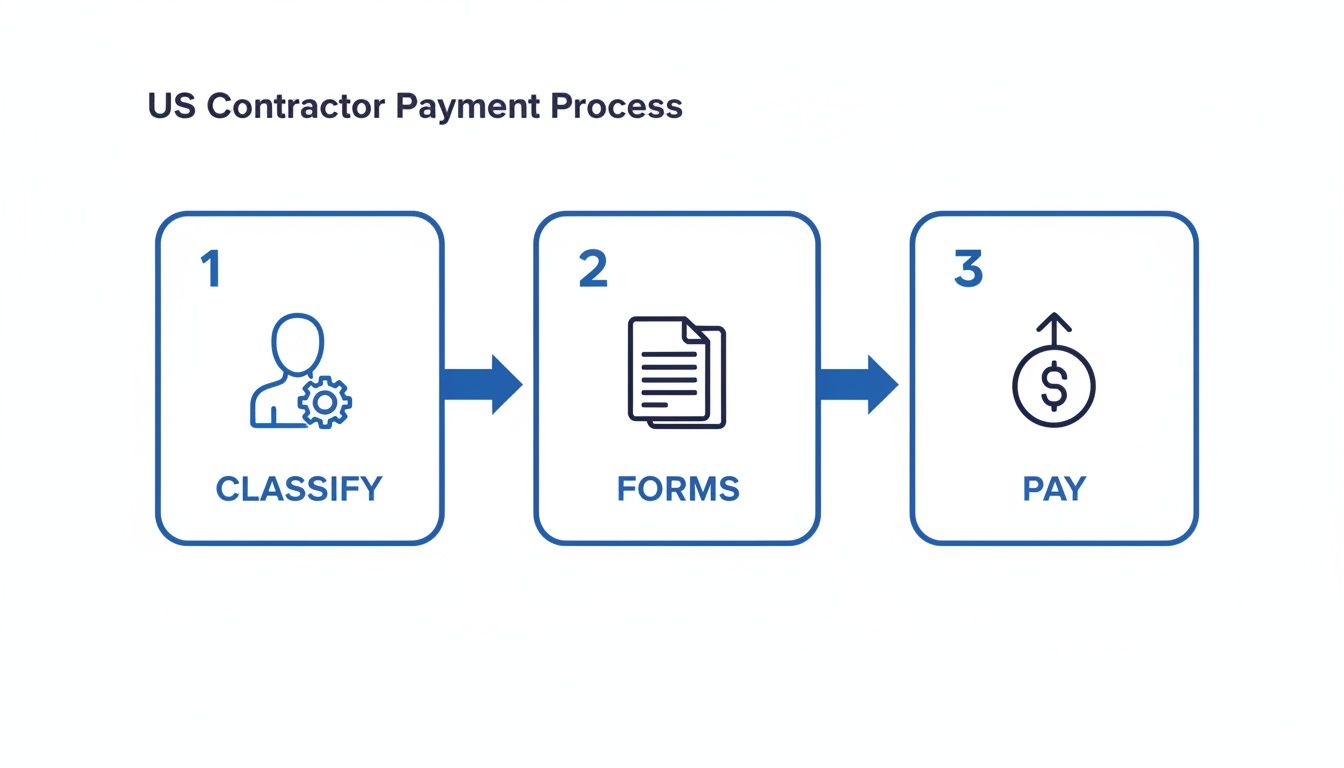
This classify-forms-pay sequence is your mantra. It’s the bedrock of a solid system for managing your U.S. contractor payments.
Before we dive deeper, here’s a quick-reference table that summarises the key compliance steps we'll be covering. Think of it as your cheat sheet for staying on the right side of the IRS.
Core Requirements for Paying US Contractors from the UK
Requirement | What It Is | Why It's Critical for UK Businesses |
|---|---|---|
Worker Classification | Determining if a worker is an independent contractor or an employee based on IRS criteria (control, finances, relationship). | Misclassification can lead to back taxes, penalties, and benefits liabilities, a costly mistake for a foreign company. |
Tax Form Collection | Obtaining a signed Form W-9 (for US persons) or W-8BEN/W-8BEN-E (for foreign persons/entities) before payment. | These forms provide the contractor's Taxpayer Identification Number and certify their tax status, which is essential for your own IRS reporting. |
Payment Reporting | Filing Form 1099-NEC with the IRS annually for each US contractor paid $600 or more in a tax year. | This is a legal requirement. Failure to file can result in significant penalties per form, which can add up quickly. |
Tax Withholding | Generally, no backup withholding is needed if you have a valid W-9. A 30% withholding may apply to foreign contractors unless a tax treaty reduces it. | Improper withholding can make your business liable for the taxes you failed to collect, plus interest and penalties. |
Getting these four pillars right from the start is non-negotiable. It protects your business and sets a professional tone for your relationship with your U.S. talent.
Why This Matters for UK Founders
For a UK business owner, the U.S. classification rules can feel completely alien. Unlike the UK’s IR35 framework, the IRS puts the burden of proof squarely on you, the hiring company, to justify why someone is a contractor. Their focus is on behavioural control, financial control, and the overall nature of your working relationship.
Here's a classic mistake I see all the time: a UK company treats a U.S. contractor just like a remote employee. They set their work hours, provide a company laptop, or pull them into daily team stand-ups. To the IRS, these are huge red flags that signal an employer-employee relationship, potentially leaving you on the hook for payroll taxes.
Successfully paying contractors in the U.S. is less about the transaction and more about the compliance framework you build around it. It’s about protecting your business and fostering trust with the American talent you’re bringing on board. In the next sections, we’ll get into the specifics, starting with the crucial paperwork you need before you even think about sending that first invoice payment.
Getting the Paperwork Right Before You Pay
Before a single dollar changes hands, we need to talk about paperwork. I know, it's not the exciting part of growing your business, but getting this initial step right is absolutely non-negotiable. It's the foundation that prevents some serious financial and legal headaches down the line.
The first, and most crucial, question you have to answer is this: is your new U.S. hire truly an independent contractor or are they, in the eyes of the IRS, an employee? Getting this wrong is one of the costliest mistakes you can make. It can lead to demands for back taxes, hefty penalties, and even benefit payments.

Unlike the UK's IR35 rules, which you might be familiar with, the IRS framework boils down to one central idea: your right to direct and control the worker. They look at this through three main lenses.
Behavioral Control: Are you telling them how, when, and where to do their job? If you're providing extensive training or setting rigid work hours, that starts to look a lot like an employee relationship.
Financial Control: Who's really in the driver's seat financially? Think about how they're paid, whether expenses are reimbursed, and who provides the essential tools and equipment.
The Relationship Itself: Is there a contract that clearly defines the relationship as one of a contractor? Are you providing employee-style benefits like health insurance or paid holidays? Crucially, is their work a core, ongoing part of your business?
Be honest with yourself here. If you find you're dictating the method of the work, not just the final outcome, you could be wandering into employee territory.
Securing the Right Tax Forms
Once you're confident you're dealing with a contractor, the next job is to get the correct U.S. tax form from them. This isn't something to do later—it has to be done before you make that first payment. These forms are your proof of their tax status and are essential for your year-end reporting.
For any U.S.-based individuals or businesses (like an LLC or corporation), you'll need them to fill out and sign a Form W-9.
This straightforward, one-page form gives you two vital pieces of information:
The contractor's official legal name and address.
Their Taxpayer Identification Number (TIN). This will either be a Social Security Number (SSN) for an individual or an Employer Identification Number (EIN) for a business.
Think of a completed W-9 as your shield. Without it, the IRS can require you to withhold a painful 24% from your contractor's payments and send it directly to them. Trust me, that's an administrative nightmare you want no part of.
What About Non-U.S. Contractors?
The rules shift a bit if your U.S. company hires a contractor who isn't a U.S. citizen and does their work from outside the United States. In this case, you need to collect a Form W-8.
There are a few different versions, but you'll most likely run into these two:
Form W-8BEN: This is for individuals who are non-resident aliens.
Form W-8BEN-E: This is the one for foreign entities (i.e., businesses).
These W-8 forms serve a different, but equally critical, purpose. They certify that the person or company is foreign and allow them to claim any tax treaty benefits that might exist between their home country and the U.S. A correctly filled-out W-8 can reduce or even completely eliminate the standard 30% U.S. tax withholding on payments to foreign contractors.
As a UK founder building a U.S. presence, you’ll also need your own U.S. tax ID. If you're just starting, you can learn more about how to get an EIN number for UK founders in our detailed guide.
Your mantra should be simple: no signed W-9 or W-8, no payment. It’s a firm rule, but it's the one that protects your business and ensures you have everything you need when tax season rolls around.
Picking the Smartest Way to Send Payments
Alright, you've got the essential compliance paperwork squared away. Now for the practical part: how do you actually get money into your contractor's bank account? This decision has bigger implications than you might think, directly hitting your bottom line and shaping your contractor's experience.
Your first instinct as a UK business might be to just wire the money from your UK bank. It's familiar, sure, but it's almost always the slowest and most expensive route. Banks are notorious for layering on fees—you’ll get hit with an upfront transfer fee and a poor currency exchange rate. Those costs really start to sting, especially when you're making payments every single month.
The Game-Changer: A U.S. Bank Account
A much savvier approach is to operate from within the U.S. financial system itself. For a UK company hiring American talent, opening a U.S. business bank account is a complete game-changer. It gives you access to the domestic payment network, which is faster, cheaper, and frankly, what U.S. contractors are used to.
The gold standard for paying anyone in the U.S. is the Automated Clearing House (ACH) network. Think of ACH transfers as the American equivalent of Bacs payments. They're reliable, secure, and either free or incredibly cheap. For your contractor, getting a simple ACH deposit is a world away from the hassle of waiting for an international wire to clear.
Setting up a bank account as a non-resident might sound like a huge hurdle, but it's a well-trodden path for foreign founders. If you're wondering where to start, our team has put together an expert guide to opening a U.S. bank account online for non-residents that walks you through the entire process.
Making this one move—establishing a U.S. banking presence—radically simplifies how you pay contractors and can save you a small fortune in fees over the long run.

Comparing Global Payment Platforms
If you're not quite ready to open a U.S. bank account, several third-party platforms specialise in cross-border payments. These can be a fantastic middle ground, offering much better rates and transparency than old-school banks. Let's look at two of the most popular options.
Wise (formerly TransferWise)
Wise has built its entire reputation on making international money transfers cheap and transparent. It's an excellent choice for UK businesses paying U.S. contractors.
Honest Fees: Wise charges a small, fixed fee plus a tiny percentage of the transfer amount. The crucial part? They use the mid-market exchange rate—the real rate you see on Google—with no hidden markup. This transparency is their biggest selling point.
Bookkeeping Friendly: Wise Business accounts plug straight into accounting software like Xero and QuickBooks, which makes recording transactions and fees a breeze.
Speedy Delivery: Payments are typically much faster than bank wires. In many cases, the money arrives within a business day or two.
For a lot of UK founders, Wise hits the sweet spot between affordability and ease of use.
PayPal
Everyone knows PayPal, and your U.S. contractor almost certainly has an account. But that convenience can come at a steep price.
Hidden Costs: PayPal’s fee structure can be a minefield. You’ll pay a transaction fee for the international payment, and their currency conversion spread is often 3-4% above the mid-market rate. That hidden cost adds up incredibly fast on larger payments.
Contractor Annoyance: It's not just you paying fees. The contractor often gets hit with another fee just to withdraw the funds to their bank account, which can be a point of friction.
When It Makes Sense: PayPal is really best for small, one-off payments where you're willing to pay a premium for convenience. For regular, substantial contractor invoices, the fees can become a serious business expense.
Making the Right Choice
Deciding how to pay your contractors is a balancing act between cost, speed, and admin time. An international bank wire is rarely the right answer.
For a long-term, professional setup, nothing beats having a U.S. bank account and using ACH. If you need a flexible and transparent alternative, a platform like Wise is a compelling solution that keeps both you and your contractors happy. Getting this right from the start sets a strong operational foundation for your U.S. expansion.
Understanding Your US Tax Reporting Obligations
Paying your contractors is a huge milestone, but your job isn't quite done when the money leaves your account. The other half of the process is reporting those payments correctly to the Internal Revenue Service (IRS). For UK businesses breaking into the U.S. market, this is a non-negotiable part of staying compliant, with firm deadlines and hefty penalties if you miss them.
Think of it this way: the IRS needs to make sure the U.S. contractors you pay are reporting that income on their own tax returns. Your reporting creates a paper trail that connects the payment from your business directly to the contractor’s taxpayer ID. This is where Form 1099-NEC enters the picture.
Decoding Form 1099-NEC
Form 1099-NEC is the key document you'll use. The "NEC" stands for Nonemployee Compensation, and the form was brought back in 2020 specifically to separate payments to contractors from other types of miscellaneous income.
The rule of thumb is simple: if you pay a U.S. contractor $600 or more in a calendar year, you have to file a Form 1099-NEC for them. This isn't per-project or per-invoice—it's the grand total you paid that person or business from January 1st to December 31st.
A critical distinction here: this rule applies to payments for services, not goods. If you bought office supplies from a vendor, no 1099-NEC is needed. But if you paid a marketing consultant, a freelance developer, or a design agency, that $600 threshold is firmly in play.
The All-Important Filing Deadline
The deadline for Form 1099-NEC is one of the strictest in the U.S. tax world. Mark your calendar. You must file the form with the IRS and get a copy to your contractor by January 31st of the following year. There are no automatic extensions for this, so hitting that date is essential.
Missing this deadline isn’t a small slip-up. The IRS imposes penalties that start around $60 per form and climb quickly the longer you wait. If they determine you intentionally ignored the requirement, the fines can get much worse. For a business working with several contractors, these costs can become a serious financial headache.
As a UK founder, these reporting duties are directly linked to your U.S. company's overall tax situation. It all fits together. To get a better handle on the bigger picture, check out our guide on how to calculate estimated tax payments for your U.S. business.
Who Needs a 1099-NEC?
So, who exactly do you need to file this form for? The requirement covers a wide range of service providers you might work with. You'll need to file for:
Individuals: This includes freelancers, consultants, and any sole proprietors operating under their own name.
Partnerships and LLCs: Payments made to businesses structured as partnerships or most types of Limited Liability Companies will trigger the requirement.
Attorneys: Payments for legal services are a special case. You almost always need to issue a 1099 for these, even if the law firm is incorporated.
There is one major exception to the rule. You generally do not need to issue a 1099-NEC for payments made to C-Corporations or S-Corporations. How do you know? The W-9 form you collected during onboarding will tell you their business classification, making it clear whether a 1099 is required.
A Note on State-Level Filing
Just when you think you've got the federal rules down, you'll find that many U.S. states have their own, separate 1099 filing requirements. It adds another layer of complexity you need to be aware of.
Some states participate in a combined federal/state program that streamlines the process. Great. But many others require you to file the 1099 data directly with their own tax agency, often with different rules and deadlines. States like Pennsylvania and New Jersey, for example, have their own distinct requirements.
As your business grows and you start working with contractors in different states, navigating this patchwork of regulations becomes a real challenge. This is one of those areas where having a good U.S. accountant or tax advisor in your corner is priceless. They can manage both federal and state reporting to ensure you're fully compliant, no matter where your team is located.
Getting Your Bookkeeping Right for US Payments
Paying your U.S. contractors is just the first step. The real test of your financial management comes down to how you track those payments. Let’s be clear: clean, accurate books aren't just for your own peace of mind—they're your primary line of defence in an audit and the only way to get a true picture of your U.S. venture's profitability.
This all starts inside your accounting software. Whether you’re using Xero or QuickBooks, your Chart of Accounts has to be set up thoughtfully from day one. A very common—and costly—mistake I see is businesses lumping all contractor payments into a generic "Wages & Salaries" account. That's a surefire recipe for a headache come tax time.
Setting Up Your Chart of Accounts
To keep things clear and make year-end reporting a breeze, you absolutely must create separate expense accounts for your U.S. contractors. This simple separation makes it incredibly easy to pull the total amounts you've paid to non-employees when it’s time to get those 1099-NEC forms out the door.
At a minimum, your setup should look something like this:
Contractor Labor: A good catch-all account for your U.S.-based freelance talent.
Subcontractors: Perfect if you're hiring other businesses to help deliver work for your clients.
Commissions: Essential for tracking payments to your U.S. sales contractors.
Legal & Professional Fees: A dedicated account for payments to your U.S. law firm or accountant is always a smart move.
This isn't just about being organised. When your accountant asks for your contractor payment totals, you'll be able to generate a clean report in seconds instead of spending hours manually sifting through transactions.
Expert Tip: One of the biggest time-wasters for founders is trying to untangle messy books. By creating a dedicated 'US Contractors' expense account—and maybe even sub-accounts for different roles like 'Marketing' or 'Development'—you're basically building a system that makes 1099 filing almost automatic.
Reconciling Payments From Different Platforms
As a UK company, you’re likely using a mix of payment methods—ACH from a U.S. bank account, a transfer via Wise, or maybe even PayPal for smaller one-off jobs. Each of these platforms has its own fee structure, and that's where bookkeeping can get tricky if you're not careful.
The golden rule is to reconcile every single payment back to a specific contractor invoice. When an ACH payment for $2,000 shows up in your bank feed, it should match perfectly against an outstanding $2,000 invoice. Easy.
But platforms like Wise and PayPal add a small wrinkle: their fees. You might approve a $1,500 invoice, but the amount that actually leaves your account is $1,508.50 after their fee is tacked on. Your accounting software needs to be configured to split this transaction correctly:
$1,500 gets coded to your "Contractor Labor" expense account.
The remaining $8.50 gets coded to a separate expense account, like "Bank Fees" or "Payment Processing Fees."
This meticulous matching ensures your expense records are spot-on. Crucially, it also means the amount you report on the contractor's Form 1099-NEC will match their invoices to the penny, not the gross amount you were debited.
US Contractor Payment Checklist for UK Businesses
To pull all of this together, here’s a simple, repeatable checklist. Think of it as your standard operating procedure for every new U.S. contractor you bring on board. Following these steps will ensure you're compliant from day one right through to tax season.
Phase | Action Item | Key Consideration |
|---|---|---|
Onboarding | Verify worker classification (Contractor vs. Employee). | Document your reasoning based on IRS control tests to justify contractor status. |
Onboarding | Collect a signed and dated Form W-9. | Confirm the name and Tax ID Number (TIN) match and keep the form securely on file. No W-9, no payment. |
Onboarding | Set up contractor in your accounting software. | Create a vendor profile with all the details from the W-9 to streamline payment and reporting. |
Payment | Receive and approve a detailed invoice. | Ensure the invoice clearly lists the services provided and the amount due. |
Payment | Send payment via your chosen method (ACH, Wise, etc.). | Choose the most cost-effective method and confirm receipt with the contractor. |
Bookkeeping | Reconcile the payment in your accounting software. | Match the payment to the invoice and correctly categorise any transaction fees. |
Year-End | Tally all payments made during the calendar year. | Run a report from your accounting software to get the total compensation for each contractor. |
Year-End | File Form 1099-NEC if the total is $600 or more. | File with the IRS and send a copy to the contractor by the January 31st deadline. |
By diligently following this checklist for every U.S. contractor, you transform a potentially daunting process into a simple, routine part of your operations. It keeps your finances clean, your contractors paid on time, and your business ready for whatever comes next as you scale in the U.S.
Common Questions About Paying US Contractors
When you're a UK founder hiring talent in the States, a bunch of questions pop up almost immediately. It’s not just about sending money across the pond; you’re wading into a different tax system, new banking rules, and unfamiliar compliance. Here are some of the most common things we get asked by entrepreneurs just getting started with US contractors.
Do I Have to Withhold US Taxes When I Pay Them?
This is the big one, and thankfully, the answer is usually straightforward. For your US-based contractors, you generally do not have to withhold any federal income tax.
The key is getting a properly filled-out Form W-9 from them before you pay them a single dollar. That form is their official declaration to you that they are a US taxpayer and gives you their Taxpayer Identification Number (TIN). With that W-9 on file, the responsibility for handling income and self-employment taxes falls squarely on the contractor’s shoulders.
But there’s a catch, and it’s called backup withholding. If you don't get that W-9, or if the IRS later tells you the TIN they gave you is wrong, you could be on the hook for withholding a flat 24% of their pay and sending it to the IRS. It's a messy situation you absolutely want to avoid, which is why we preach the "no W-9, no payment" mantra.
Things get a bit different if your contractor isn't a US person but is doing work while physically in the US. In that scenario, their payments could be subject to a 30% withholding tax. A contractor from the UK might be able to use the US-UK tax treaty to get that reduced or eliminated, but they'd need to provide you with a Form W-8BEN to claim it.
Is It Really That Important to Have a US Business Bank Account?
Legally, no, it's not mandatory. But practically? It’s absolutely essential.
Trying to pay US contractors from your UK bank account is like running a marathon in flip-flops—you might get there, but it’s going to be slow, painful, and ridiculously expensive. International wire transfers come with hefty fees and terrible exchange rates that eat into your margins.
Opening a US bank account is the single best move you can make to streamline your American operations. It’s your ticket to the domestic ACH network—the standard for cheap, reliable payments in the US. It’s what your contractors expect and are used to.
Beyond payments, a US account just makes everything easier. Your bookkeeping is cleaner, you can use US-native payment software, and frankly, it makes your business look more established and professional to your American partners. It changes a complicated international finance task into a simple domestic transfer.
How Should I Handle Currency Conversions?
Your US contractors will invoice you in US dollars (USD), meaning you’ll be converting from pounds (GBP). How you manage that conversion directly impacts your bottom line.
You’ve basically got three options:
Your UK Bank: Sending an international wire through your bank is the old-school way. They’ll convert the currency for you, but they won’t give you the real mid-market exchange rate. Instead, they'll build in a markup of 2-4% as a hidden fee.
PayPal: Super convenient for small, one-off payments, but notoriously bad for its exchange rates. PayPal’s currency conversion spread can easily cost you an extra 3-4% on every payment you make.
Specialist Platforms like Wise: Services like Wise are built for this exact purpose. They give you the real mid-market exchange rate and charge a small, transparent fee upfront. This is almost always the cheapest way to turn your GBP into the USD your contractor needs.
Getting this right becomes a huge deal as you hire more people. The 2025 Global Payroll Payments Report found that a staggering 66% of payroll pros don't have the tools to track what they're actually losing to bank and provider costs. You can dig into more trends from the full Transfermate report. By choosing a transparent platform, you avoid becoming another one of those statistics.
What Happens If I'm Late Paying a Contractor?
The IRS is focused on whether you report the payments correctly, not your payment schedule. But from a business perspective, paying late is a bad look. Your US contractors are running their own businesses, and they count on your timely payments to manage their own cash flow.
Most professionals will have their terms right on the invoice—"Net 15" or "Net 30," for example. Sticking to those terms is how you build trust and become the kind of client great freelancers want to work with.
If you know a payment is going to be delayed, just communicate. A quick heads-up is always better than silence. Consistently paying late is a surefire way to lose good people, as they’ll naturally gravitate toward clients who pay reliably and on time.
Juggling US contractor payments, tax compliance, and bookkeeping is a heavy lift for any UK founder. At Set Up Stateside, we live and breathe this stuff so you don't have to. We handle everything from company formation to the day-to-day accounting and tax filings, giving you the expert support you need to thrive in the US. Learn how we can help.


Comments