

What Is an EIN Number and How Do UK Founders Get One

An Employer Identification Number (EIN) is a unique nine-digit code the IRS gives to businesses operating in the United States. The simplest way to think of it is as a Social Security Number for your company. It's the primary way your business is identified for tax and financial tracking.
This number is absolutely fundamental for nearly every business task you can think of, from opening a bank account to hiring your first US-based employee.
Your Business Passport to the US Market
For a UK founder, the best analogy for an EIN is your company’s official passport. Just like your personal passport lets you cross borders and operate internationally, an EIN gives your business legal and financial access to the American market. It's the foundational document that proves your company is legitimate in the eyes of the US government.
Without an EIN, your business is essentially a ghost. You can't legally hire staff, you can't open a US bank account, and you certainly can't file federal taxes. It's the first and most critical step in building a compliant and operational American entity, making it priority number one when you decide to expand.
The Key to Unlocking US Operations
Think about launching your UK brand into the massive US market, where you'll be competing alongside over 33 million small businesses. The vast majority of them are powered by this simple nine-digit code.
First introduced by the IRS way back in 1974, this unique identifier—always formatted as XX-XXXXXXX—is what separates business entities from individuals. For UK founders, getting an EIN is the gateway to financial independence, empowering you to manage US sales and operations without ever needing a physical office.
To help you get a quick handle on this, here's a simple breakdown of the most important aspects of an EIN.
EIN At a Glance: Your Quick Reference Guide
Aspect | Key Detail | Relevance for UK Founders |
|---|---|---|
What It Is | A unique nine-digit federal tax ID (XX-XXXXXXX). | The official identifier for your US business entity. |
Who Issues It | The Internal Revenue Service (IRS). | It's a federal requirement, not a state one. |
Primary Purpose | Tax administration and business identification. | Essential for filing US taxes and proving legitimacy. |
Key Use Cases | Opening a bank account, hiring, building credit. | Unlocks all core financial and operational activities. |
Is it Mandatory? | Yes, for nearly all business types with employees or filing specific returns. | A non-negotiable first step for serious US expansion. |
As you can see, getting an EIN isn't just a box-ticking exercise for compliance; it's about actively enabling your growth.
It allows you to:
Open a Business Bank Account: US banks will almost always demand an EIN to open a business account. This is crucial for separating your company's finances from your personal funds.
Hire Employees: If you're building a team in the US, you absolutely need an EIN to report wages and handle all the necessary payroll taxes.
File Tax Returns: Every business entity, from LLCs to C Corporations, must use its EIN when filing federal and state tax returns.
Build Business Credit: Your EIN helps establish a credit profile for your company that is completely separate from your personal credit history.
This number is the very bedrock of your US operations. It's what turns your UK-based company into a fully functioning American enterprise. If you're ready to get started, you'll find our guide on how to register a company in the USA an invaluable next step.
Why Your UK-Owned Business Needs an EIN
Knowing what an EIN is is one thing, but truly understanding why you need one is what really matters. For UK founders breaking into the US market, an Employer Identification Number isn't some bureaucratic box-ticking exercise. It's the key that unlocks your business's legitimacy and operational ability stateside.
Frankly, certain crucial activities are just impossible without it.
Think of it as your business's official ticket to the game. You simply can't hire your first US employee, open a US business bank account, or file the required taxes for your LLC or corporation until you have this nine-digit number. It’s the handshake that tells American banks, government agencies, and vendors that you’re a serious, compliant player.
Triggers That Make an EIN Non-Negotiable
For most UK businesses expanding to the US, the need for an EIN becomes obvious almost immediately. The second you decide to do any of the following, getting one should jump to the top of your to-do list.
Here are the most common triggers:
Hiring US Employees: The moment you want to bring on US talent—even a single remote salesperson—you legally need an EIN to handle payroll taxes and report their wages to the IRS. No exceptions.
Opening a US Bank Account: Nearly every US bank (over 90%) will ask for an EIN to open a business account. This is absolutely essential for managing US-dollar revenue, paying local suppliers, and keeping your finances clean.
Operating as a Corporation or LLC: If you’ve gone through the trouble of setting up a US entity like a C Corp or LLC, you must get an EIN to file its federal tax returns.
Filing Specific Tax Returns: Does your business deal in industries that require excise, alcohol, tobacco, or firearms tax returns? You'll need an EIN for those, too.
An EIN does more than just check a legal box. It gives your UK-owned company its own distinct American identity, separating its finances and legal responsibilities from the parent company and its owners. This separation is vital for liability protection and straightforward accounting.
Real-World Scenarios for UK Founders
Let's ground this in reality. Imagine you run a successful UK-based SaaS company and you've just found the perfect sales executive in California to crack the Silicon Valley market. To pay them legally and handle all the necessary tax withholdings, an EIN is non-negotiable.
Here’s another one: say you have a fantastic e-commerce brand from Manchester selling to American customers. To make your life easier, you want to open a US bank account with a modern provider like Mercury or Relay. The very first thing their application will ask for is your EIN confirmation letter. Without it, you're stuck.
For UK small and medium businesses eyeing US growth, the EIN is the key to getting started right. The IRS uses these nine-digit codes to keep track of business activity—a group that included 1.2 million new employer businesses formed in 2022 alone. You can learn more about the critical role of an EIN for US businesses directly from the IRS website.
US Tax IDs Explained: EIN vs. SSN vs. ITIN
Getting to grips with the U.S. tax system can feel like you've been handed a dictionary of acronyms. For UK founders, three letters pop up constantly: EIN, SSN, and ITIN. Understanding the difference isn't just a minor detail—it's fundamental.
Mixing them up can bring everything to a grinding halt, leading to rejected applications and frustrating delays. The core concept to grasp is that one of these is for your business, and the other two are for individuals. They are not interchangeable.
Think of it this way: the U.S. government sees your business as a completely separate legal "person." Just like you have your own National Insurance number in the UK, your U.S. company needs its own unique identifier for tax purposes. That ID is the EIN.
What Each Tax Number Is For
So, let's break down who needs what.
An SSN, or Social Security Number, is a nine-digit ID issued to U.S. citizens, permanent residents, and certain temporary workers. It's the standard identifier for individuals to work, pay taxes, and access social benefits. As a UK-based founder, you won't have one of these, and you don't need one for your company.
An ITIN, or Individual Taxpayer Identification Number, is a different beast. It's a tax processing number the IRS gives to individuals who need to file U.S. taxes but aren't eligible for an SSN. This might apply to you personally in certain situations, but it has nothing to do with your business entity itself.
Finally, we have the star of the show: the EIN, or Employer Identification Number. This nine-digit number is issued only to business entities. Your U.S. LLC or C Corporation is legally required to have an EIN to operate, open a bank account, and hire staff, no matter where you, the owner, live.
Key Takeaway: Your business needs a business ID. You can't substitute a personal number like an SSN or ITIN for your company's EIN. The IRS draws a very clear line between you and your business.
To make this even clearer, let's put them side-by-side.
US Tax ID Numbers Compared: EIN vs. SSN vs. ITIN
This table breaks down the key differences between the main U.S. tax identification numbers to help UK founders understand which one applies to their business and personal situations.
Identifier | Issued To | Primary Purpose | Is This for My UK-Owned US Company? |
|---|---|---|---|
EIN | Business entities (LLCs, Corps, etc.) | Identifying businesses for tax filings, banking, and payroll. | Yes, this is essential. |
SSN | US citizens and eligible residents. | Individual tax filing, employment, and social security. | No, not applicable. |
ITIN | Non-resident individuals with US tax obligations. | Personal tax filing for those ineligible for an SSN. | No, this is for you personally, if needed. |
Getting your head around this table is the first big step. It confirms why the entire setup process for your U.S. company hinges on getting that EIN. It’s the foundational piece of the puzzle for everything that comes next.
How UK Founders Can Get an EIN Without an SSN
So, you’re a UK founder ready to make your mark in the US, but you’ve hit a common snag: the EIN application. Since you don’t have a Social Security Number (SSN), the simple online IRS portal is, unfortunately, not an option for you. This is a classic hurdle for international entrepreneurs, but it’s definitely not a deal-breaker.
Think of it this way: there’s a separate, well-trodden path just for non-residents. Your journey involves a bit more paperwork, centered around a single, crucial document: IRS Form SS-4, the official Application for Employer Identification Number. It’s a manual process, yes, but it’s the tried-and-true method for getting your US business registered correctly.
The entire process really just comes down to filling out this form with precision and submitting it to the IRS for a human review. Get it right, and you'll have the number you need to start operating.
The Step-by-Step Playbook for Form SS-4
Getting your EIN this way demands a sharp eye for detail. The steps themselves aren't complicated, but a single mistake on the form can send you to the back of the line and cause major delays. The key is to be methodical.
Here’s a practical breakdown of what you need to do:
Download Form SS-4: First things first, grab the latest version of the form directly from the IRS website. You always want the most current one to avoid compliance issues.
Gather Your Company Information: Get your ducks in a row. You'll need the exact legal name of your US company, its mailing address, the name of the "responsible party" (that’s you), and the date the business was officially formed.
Complete the Form Carefully: This is where founders often slip up. Pay close attention to every field. For line 7b, which asks for an SSN or ITIN, you must write "Foreign." This single word is critical; it tells the IRS agent reviewing your form exactly why that box is empty.
Once you’ve filled everything out and double-checked it for accuracy, you’re ready to send it off.
Choosing Your Submission Method: Mail vs. Fax
You have two ways to get your completed Form SS-4 to the IRS, and your choice will have a huge impact on your timeline.
Submission by Fax: This is, by far, the faster manual option. As long as your form is accurate, you can often get your EIN faxed back to you in as little as four to seven business days.
Submission by Mail: Going the traditional postal route is much, much slower. Be prepared to wait anywhere from four weeks to several months, particularly if you’re applying during a busy tax season when the IRS is swamped.
For UK founders looking to get up and running without delay, faxing is the clear winner. The time you save could be the difference between opening your US bank account this month versus waiting until next quarter.
This diagram helps put the EIN in context with other US tax IDs.
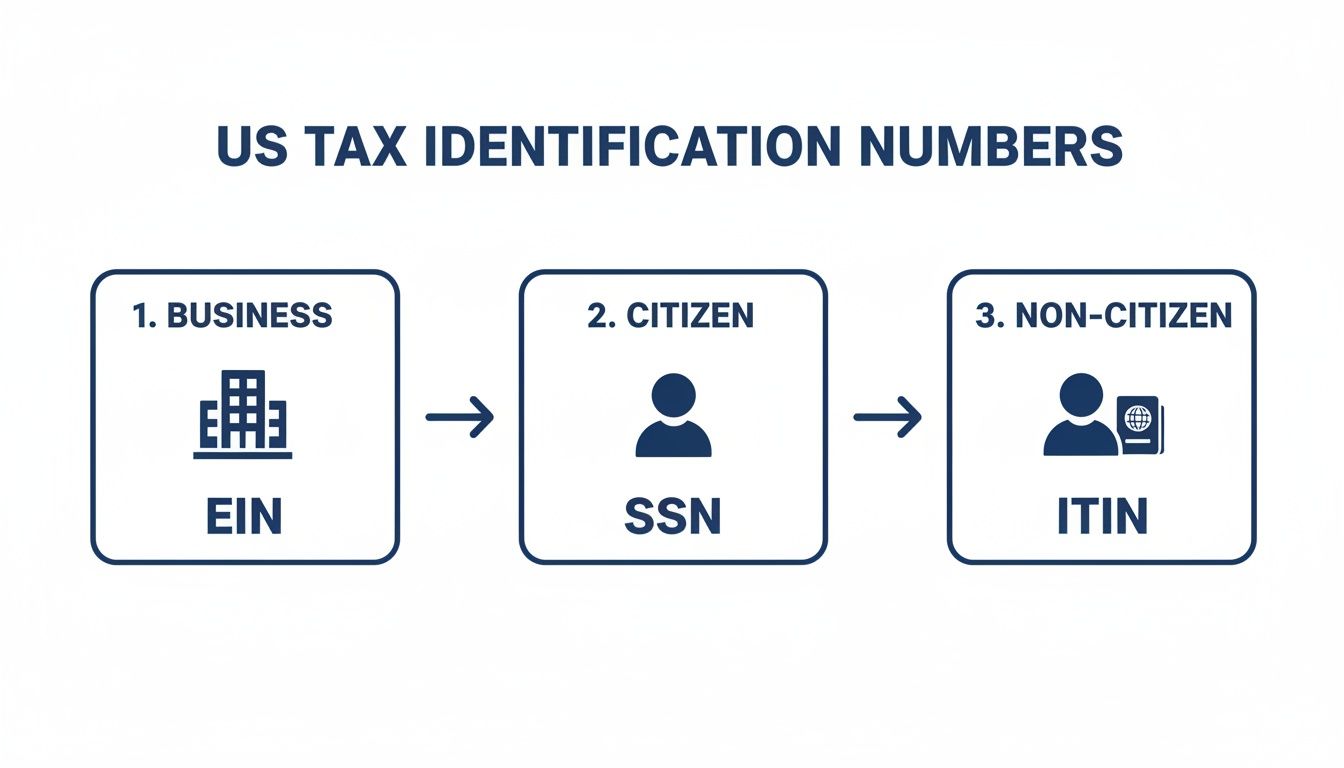
As you can see, the EIN is strictly for business entities, whereas the SSN and ITIN are for individuals.
The Smart Alternative: Using a Third Party
Let's be honest—navigating IRS paperwork and dealing with potential follow-up questions from another time zone can be a real headache. This is exactly why many UK founders choose to work with a designated third party, like Set Up Stateside. We become your official representative, taking the entire application process off your plate.
This approach takes the guesswork out of the equation. We help you avoid the common mistakes that lead to rejections and handle all the back-and-forth with the IRS for you. It frees you up to do what you do best: build your business.
7. Putting Your New EIN to Work Immediately
You’ve got your EIN confirmation letter. Congratulations! This is a huge milestone. Your US business is no longer just an idea; it's a real, recognized entity.
Think of your new nine-digit number as the master key that unlocks all the important doors for operating in the States. Getting it isn't the finish line—it's the starting gun. Now's the time to build the financial and legal framework that will support your American expansion. Acting fast helps you build a professional, trustworthy presence right from the start.
Your Immediate Action Checklist
With your EIN secured, you can finally tackle the foundational steps that turn your US company from a registration document into a fully functional business.
Here’s what you should be doing right away:
Open a US Business Bank Account: This is your number one priority. Virtually every US bank will ask for your EIN before they even look at your application. A dedicated account is crucial for managing revenue in USD, paying local expenses, and keeping your finances cleanly separated from your UK operations.
Set Up Payroll Services: Planning to hire in the US? You'll need a payroll system, and your EIN is the ticket. It’s essential for reporting employee wages and paying federal and state payroll taxes correctly.
Apply for Business Licenses and Permits: Most industries and locations require specific state or local permits to operate legally. You'll need to put your EIN on all those applications.
Integrate with Accounting Software: Get your bookkeeping right from day one. Use your EIN to connect your new US bank account and operations to software like QuickBooks or Xero.
For a UK founder, your EIN is more than just a tax ID—it's your business's permanent federal passport. It never expires and is never reissued, even if the business closes down. This number is your lifelong key to the US financial system.
Unlocking US Banking and Finance
For most international founders, opening a US bank account is the most urgent task. It lets you accept payments in USD, sidestep hefty currency conversion fees, and start building a financial track record in the States. Without an EIN, this is almost impossible.
If you’re wondering where to start, you might be interested in our expert guide to opening a U.S. bank account online for non-residents: https://www.setupstateside.com/post/your-expert-guide-to-opening-a-u-s-bank-account-online-for-non-residents
The EIN is also the backbone of the US labor market. Research from the U.S. Census Bureau using data from 1994 shows how EINs were used to track employer-to-employer shifts, which accounted for 21% of all worker mobility. For you, this means your EIN plugs your business directly into the established systems that make American commerce and employment tick.
EIN Management and Long-Term Compliance
Getting your Employer Identification Number is a huge first step, a real victory when you're setting up a U.S. business. But the work doesn't stop there. Think of your EIN less as a finish line and more as the keys to your company's financial engine—it needs ongoing care to keep things running smoothly.
Properly managing your EIN is all about staying on the right side of the IRS and making sure your U.S. operations don't hit any snags. Forgetting to tell the IRS about a key business change or misplacing that crucial confirmation letter can cause major headaches later. Being proactive is the secret to avoiding painful delays and penalties, especially when you're running the show from outside the U.S.
Keeping Your EIN Information Current
Your EIN is permanently assigned to your business, but the details the IRS has on file aren't set in stone. It's on you to keep them in the loop whenever something changes.
Changing Your Business Address: If your company's mailing address in the U.S. changes, you have to let the IRS know. You'll do this by filing Form 8822-B, Change of Address or Responsible Party. This is critical for making sure you get tax notices and other official mail.
Updating the Responsible Party: The IRS needs to know who the "responsible party" is—the person with ultimate control over the business. If that person changes, you'll use that same Form 8822-B to update their records.
Business Name Change: Did you rebrand? If you legally change your business's name, you’ll need to inform the IRS. The simplest way is usually by checking a specific box on your annual tax return.
The most common hiccup I see founders run into is losing their original EIN confirmation letter. This document, officially called the CP 575 notice, is the one piece of paper every bank will ask for when you go to open an account. If it goes missing, don't panic. You can get a replacement verification letter, known as a 147C, from the IRS.
What to Do If You Lose Your EIN Letter
It happens more often than you'd think. In the chaos of getting everything set up, that CP 575 notice gets misplaced. If you applied online and didn't save the digital copy right away, you can't just go back and download it again.
Instead, you'll have to call the IRS Business & Specialty Tax Line. You'll ask them for an EIN Verification Letter (147C). They can then fax or mail you this official document, which confirms your business name is tied to your EIN. Be ready for a bit of a wait on the phone, but it’s the proper way to get that essential proof back in your hands.
Finally, remember that having an EIN means you have U.S. tax obligations. To get ahead of what's coming, learn more about how to calculate estimated tax payments for your U.S. business in our detailed guide.
UK Founders' Top Questions About EINs
Diving into the US system from across the pond can feel like learning a new language. We get questions from UK founders every single day, so let's cut through the noise and get straight to the answers you're looking for.
So, How Long Does It Really Take to Get an EIN?
This is the big one, and the answer comes down to how you file your Form SS-4. If you don't have a US Social Security Number, your options are old-school.
Sending your application by mail is the scenic route—and not in a good way. You could be waiting anywhere from four weeks to several months.
The faster track is to submit by fax. When done this way, you can often get your EIN back in as little as four to seven business days, provided every detail on the form is perfect.
Is There a Fee for an EIN?
Nope. The IRS provides EINs completely free of charge.
You'll see plenty of unofficial websites offering to get one for you for a fee, but they're just charging for something the government gives away. While a formation service like ours has a cost for handling the process, the actual number from the IRS is always free.
The biggest hurdle for international founders is the lack of online access. The IRS has a convenient online application, but it's gated behind having a US tax ID. This forces you into the manual world of mail or fax, where a single misplaced comma can set you back weeks.
What Happens If I Mess Up the Application?
A mistake on your Form SS-4 is, simply put, a major headache. The best-case scenario is a long delay; the IRS will reject the form and mail it back, kicking you to the back of the line to start all over again.
We see the same simple errors trip people up all the time:
Company Name Mismatch: Your company's legal name must be exactly as it appears on your formation documents.
Forgetting the "Foreign" Tag: On line 7b, instead of a Social Security Number, you must write "Foreign." It's a small detail with big consequences.
Blank Fields: Leaving a required box empty is an easy way to get an automatic rejection.
When it comes to IRS paperwork, precision is everything. Getting it right the first time is the key to a fast, painless process.
Trying to manage IRS forms and timelines from the UK can easily derail your launch. At Set Up Stateside, we take the entire EIN application off your plate. We make sure it's done right the first time so you can get your US business off the ground without the bureaucratic runaround. Learn more about how we can help at https://www.setupstateside.com.


Comments