

What Is Sales Tax Nexus a Guide for UK Founders in the US

Sales tax nexus is the link between your UK business and a U.S. state that legally forces you to register, collect, and hand over sales tax there.
Think of it as leaving a commercial footprint. If your business leaves a big enough footprint in a particular state, you're officially on the hook to play by its tax rules.
Your Introduction to US Sales Tax Nexus
For UK founders, trying to get your head around U.S. sales tax from the other side of the pond can feel like a nightmare. It usually boils down to one simple question: how on earth can my remote business owe taxes in a country where I don’t have a single office or employee?
The answer is all about what a state government considers a "significant connection."

For a long time, this connection—this nexus—was simple. You needed a physical presence, like a warehouse or a shop, to be required to collect sales tax. But the explosion of e-commerce changed the game completely.
Everything was turned on its head in 2018 with a U.S. Supreme Court case, South Dakota v. Wayfair. This monumental decision threw out the old physical presence rule, paving the way for a new reality for online sellers everywhere.
The Shift from Physical to Economic Presence
That court case brought a new term into the spotlight: economic nexus. For most UK businesses selling to American customers, this is the concept that matters most. Instead of being tied to a physical location, economic nexus is triggered entirely by your sales activity.
Economic nexus means your UK business, even without a single employee or office in the U.S., can be required to collect sales tax if your sales revenue or transaction volume in a state crosses a certain line.
This was a fundamental rewrite of the rules for international businesses. It's no longer about where you are—it's about where your customers are. The tricky part? Every state sets its own thresholds, creating a complex patchwork of compliance rules you need to navigate.
Getting this right is crucial for building a sustainable and legally sound U.S. operation. It's also why having your U.S. entity set up correctly and getting the right tax IDs from day one is so important. If you're just starting, our guide on how to get an EIN number for UK founders covers those essential first steps.
Sales Tax Nexus At a Glance
The Wayfair decision created a clear 'before' and 'after' for sales tax. Here’s a quick breakdown of what changed:
Rule Type | What It Means for UK Sellers | Primary Trigger |
|---|---|---|
The Old Rule (Pre-Wayfair) | You generally only owed sales tax if you had a physical office, employee, or warehouse in a state. | Physical Presence |
The New Rule (Post-Wayfair) | You can owe sales tax based purely on your sales volume, even with zero physical presence. | Economic Activity |
This table really highlights the shift. The old rules gave most UK e-commerce businesses a free pass, but now, your sales success in the U.S. is what creates your tax obligations.
In this guide, we'll demystify sales tax nexus completely. We’ll break down the different types, show you how to figure out your own obligations, and give you a clear path forward.
The Four Main Ways Your Business Can Trigger Sales Tax Nexus
Knowing what sales tax nexus is gets you to the starting line. But understanding how you trigger it is how you actually run the race. For a UK business, creating that crucial commercial connection in a US state usually happens in one of four ways.
Think of these as different paths that all lead to the same destination: a sales tax obligation. Your business might be on one path, or you could be unknowingly travelling down several at once. Let's break down each one so you can see exactly where your business stands.
Physical Presence Nexus: The Original Rule
Before e-commerce took over, nexus was pretty straightforward. It was all about physical presence nexus. This is the traditional "boots on the ground" scenario, triggered when your business has a tangible, physical connection to a state.
If you run a Manchester-based fashion brand or a London SaaS company, this might seem irrelevant. But the definition of "physical" is much broader than you'd think. It's not just about opening an office.
Here are the most common ways UK businesses accidentally establish a physical presence:
Storing Inventory: Using a third-party logistics (3PL) warehouse or Amazon FBA (Fulfillment by Amazon) centres to hold your products in a state creates an immediate physical presence.
Having Employees or Contractors: A single employee, a part-time worker, or even an independent contractor working for you from their home in a particular state is enough to create nexus.
Attending Trade Shows: In some states, just setting up a booth and making sales at a conference can trigger nexus, sometimes temporarily and sometimes permanently.
Owning or Renting Property: This one is the most obvious—leasing an office, a warehouse, or any other physical space firmly plants your footprint in that state.
It’s shocking but true: even a single employee or one box of inventory sitting in a warehouse can be enough to create physical nexus and obligate you to collect sales tax.
Economic Nexus: The E-commerce Game Changer
This is the big one for most UK businesses selling into the US. Economic nexus threw out the old rulebook by making your sales volume the trigger, completely separate from your physical location. It all started with the landmark South Dakota v. Wayfair Supreme Court decision, and it’s the main reason your remote business now has to be on top of US sales tax.
Before this ruling, remote sellers didn't have to collect sales tax if they had no physical presence, which was costing states between $694 million and $3 billion annually. Post-Wayfair, everything changed. South Dakota set the original standard back in 2016 with a clear test—over $100,000 in annual sales or 200 separate transactions. By January 2023, every US state with a sales tax had its own version. You can dig into the history of this massive shift by reading up on the economic nexus developments in the United States.
The thinking behind it is simple: if you benefit significantly from a state's economy, you have a responsibility to contribute to its tax base.
The tricky part is that every state sets its own sales thresholds. We'll get into those specific numbers later, but for now, just remember that your sales figures alone can create a very real tax obligation.
Click-Through and Affiliate Nexus
Even before economic nexus became the law of the land, some states were already looking for ways to tax sales driven by in-state promoters. This led to what we call click-through nexus and affiliate nexus.
Let's say your UK tech company pays a commission to a blogger in California for every customer who clicks a link on their site and buys your product. That relationship with the California-based affiliate can create nexus for your business in California.
Click-Through Nexus: This is triggered when you make a certain amount of sales from referrals originating from in-state websites or people.
Affiliate Nexus: This is a bit broader. It applies when an in-state affiliate does things on your behalf—like soliciting sales or handling local customer service—that are significant enough to establish your presence.
While many states have since replaced these rules with their broader economic nexus laws, some still have them on the books. It’s a good reminder that your US marketing partnerships can have direct tax consequences.
Marketplace Facilitator Nexus
Finally, if you sell on platforms like Amazon, Etsy, or Walmart, you need to know about marketplace facilitator nexus. States saw the explosion of marketplace selling and decided to shift the tax collection burden from the individual seller to the platform itself.
This means that for any sales you make through its platform, Amazon is legally on the hook for handling the sales tax. This is fantastic news for sellers, as it takes a huge compliance headache off your plate.
But hold on—you're not entirely off the hook. Here are the crucial catches:
Your Responsibility | Why It Matters |
|---|---|
Tracking Sales for Thresholds | Your sales on Amazon still count toward a state's economic nexus threshold. Hitting $100,000 in a state via Amazon could trigger nexus for sales you make through your own website. |
Separate Filing Requirements | Even if the marketplace remits the tax, some states still require you to register for a sales tax permit and file returns, reporting your marketplace sales as exempt. |
These four types of nexus—physical, economic, affiliate, and marketplace—are the building blocks of your US sales tax obligations. Figuring out which ones apply to your business is the first and most critical step toward getting compliant.
Understanding the Maze of State Thresholds
Okay, you’ve got a handle on the four main ways you can trigger sales tax nexus. Now comes the hard part: applying that knowledge in the real world. This is where theory crashes into a wall of complexity because the U.S. doesn't have a single, unified sales tax system. Instead, it’s a chaotic patchwork of rules that change dramatically from one state to the next.
For most UK businesses, the biggest headache is economic nexus. Every state with a sales tax sets its own unique threshold—a specific amount of sales revenue or number of transactions that, once you cross it, means you're on the hook for collecting their tax. This isn't a one-size-fits-all deal; it's a maze, plain and simple.
This diagram breaks down the four main triggers that can create a sales tax obligation for your business in the U.S.
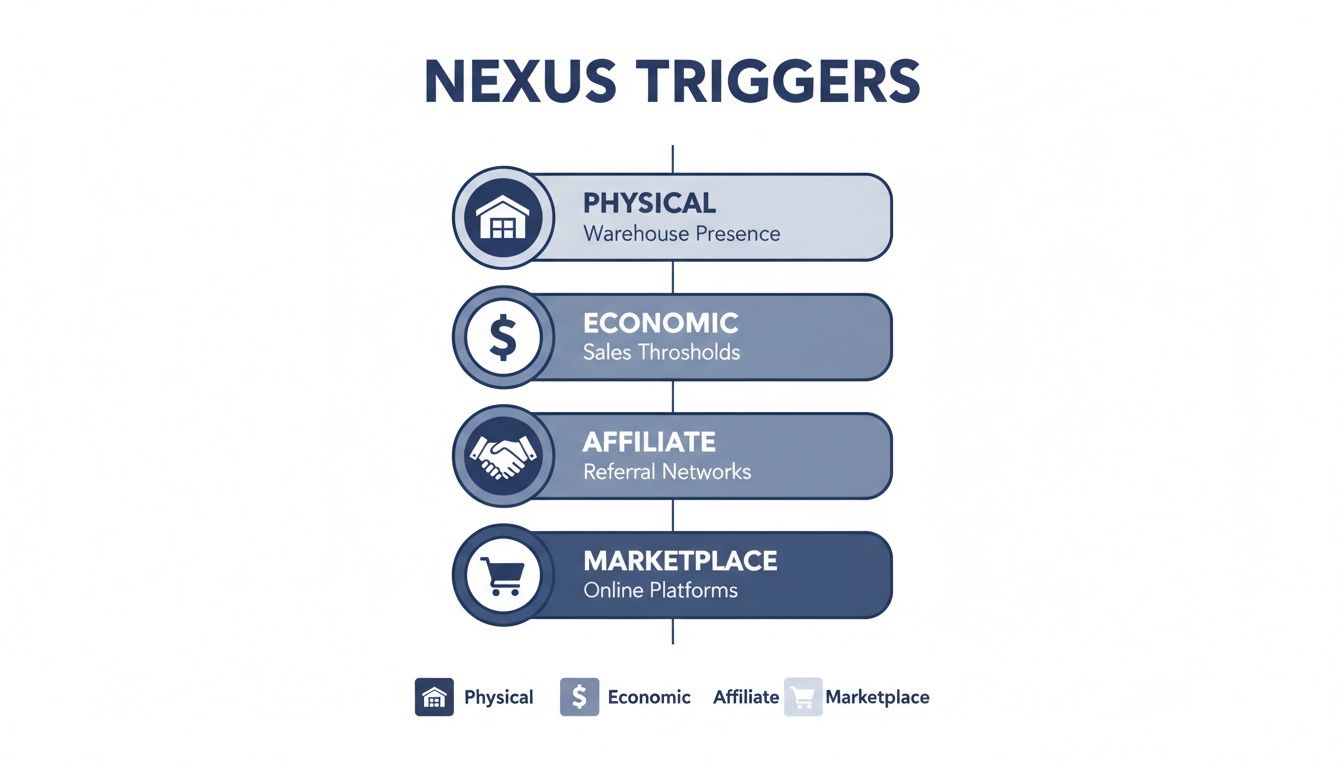
While having a physical presence or hitting an economic sales target are the most common ways UK sellers find themselves with nexus, don’t sleep on the risks from affiliate and marketplace activities. They can catch you by surprise.
H3: Decoding the Dollars and Dates
The sheer variety in these state-level rules is staggering, and it’s exactly why trying to track this stuff manually is so risky. A $100,000 revenue threshold is a common figure you’ll see, but it's far from universal.
And these goalposts are always moving. We’ve seen New York raise its threshold from $300,000 to $500,000, while states like Ohio have gone the other way. The details buried in the fine print can easily trip up even the sharpest founders.
You absolutely have to get your head around two key concepts: what sales they’re counting and over what period.
Gross vs. Taxable Sales: Does the threshold look at your total (gross) sales into the state, or only sales of taxable goods and services? Some states, like California, count every penny of gross sales, so even your non-taxable revenue pushes you closer to the limit.
Lookback Period: States measure your sales over a specific timeframe, what’s called a lookback period. This is usually the "previous or current calendar year" or a "rolling 12-month period." Get this wrong, and you could blow past your nexus trigger date without even realising it.
The moment you cross a state's economic nexus threshold, your obligation to register and start collecting sales tax begins. It’s not an optional step or something you can put off—it's an immediate legal requirement.
H3: Thresholds in Key Commercial States
To give you a real sense of how different these rules can be, let’s look at a few major commercial hubs popular with UK businesses. Each one presents a totally unique set of requirements that demand careful monitoring.
Here’s a quick snapshot that shows just how varied the economic nexus rules are in four key states.
Economic Nexus Thresholds in Key US States
This table gives a comparative look at the sales revenue and transaction count thresholds that trigger economic nexus in major U.S. markets. For UK businesses, these are some of the first states where you're likely to have to register.
State | Sales Threshold | Transaction Threshold | Notes for UK Sellers |
|---|---|---|---|
California | $500,000 | None | The threshold is based on your total gross sales of tangible personal property delivered into the state. |
New York | $500,000 | 100+ transactions | You must meet both the sales and transaction counts in the previous four sales tax quarters. |
Texas | $500,000 | None | This threshold is based on your total revenue from sales of taxable services and tangible personal property. |
Florida | $100,000 | None | Based on sales of tangible personal property delivered into Florida. If you sell here, you might find our guide on how to obtain a Florida resellers permit useful. |
This table makes one thing painfully clear: trying to manually track your sales against this constantly shifting landscape is a recipe for disaster. What works for Texas is completely irrelevant in New York, and the rules in Florida are different all over again.
This complexity really drives home why a professional nexus analysis isn’t a luxury. For any growing business, it's a fundamental necessity for managing risk, staying compliant, and building a sustainable company in the United States.
How to Do Your Own Preliminary Nexus Check
Alright, let's move from theory to action. Understanding what sales tax nexus is is one thing, but figuring out if you have it is the crucial next step. It's time to roll up your sleeves and give your business a proactive health check.
Think of this as an internal fact-finding mission, not a stressful audit. The goal here is simple: gather the right information to see where you stand. This initial review will help you spot any potential red flags and determine if you need to dig deeper with a professional.
Step 1: Map Your Physical Footprint in the US
First things first, forget about your sales numbers for a minute. Let's focus entirely on where your business has a physical connection to the US. This is the original, old-school form of sales tax nexus, and it’s surprisingly easy to overlook.
You need to get a clear picture by asking some direct questions:
Where is your inventory? Do you store products in any US warehouses? This is a big one. It includes any third-party logistics (3PL) partners and, critically, any Amazon FBA fulfillment centres. You need to know every single state where your goods sit.
Where is your team? Do you have any employees, independent contractors, or sales reps working for you on US soil? Even a single remote team member in a state can be enough to create nexus.
What property do you have? Do you own or rent any offices, equipment, or other physical assets anywhere in the US? This is a classic physical tie.
What are your business activities? Have you or your staff attended trade shows or travelled to a state to meet clients and solicit sales? Some states view these activities as a trigger for nexus.
Step 2: Analyse Your Sales Data, State by State
Once you’ve mapped out your physical presence, it's time to dig into your sales data. This is where you'll assess your economic nexus risk, and you'll need to look back over at least the last 12-24 months. A word of warning: looking at your total US revenue is not enough. You have to break it down state by state.
For every single state, you need to pull two specific numbers:
Total Gross Sales: The total revenue from all sales shipped into that state, before any deductions.
Total Number of Transactions: The simple count of individual orders sent to customers in that state.
This level of detail is non-negotiable. Because state thresholds are all different, a report just showing "Total US Sales" is practically useless for a proper nexus analysis.
Step 3: Cross-Reference Your Data Against State Thresholds
Now for the moment of truth. You’ll take your state-by-state data and compare it against each state's unique economic nexus rules. By 2023, every single US state with a sales tax had an economic nexus law on the books, so this step is mandatory for anyone selling across the country.
States moved fast after the Wayfair ruling. South Carolina's $100,000 threshold started way back in November 2018. Virginia's $100,000 or 200 transactions rule was live by July 2019, and Washington’s $100,000 threshold kicked in by October 2018. To get the full picture, you'll need to research the specific rules and effective dates for each state.
Crucial Tip: Pay close attention to the details. Does the state measure gross sales or only taxable sales? And what's the "lookback period"—do they look at the previous calendar year or a rolling 12-month period? These small differences matter.
Step 4: Account for Affiliates and Marketplaces
Finally, don’t forget the other, less obvious ways you might create nexus. If you work with US-based affiliates, partners, or influencers, you need to check if their referral activities create click-through nexus in their home state.
And perhaps most importantly, remember that your sales through marketplaces like Amazon absolutely count toward a state's economic nexus thresholds. Even though Amazon is collecting and remitting the tax on those sales, the revenue is still yours and can push you over the limit.
Completing this self-analysis is the perfect launching pad. It gives you the clarity to understand your potential exposure and provides the exact data you'll need to build a solid compliance plan with a trusted partner like Set Up Stateside.
You Have Nexus. So, What Happens Next?
That moment of realisation can be unsettling. You've run the numbers, mapped your footprint, and the conclusion is clear: your UK business has sales tax nexus in one or more US states. It might feel like you've just opened a can of worms, but don't panic. The next steps are logical and completely manageable once you have a clear plan. Your goal now is to move from discovery to action.
The first and most critical rule is simple: you must not collect a single cent of sales tax until you are officially registered. Collecting tax without a permit is illegal. Your immediate next step is to register for a sales tax permit in every single state where you've confirmed you have nexus.
Registering for a Sales Tax Permit
This registration process is how you officially notify the state that you'll begin collecting and remitting sales tax on their behalf. The application will ask for key details about your business, like your company type, your federal Employer Identification Number (EIN), and, crucially, the date you first established nexus. That date is vital, as it tells the state exactly when your obligation began.
Once your registration is approved, the state will issue your sales tax permit and assign you a filing frequency. How often you have to file usually depends on your sales volume.
Monthly: Higher-volume sellers are often required to file every month.
Quarterly: This is a common frequency for businesses with moderate sales.
Annually: Businesses with lower sales volumes may only need to file once a year.
Getting this initial setup right is foundational. If you're navigating this for the first time, our detailed guide on getting a US sales tax permit from the UK walks you through the specific requirements step-by-step.
Your Ongoing Compliance Responsibilities
Receiving your permit isn’t the finish line; it’s the starting gun. From that point forward, you have several ongoing responsibilities to stay compliant.
A sales tax permit isn't a one-time task; it's the start of an ongoing relationship with a state's tax authority. Your key responsibilities are to calculate, collect, file, and remit tax accurately and on time.
Your ongoing duties really boil down to three core activities:
Calculate Correctly: The US has over 12,000 different sales tax jurisdictions. Rates can change from one zip code to the next, and you’re responsible for charging the exact rate for your customer's delivery address.
File on Time: You must submit a sales tax return for each filing period, even if you had zero sales. Missing a deadline can trigger automatic penalties, so it's not something to take lightly.
Remit the Tax Collected: Along with your return, you must pay the total amount of sales tax you collected. That money was never yours to begin with; you were simply holding it in trust for the state.
Addressing Past Obligations and Back Taxes
What happens if you discover that your nexus trigger date was months, or even years, in the past? This is a serious situation. It creates a liability for "back taxes"—all the tax you should have collected during that period but didn't. Ignoring this is a significant risk, as states have ways of finding non-compliant businesses.
The best approach is to tackle it head-on through a Voluntary Disclosure Agreement (VDA). A VDA is a formal process where you proactively report the back taxes owed to the state. In exchange for coming forward voluntarily, states will often waive the hefty penalties and may even reduce the interest owed. This is a far better outcome than waiting for them to find you.
Navigating registrations, filings, and potential back taxes is where expert support becomes invaluable. At Set Up Stateside, our compliance services are designed to manage this entire lifecycle for you, turning a daunting process into a streamlined part of your US operations.
Common Nexus Mistakes UK Companies Make
Navigating U.S. sales tax from the UK is tricky, and it’s easy to make costly mistakes, even with the best intentions. Knowing the common pitfalls is your first line of defense in building a compliant U.S. operation and steering clear of nasty financial penalties.
The most common mistake? The 'head in the sand' approach. It’s tempting to just ignore sales tax nexus and hope for the best, especially when you're just starting out. But as your business scales, so does your audit risk. States are getting much better—and more aggressive—at finding remote sellers who aren’t paying their fair share.
Assuming Marketplaces Handle Everything
This is a huge one. So many UK sellers on platforms like Amazon or Etsy assume the marketplace has their sales tax obligations completely covered. It's a dangerous assumption that creates a massive blind spot.
Yes, these platforms collect and remit tax on sales made through their site, thanks to marketplace facilitator laws. But here's the catch: your sales on Amazon still count toward a state's economic nexus threshold.
Let’s say you hit $100,000 in Amazon sales in California. That alone can trigger nexus, meaning you’re now on the hook for collecting sales tax on all sales you make directly through your own website to customers in that state. Amazon handles its sales, but you're responsible for yours.
Overlooking Physical Triggers and Data Gaps
In the age of e-commerce, it's easy to forget about physical nexus. But it’s still very much a thing. Hiring just one remote employee in the U.S. or storing a small batch of inventory in a third-party warehouse are classic triggers. These seemingly minor operational moves have major tax consequences and can create an immediate registration requirement.
Think about it: you might be meticulously tracking your sales data, but a single forgotten box of inventory sitting in a Texas warehouse could have established nexus months ago. Suddenly, all your economic threshold analysis becomes secondary. This is why you need a complete picture of your entire U.S. footprint.
Finally, not tracking sales with state-level detail makes compliance impossible. If you don't know your exact revenue and number of transactions for each state, you're flying blind. You won’t see a threshold approaching until you’ve already crossed it.
The complexity here is real. In a survey five years after the landmark Wayfair decision, 72% of businesses said they had to invest in new technology to keep up with compliance, and 40% reported higher costs overall. For UK founders, diligently tracking sales per state is non-negotiable. That common $100,000 threshold in over 30 states can turn your digital success into a very real tax headache. You can dive deeper into the background by exploring the history of economic nexus in the United States.
Common Questions We Hear About Sales Tax Nexus
When we talk with UK founders about expanding into the US, a few key questions about sales tax nexus always come up. Let's tackle them head-on.
Do I Need to Worry About Nexus if I Sell Services, Not Products?
Yes, absolutely. It's a common misconception that sales tax only applies to physical goods. The reality is that many U.S. states have expanded their tax laws to cover digital products and services.
This means things like SaaS subscriptions, consulting, and even streaming media can trigger nexus. If your service is taxable in a particular state and your revenue there crosses the economic threshold, you're on the hook for collecting and remitting sales tax. It's a tricky area that's always changing, so getting a proper analysis is key.
What Happens if I Should Have Been Collecting Tax for Years but Haven't?
This is a tough spot to be in, but ignoring it is the worst thing you can do. If you discover you had nexus in the past but didn't collect tax, you've got a "back tax" liability. That means you owe the uncollected tax, often plus some hefty penalties and interest.
The best way forward is usually a Voluntary Disclosure Agreement (VDA). This is a formal process where you approach the state to settle your past-due taxes. In return, they often agree to waive the penalties. The crucial part? You have to approach them before they find you.
Do My Amazon Sales Count Towards the Thresholds?
Yes, they almost always do. This is a critical point that trips up a lot of e-commerce sellers. Even though marketplace facilitator laws mean Amazon handles the sales tax on its own platform, those sales still contribute to your total revenue in a state.
Think of it this way: your Amazon sales can easily push your total revenue over the $100,000 economic nexus threshold. Once that happens, you now have an obligation to collect sales tax on sales you make through all other channels, like your own website. You have to look at the complete picture.
Figuring out U.S. sales tax nexus can feel overwhelming, but it's a puzzle you don't have to solve on your own. The experts at Set Up Stateside are here to help with a full nexus analysis, state registrations, and ongoing compliance, so you can grow your UK business in the U.S. without the headaches. Book a consultation to get your sales tax sorted today.


fly88bi.jp.net bữa mình thấy người ta nhắc nên bấm vào coi thử cho biết chứ cũng không định làm gì nhiều. Vào cái là thấy giao diện khá sáng sủa, khoảng trắng vừa đủ nên nhìn không bị ngộp. Mình lướt một vòng thì để ý mấy khung nội dung họ chia theo từng block rõ ràng, kiểu nhìn cái là biết đang ở phần nào, không phải căng mắt tìm. Cái mình thích là menu đặt ngay chỗ dễ thấy, chuyển qua lại mấy mục nhanh, không bị vòng vèo. Mình chỉ xem bằng điện thoại thôi mà kéo xuống vẫn ổn, chữ với bố cục không bị vỡ hay chồng lên nhau. Nói chung cảm giác là trang…
https://keonhacai.cam/ mình mới tạt vào coi thử vì thấy mấy đứa bạn hay nhắc, chủ yếu tò mò giao diện thôi. Vừa mở lên thấy trang làm khá thoáng, chữ dễ nhìn, mấy phần nội dung chính được đặt rõ nên không phải căng mắt tìm. Mình lướt nhanh một vòng mà vẫn nắm được ý vì các khối thông tin chia ra gọn gàng, nhìn cái biết đoạn nào là nội dung, đoạn nào là phần bổ sung. Có chỗ nói về tải app cũng viết kiểu thẳng thắn, đọc qua là hiểu là dùng app thì thao tác nhanh hơn so với mở trên trình duyệt. Nói chung mình thích kiểu trình bày đơn giản vậy, nhất là…